
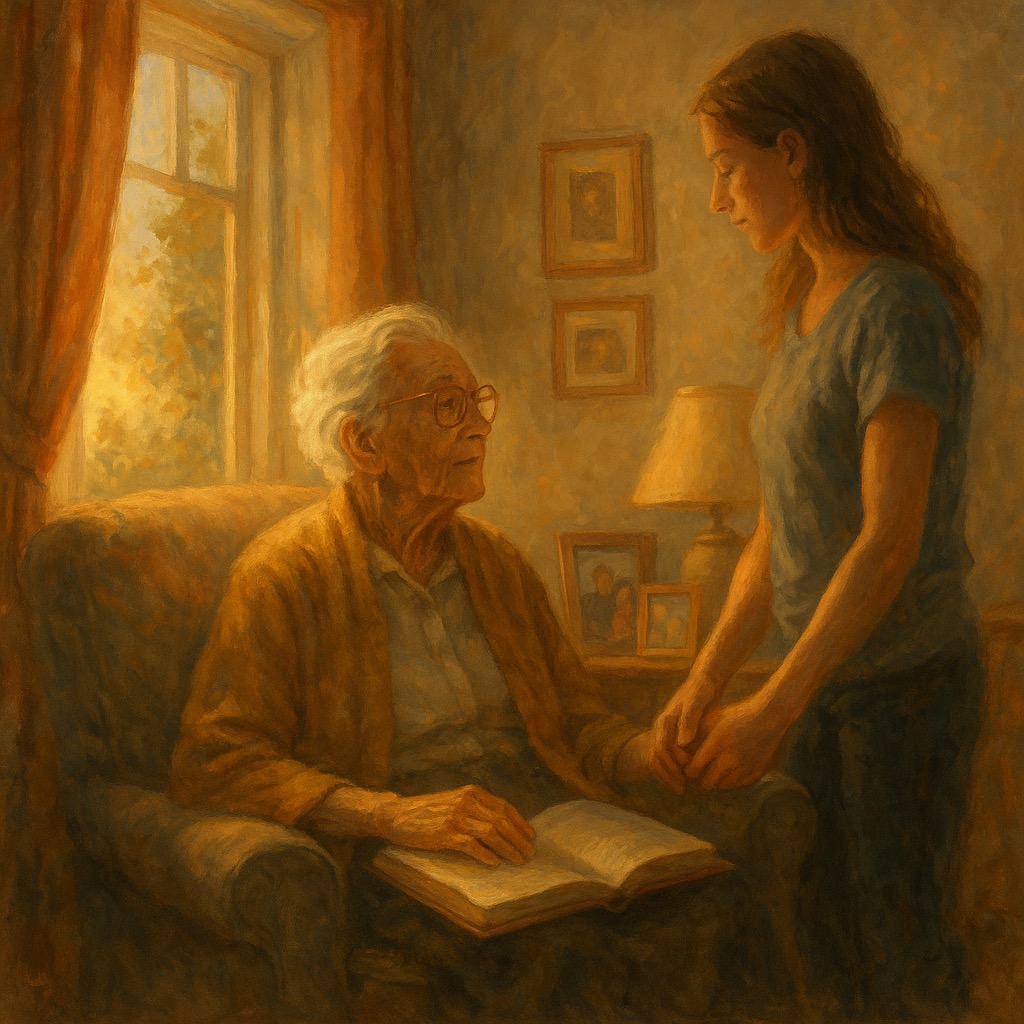
There are presences that never fade — even when the body yields to slowness and fragility. They carry in their serene gaze the glow of someone who has crossed the world many times without leaving home. Older people are not pages turned, but open books, their margins worn by those seeking answers. Until their final breath, they remain — whole, complex, vibrant. A living reliquary where knowledge, silences, losses, victories, and gestures of love rest.
For children, grandchildren, nieces, nephews, brothers, and sisters — those companions of blood and childhood who share the same roots — the task is more than ensuring safety. It is understanding that we are not caring for a body in decline, but for a story that endures. Every wrinkle the years inscribed on their faces is a paragraph of life. Every quirk is an emotional identity card. Each stubbornness — so often misread — is a way of defending one’s own sovereignty before a world that insists on hurrying what should be contemplated.
Siblings grow old together, even if at different rhythms. Between them, care can be both mirror and embrace: seeing in the other one’s own future, and in that future the shared memory. Caring for an aging brother or sister is recalling a childhood of clasped hands, silent pacts, and departures that only life can explain. It is rescuing wordless tenderness, the complicity that never ages.
True care demands listening. And listening here is more than hearing words; it is welcoming pauses, respecting silences, giving time to another’s time. To care for someone who has lived so much is to recognize wisdom in every gesture, even when that gesture falters. It is resisting the temptation to infantilize, to impose routines without consultation, to treat as incapable those who once carried the world on their shoulders. Behind thin skin and an unsteady gait resides a soul whose brilliance has never dimmed — it has only changed tempo.
This is not about repaying a debt. It is about acknowledging a legacy. An elder is not a burden — but a beacon. Not a shadow of what once was — but the root of what we are. They are the link between what has passed and what is yet to come. To deny their importance is to wound our own continuity. As Simone de Beauvoir wrote, “All it takes is for one civilized person to cease being in solidarity with the aged for the entire edifice of civilization to collapse.” Growing old is not a flaw to be corrected; it is an achievement to be honored.
Therefore, may the younger — whether kin or not — and the brothers and sisters who share the road of time draw near with humility. May they touch lightly. May they ask with genuine curiosity. May they accompany not out of obligation, but out of reverence. And may they know: every moment shared with someone who has lived so long is a lesson that will not be repeated, a chance to see the world through wiser, slower, deeper eyes.
In the end, there is no full stop — only passage. There is permanence in the memories that flow into us like silent waters. There is beauty in continuing, even when everything shifts. Life does not end in one breath — it becomes a trail. And along that trail, made of simple gestures and an intact presence, we carry on: with a little more listening, a little more time, a little more tenderness in our steps.
By Palmarí H. de Lucena