
Some journeys end when we return home. Others continue to flow beneath the surface of memory.
Memory is selective. It loosens its grip on faces, blurs dates, and quietly rearranges the chronology of our lives. Yet it preserves, with astonishing fidelity, the light of certain places. That is how I remember the trout streams around Lake Pocono, tucked into Pennsylvania’s Pocono Mountains. I can no longer recall the first trout I caught or how many slipped back into the current after a brief struggle. The details have faded with time, but what remains is something richer than fact: water as clear as polished glass slipping over ancient stones, the resinous scent of sun-warmed pines, morning mist rising through the valley, and the steady murmur of a stream that seemed to breathe with the mountain itself.
Over the years, I have come to believe that some places are never simply visited. They settle quietly within us, becoming part of our inner landscape until memory and geography begin to share the same contours. The streams of Lake Pocono seemed untouched by urgency. Water curled around moss-covered boulders, disappeared beneath exposed roots, and emerged again farther downstream with the quiet confidence of something that had nowhere else it needed to be. To stand beside that current was to surrender, if only for a few hours, to a rhythm older than clocks and quieter than thought. It was there that I first understood that fly fishing had less to do with catching trout than with learning to see.
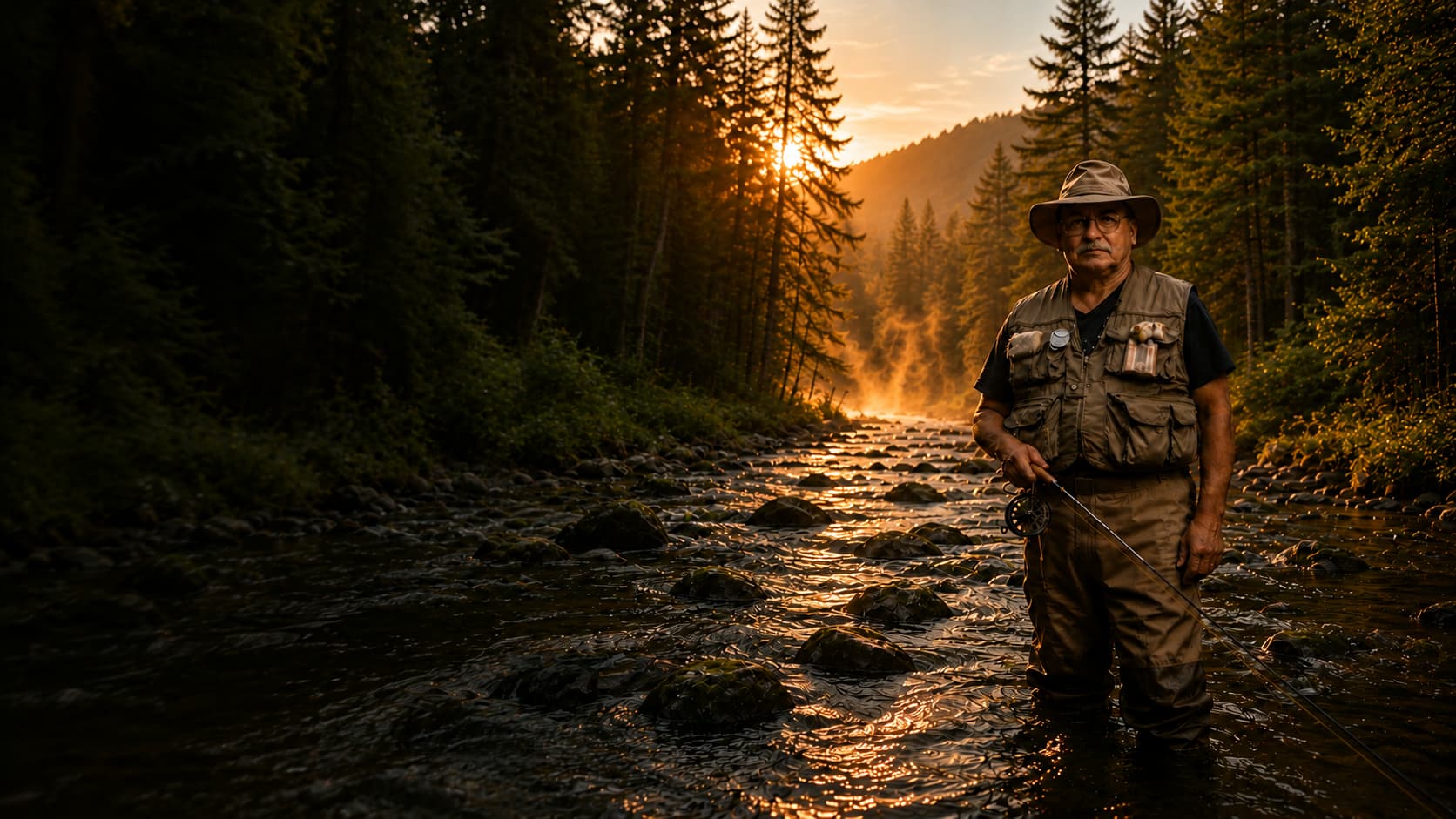
My first morning on the stream began beneath a veil of mist that softened the pines and blurred the far bank into shades of gray and green. The river moved with quiet purpose, its surface broken only by riffles shimmering in the early light. An older woman was already standing knee-deep in the current. She stood with the quiet assurance of someone who had spent a lifetime reading water. Her waders seemed part of the river itself, her weathered vest held neatly arranged fly boxes, and beneath the brim of a faded hat her face reflected the calm concentration of someone entirely at home in the natural world. She remained motionless for a long moment, studying the current as though listening to a conversation I could not hear. Then she cast. There was no flourish, no hint of performance. The rod bent almost imperceptibly, the fly line unfurled into a graceful loop, and the tiny dry fly settled onto the surface as though the river had accepted it rather than received it.
I watched without speaking. After a moment she turned toward me, smiled, and offered the only advice she ever gave me. Before you choose a fly, study the water. She said nothing more. At the time, I heard her words as practical wisdom from an experienced angler. Only years later did I understand she had not been talking about fishing at all.
Trout follow an invisible calendar written by the seasons. Each hatch of mayflies, caddisflies, and stoneflies changes the rhythm of the river, and those who fish well learn to read those subtle signs long before tying on a fly. The stream reveals everything, but only to those willing to slow down long enough to observe it. Since that morning, I have found myself repeating the same ritual whenever I walk beside moving water. I stop before taking another step. I study the current, the shifting light across submerged stones, the drifting insects, and the shadows beneath the surface. Only afterward do I realize that, in one way or another, I have been searching for those Pocono streams again.
Late in the afternoon, when the sun settled into the crowns of the maples and the valley grew quiet, another memory returned. Schubert’s Die Forelle no longer sounded like music inspired by a river. Instead, it seemed the melody had always belonged to the river, and Schubert had simply been the first to write it down. Today I could not tell you whether I first discovered the music or the stream. Somewhere over the years they became inseparable, each calling the other back into memory.
The streams of Lake Pocono continue to flow over the same ancient stones, indifferent to memory and untouched by the passing years. Every spring the insects return. Summer lingers in the evening light. Autumn leaves drift silently around the next bend before disappearing downstream. Everything changes, and yet something essential remains.
I have come to believe that the finest journeys never truly end. They continue beneath the surface of our lives like hidden springs, returning unexpectedly through the scent of pine after warm rain, the cool sound of moving water, or the opening notes of a familiar melody. Those moments remind us that the most enduring souvenirs are rarely objects we can carry home. They are ways of seeing that quietly reshape the person who returns.
Whenever life begins to gather too much speed, I find myself returning to that quiet bend in the Pocono Mountains—not by highway or by airplane, but by memory. The water is still clear. Morning mist still rises through the pines, and somewhere beneath the surface a trout waits patiently in the seam where two currents meet. Before taking another step, I pause and look at the water. It is impossible to know whether the river has remained unchanged, or whether memory has simply been kind enough to preserve it that way. Perhaps the distinction no longer matters. Some landscapes continue to flow long after we leave them, shaping the quiet currents of our lives in ways we seldom recognize until years have passed. I left Pennsylvania long ago. The river, I sometimes think, never left me.
Palmarí H. de Lucena