
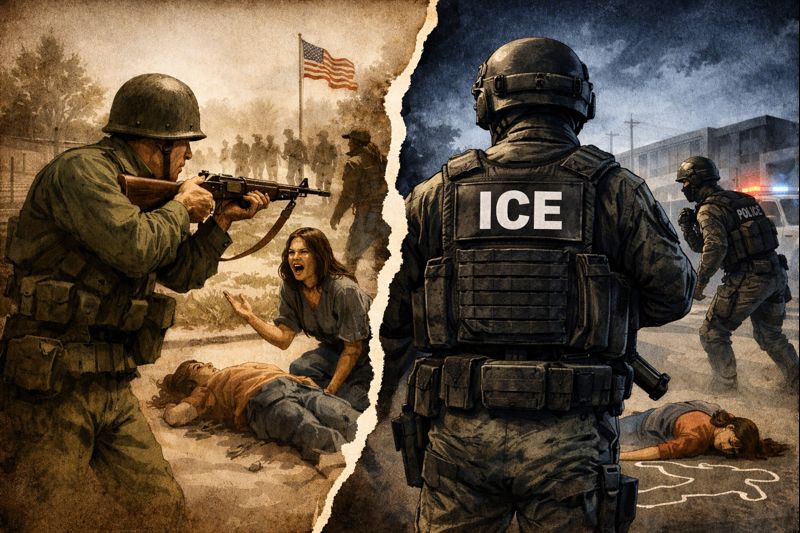
There are moments in a democracy when isolated events stop being episodes and start becoming signals. Not because of how many die, but because of what happens—and who does it. The shooting of students at Kent State in 1970 did not invent opposition to the Vietnam War. It marked the moment many Americans understood that the logic of war had returned home.
Vietnam was not politically lost only in Southeast Asia. It began to unravel when violence justified abroad surfaced inside the country’s civic space. The killing of unarmed students by National Guard troops on a university campus shattered a boundary democracies depend on: the line between security and repression.
That is why contemporary cases of lethal force by state agents on American soil provoke unease, even when facts are disputed or investigations ongoing. When officers of Immigration and Customs Enforcement—an agency created to police borders and immigration—are involved in an operation that ends with the death of an American citizen, the issue is no longer merely legal. It becomes political and moral.
The problem is not just error. It is drift. Institutions designed for administrative enforcement begin to act, directly or indirectly, as domestic security forces with the power to kill. That shift weakens limits that mature democracies struggle to maintain.
Democracies endure less through force than through trust. State violence is tolerated only as a tragic exception, constrained by clear rules, oversight, and accountability. When exceptions begin to look routine, the damage accumulates quietly: legitimacy erodes, rhetoric hardens, civic consensus contracts.
The Vietnam analogy should not be abused. This is not about equating wars with domestic incidents. The parallel lies elsewhere—in the perception that the state has begun to treat its own citizens as threats to be managed rather than rights to be protected.
Kent State showed that democratic authority is rarely lost in a single act. It dissolves through sequences that go unacknowledged, poorly investigated, and insufficiently corrected. Institutional defensiveness and the normalization of force accelerate that decay.
Wars end when they lose political meaning, not only when fighting stops. Democracies falter when citizens come to fear those charged with protecting them. The danger lies less in one episode than in the precedent it sets—and in the silence that follows.
Order requires power, but it survives on restraint. No democracy lasts long when it confuses authority with intimidation.
by Palmarí H. de Lucena