
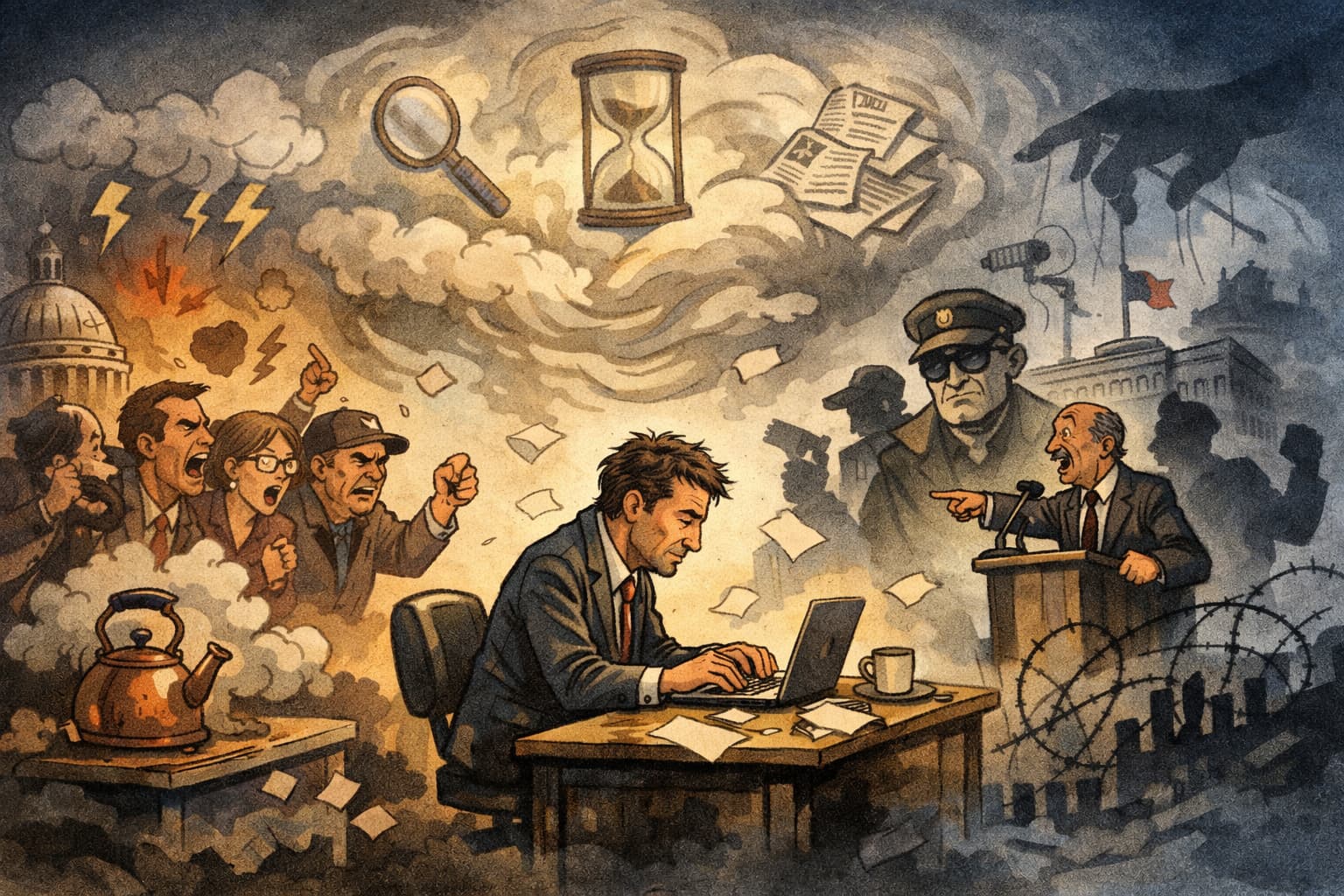
It is often argued that opinion writing is, by its very nature, polemical—and therefore at odds with the ideal of journalistic balance. The claim has an intuitive appeal, but it rests on a conceptual error. Polemic is not an editorial genre; it is, at most, a possible consequence. Treating the two as interchangeable diminishes public debate and erases a distinction essential to understanding how journalism functions in democratic societies.
Opinion journalism is not designed to manufacture controversy. Its purpose is more modest—and more demanding: to interpret facts through the lens of principles. Its point of departure is not provocation, but observable reality. When an opinion piece unsettles readers, this is rarely the result of excessive rhetoric. More often, it reflects the uncomfortable truth that public decisions, when examined with method, context, and historical memory, do not hold up well under rational scrutiny.
Clarity begins with differentiating roles. An opinion article presents the interpretation of an identified author, who openly assumes responsibility for that reading of events. An editorial articulates the institutional position of a newspaper, shaped by collective judgment and expressed in a deliberately restrained voice. A column occupies a more fluid space—an ongoing presence where analysis, style, and personal observation intersect. None of these forms exists to inflame debate; all exist to give it shape and meaning.
Polemic emerges not from opinion itself, but from the friction between words and deeds, between promise and outcome, between legality and legitimacy. In such moments, the discomfort precedes the text; it is embedded in the facts. Opinion does not invent the tension—it orders it, names it, and presents it to the reader as an invitation to reflection. Eliminating this stage does not produce balance. It produces obscurity.
Here another distinction becomes unavoidable. Argumented opinion is not activism. The former is anchored in verifiable facts, attentive to nuance, and open to disagreement as a constitutive element of democratic life. The latter begins with fixed conclusions and selectively recruits evidence to support them. When that line is crossed, the failure is not of opinion as a genre, but of a text that has abandoned journalistic discipline.
Critics also accuse opinion writing of “taking sides.” What this objection overlooks is that all serious analysis rests on a shared ethical floor: legality, transparency, public accountability, respect for fundamental rights. To defend these principles is not partisanship; it is civic responsibility. Absolute neutrality in the face of evident institutional failure is not prudence—it is abdication, thinly disguised as restraint.
Balance in opinion journalism, then, is not measured by the absence of position, but by the quality of reasoning. A balanced argument acknowledges limits, weighs consequences, avoids gratuitous personalization, and distinguishes institutional critique from personal attack. It is possible—indeed, necessary—to be firm without being shrill, precise without being doctrinaire.
It is no accident that responsible opinion proves especially unsettling to authoritarian systems. Such regimes can tolerate data, reports, and statistics, provided they retain control over interpretation. What they cannot tolerate is independent judgment: the comparison with past commitments, the recovery of inconvenient memory, the refusal to let promises quietly to expire. Opinion disrupts narrative monopolies. It restores memory. It denies power the comfort of forgetting.
To reduce opinion to mere polemic is, ultimately, a convenient way of dismissing it. If everything is labeled “controversial,” nothing needs to be answered on its merits. The result is a thinner democratic culture, one in which dissent—an essential element of public life—is treated as a disturbance rather than a resource.
In a public sphere saturated with noise, opinion journalism continues to perform an irreplaceable task: thinking aloud, with responsibility. When that exercise produces discomfort, the source of the unease is rarely the text itself. More often, it lies in the reality the text insists on bringing into view.
By Palmarí H. de Lucena