
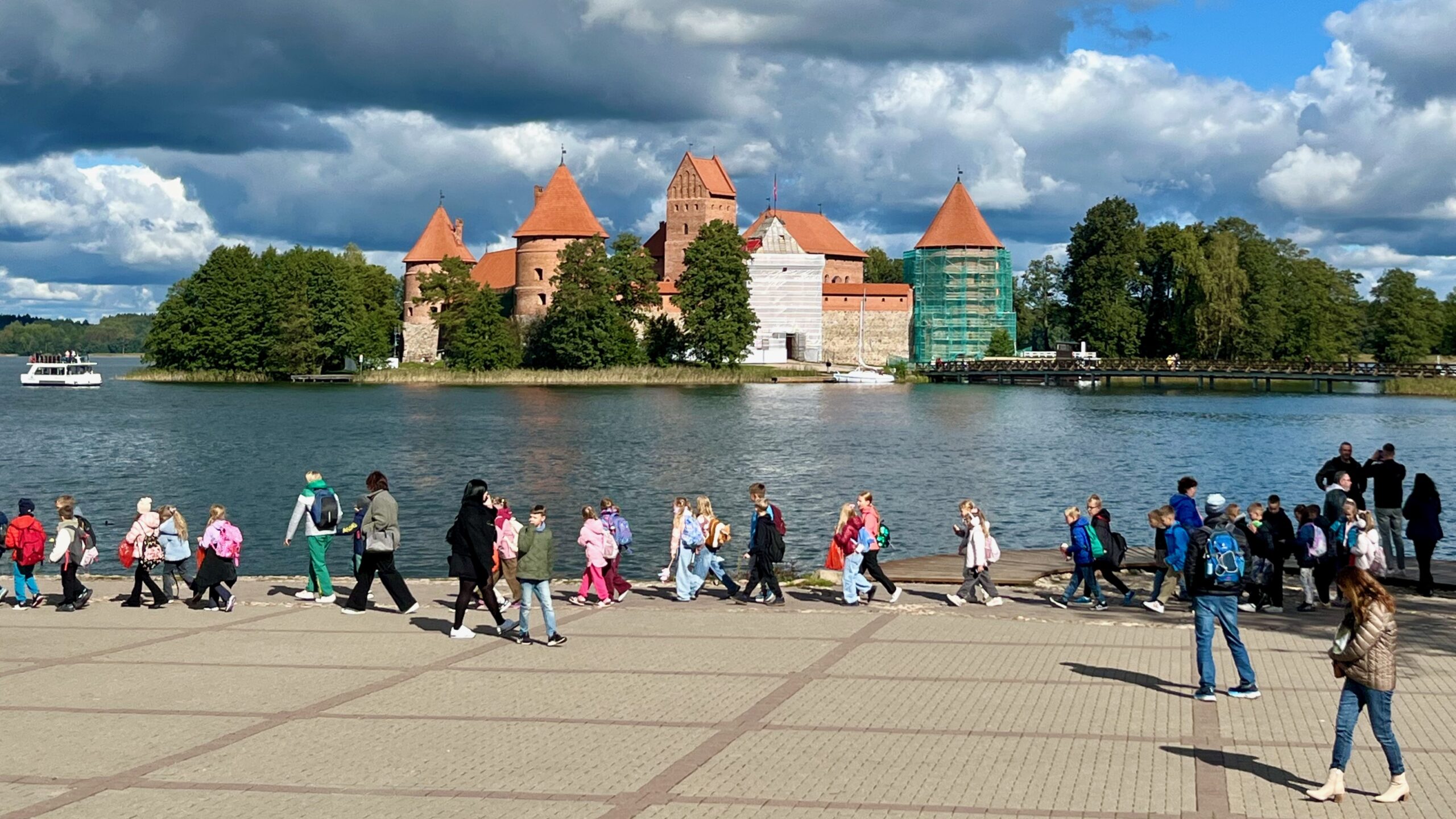
The road to Trakai seemed to announce something rare. Between silent forests and shimmering lakes, I felt I was not merely traveling to a destination, but stepping into a suspended time. When I first saw the castle mirrored in Lake Galvė, I knew the vision would never leave my memory.
Crossing the wooden bridge, my steps felt lighter, as though each plank carried centuries of remembrance. I thought of Gediminas, who raised the first fortress in Old Trakai, and of Vytautas the Great, who transformed the site into the capital of the Grand Duchy of Lithuania. I imagined foreign envoys arriving by boat, torches lighting the stone halls, and solemn voices forging alliances that would change the fate of nations.
But Trakai is more than walls and battles. It is also the poetry of a people who made this place their home: the Karaites. Brought from Crimea in the 14th century at Vytautas’s invitation, they carried with them unique traditions, a faith rooted only in the written Torah, and the custom of building wooden houses with three windows—one facing God, another the family, and the third the ruler. These houses still stand, holding the memory of centuries.
At the heart of their community rises the kenesa, the Karaite house of prayer. Unlike rabbinic synagogues, it is austere and intimate, created for a direct encounter with the words of the Torah. Inside, silence mingles with the soft cadence of prayers, while the light filtering through the windows takes on a sacred weight. The kenesa is not only a religious space but a symbol of survival—a testament to a people who, though few in number today, endure as guardians of their faith and culture.
The streets still whisper this heritage: in a language preserved through centuries, in the delicate kibinai pastries baked daily, in the cadence of communal life itself. Even now, the Karaites remain inseparable from Trakai’s identity.
At dusk, the sun gilded the towers and painted the waters purple. I stood still, watching the castle duplicate itself in the lake’s mirror, and realized that Trakai’s beauty lies precisely in this: the convergence of stone and water, power and faith, memory and poetry. And today, this bond between past and present is reaffirmed by the Lithuanian government’s careful restoration of the castle’s five towers—a gesture of commitment to history and culture, ensuring that Trakai’s story continues not only in memory, but in stone.
As I left, I understood it was not I who carried the place away—it was the place that had lodged itself within me, with the weight of its stones, the shimmer of its waters, and the enduring legacy of its Karaites.
Palmarí H. de Lucena