
African football came of age when the 2010 World Cup arrived in South Africa.
It was more than a tournament. It was a declaration.
For the first time, the world’s game spun to the endless drone of vuvuzelas beneath the dry southern winter, in front of a continent that no longer accepted being treated as an extra in its own story.
Algeria’s Desert Foxes were there. Cameroon’s Indomitable Lions. Ivory Coast’s Elephants. Nigeria’s Super Eagles. Ghana’s Black Stars. And Nelson Mandela’s boys — South Africa’s Bafana Bafana.
Respected, perhaps. But still viewed with the kind of condescension usually reserved for “exotic” national teams.
To much of Europe, African football remained trapped inside an old cliché: physical power, improvisation, tactical chaos.
What they failed to understand was that Africa played with something no European academy could ever teach:
memory.
The continent had been announcing its arrival for decades.
Zambia’s Copper Bullets dismantled Italy’s old guard of Tacconi, Carnevale and Baggio with a stunning 4–0 victory at the Seoul Olympics. Senegal opened the 2002 World Cup by defeating reigning champions France before a stunned planet. Nigeria’s Olympic side conquered Brazil and Argentina on the road to gold in Atlanta. Ghana enchanted the world in 2010. Roger Milla’s Cameroon had already danced across European arrogance back in 1990.
Improbable matches. Unbelievable results. Zebras running free across the plains.
Fortunately for the favorites, Botswana’s actual Zebras did not qualify for the 2010 World Cup. The others were already dangerous enough.
Yet no story captures the tragedies and miracles of African football quite like that of Zambia’s Chipolopolo — the Copper Bullets.
On April 28, 1993, an old and exhausted military aircraft crashed into the Atlantic Ocean off the coast of Gabon. On board were eighteen Zambian national team players traveling to a 1994 World Cup qualifier against Senegal.
The country lacked the resources to charter a commercial flight.
It was a profoundly African tragedy: heroism on the pitch, abandonment beyond it.
Kalusha Bwalya escaped by accident — or perhaps by destiny.
The PSV Eindhoven star and Romário’s teammate in the Netherlands had been forced by his club to travel separately on a commercial flight. He survived while his teammates disappeared into the sea.
He would later return to rebuild the national team while carrying the collective grief of an entire nation on his shoulders. Zambia would miss qualification for the 1994 World Cup by a single goal.
The disaster did not destroy the team.
It transformed it into myth.
I met Kalusha in 2004, in the lobby of the Taj Hotel in Lusaka. A group of young players chatted excitedly when an older man slowly approached, like someone walking toward a decisive penalty kick.
The room fell silent.
I asked the receptionist who he was.
Her eyes widened.
“You don’t know the great Great Kalu?”
That was how Zambians pronounced it: Great Kalu, the national hero.
That day, Chipolopolo were preparing for a World Cup qualifying match against Liberia. We spoke at length. Kalusha talked calmly about Zambia’s economic struggles, the precarious state of the stadiums and the endless difficulty of keeping football competitive on a continent where talent rarely arrives accompanied by structure.
He remembered Romário fondly. He spoke about Godfrey Kangwa — the midfielder killed in the 1993 disaster, nicknamed “Dunga” by Zambian supporters because of his leadership and spirit.
There was sadness in his voice.
But above all, there was dignity.
He invited us to the match.
We arrived at the stadium amid relentless drums, horns, songs and laughter. It felt as though the entire country awaited one more miracle from Great Kalu. The stands pulsed like a living organism.
Near the end of the second half, his substitution was announced.
The stadium exploded.
And then the inevitable happened.
In the closing minutes, Chipolopolo scored.
Zambia 1. Liberia 0.
Kalusha ended his final match for the national team victorious — the way African heroes often leave: surrounded by sweat, dust and collective delirium.
Politics would follow. The federation presidency. FIFA committees. Scandals. Power struggles.
But for Zambians, he had already transcended ordinary humanity.
He had become national memory.
Since 2010, African football has changed profoundly.
The African diaspora has established itself as one of the central forces in European football. Academies funded by foreign clubs now stretch from Dakar to Abidjan. Federations that once operated amateurishly have slowly professionalized. And the African player is no longer viewed merely as an athletic phenomenon, but increasingly as part of the tactical and intellectual center of modern football.
Mohamed Salah. Achraf Hakimi. Victor Osimhen. Ademola Lookman. Sadio Mané.
They belong to a generation that no longer plays with any sense of historical inferiority.
The 2026 World Cup symbolizes that transformation.
For the first time, Africa will receive nine direct places at the tournament, with the possibility of a tenth through the intercontinental playoffs. A continent marginalized for decades by football’s global power structure now arrives larger, stronger and politically more influential.
Morocco is no longer treated as a surprise after its historic semifinal run in Qatar. Senegal has consolidated itself as a continental power. Ivory Coast has re-emerged with a fast and technically gifted generation. Egypt has returned to prominence. Algeria has matured. And South Africa returns to the global stage sixteen years after hosting the World Cup, bringing the sound of vuvuzelas back to the planet.
At the same time, absences such as Nigeria and Cameroon remind everyone of a brutal truth:
there are no qualifiers more ruthless than Africa’s.
Today, the continent exports more than players.
It exports identity.
There is organization now. Collective discipline. Tactical sophistication.
And yet improvisation remains its most beautiful art form.
Perhaps that is the true secret of African football: transforming scarcity into imagination.
Because in Africa, football was never just football.
It is survival.
It is national pride.
It is dance.
It is prayer.
It is colonial memory transformed into symbolic revenge before the world.
For decades, African football was treated as folkloric curiosity by European administrators who never truly grasped the cultural depth of the game on the continent.
While Europe industrialized football and South America romanticized talent, Africa turned the ball into a language of collective survival.
Perhaps that is why its victories provoke such discomfort.
When an African team defeats one of football’s traditional powers, it is not merely a scoreline that changes. For ninety minutes, an old hierarchy of world football cracks open.
What Morocco achieved in Qatar in 2022 was not an accident.
It was the announcement of a tectonic shift.
For the first time, an African national team no longer seemed satisfied with participating in history.
It wanted to command it.
And perhaps that is the real fear haunting the old giants: the realization that the zebras no longer appear only once in a while.
Now they know the way.
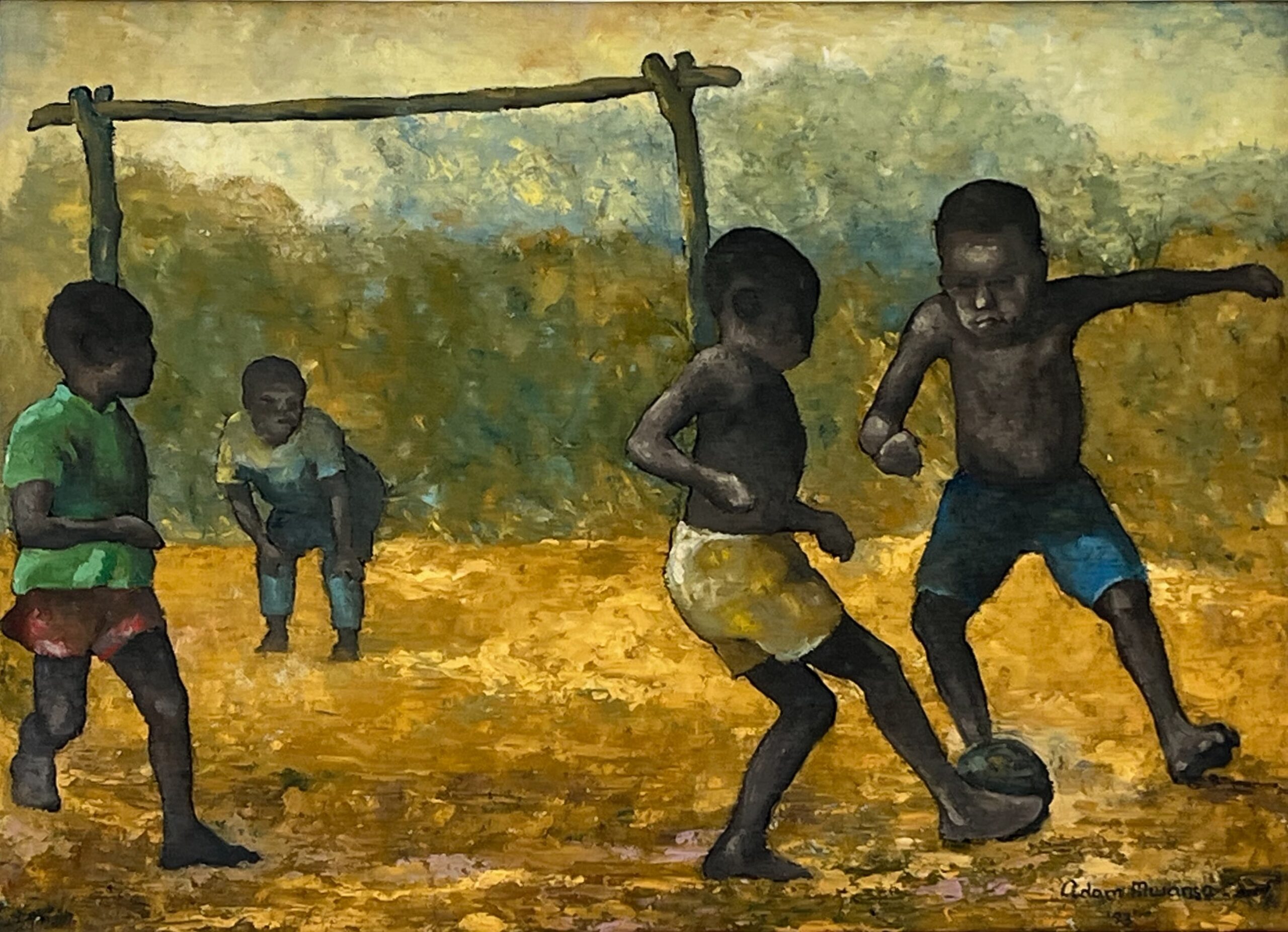
As long as there is a patch of red dirt, a pair of improvised goalposts and a child chasing a rag ball beneath the savannah sunset, there will be hope.
The giants should be careful.
The zebras are still running free across the plains.
Palmarí H. de Lucena
Editor’s Note
In Brazilian football slang, the word zebra refers to a shocking or highly unexpected result — when a much weaker team defeats, or even draws against, a heavy favorite.
In this article, the metaphor carries a double meaning: both the Brazilian football expression for an upset and the literal image of zebras running free across the African plains — symbolizing African teams repeatedly disrupting the established hierarchy of world football.