
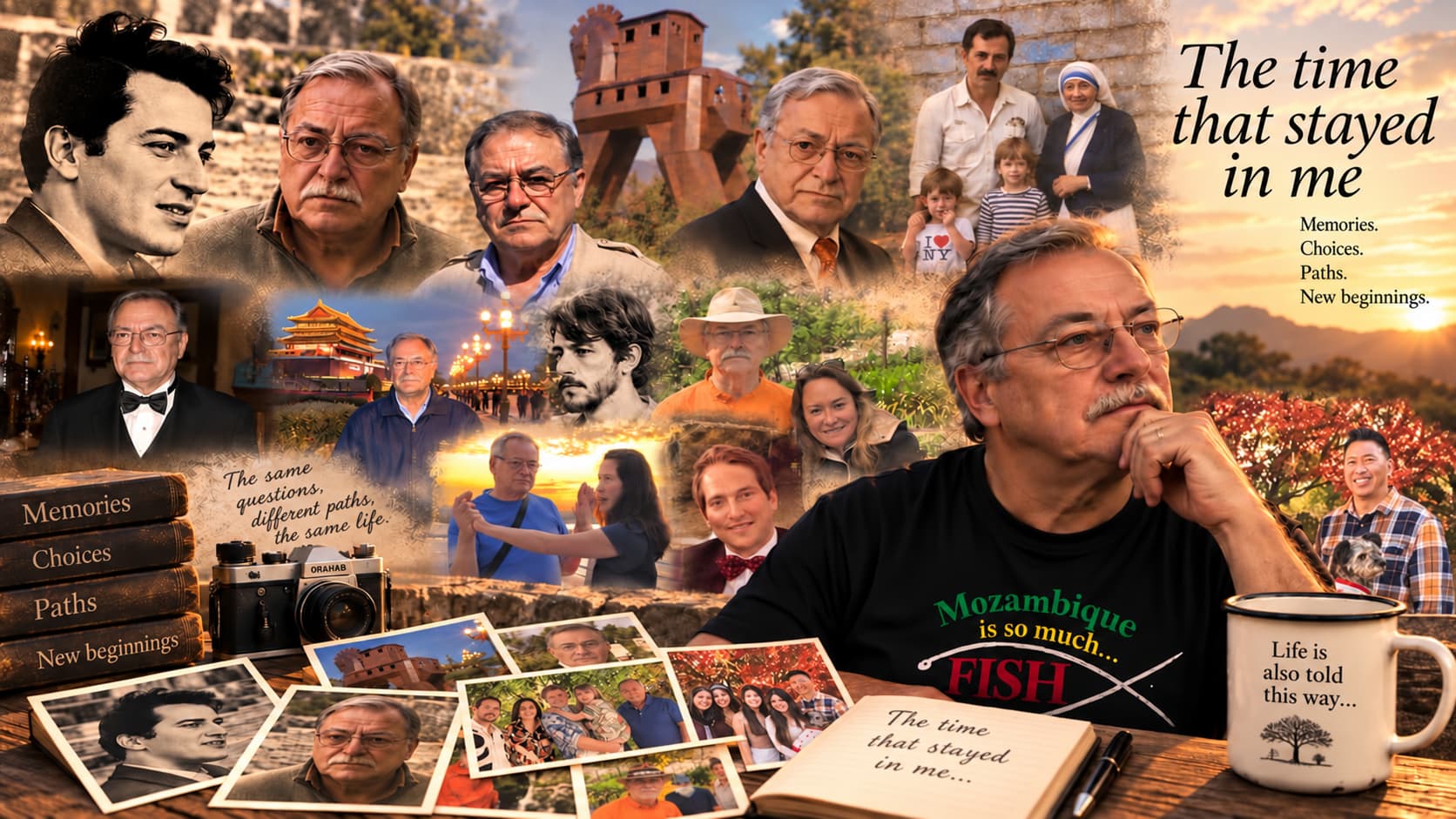
I have learned, with the years, that some changes happen so quietly that we notice them only when there is no way back to who we once were. One day, standing before the mirror, we recognize the face but feel a stranger looking back. In an old photograph, we find a young man carrying our eyes, our smile, perhaps some gesture we still possess, yet he seems to belong to another life. Somewhere between the person I was and the man I have become, I began to understand my own story.
I remember certain afternoons when the day seemed in no hurry to end. There was a particular light over the houses, a silence settling in slowly, and the feeling that, for a few moments, the world had paused to linger in itself. I did not know then that those ordinary afternoons would one day acquire another meaning. Life has a way of hiding its beauty inside what seems unremarkable.
While we are living, we rarely recognize the importance of an instant. A conversation may seem like only a conversation; an embrace, only an embrace; a farewell, only a farewell. It is later, when absence settles into the room, that we understand we were sometimes not merely living a moment. We were saying goodbye to it without knowing. The last times seldom announce themselves. They hide inside ordinary days and reveal their weight only afterward.
I have photographs that keep me company. Some have lost their sharpness, and perhaps that is why they seem more truthful. I look at a young face and recognize something of myself, although the man in the picture already feels distant. I feel a quiet tenderness for the person I was. I do not wish to become him again. He had different certainties, different illusions, different impatiences. I carry the marks he had yet to know.
Between us lies a long road of choices, encounters, losses, mistakes, and beginnings again. There were times when I had to keep going without any assurance that the road would end well. There were days when silence seemed larger than hope. I did not win every battle. Some left marks I can still recognize. Yet I learned that going on is itself a form of courage. Sometimes getting back up does not mean being strong. It simply means deciding that the next step is still worth taking.
Beginning again does not mean erasing what happened. It means carrying forward what experience has taught us, scars included. After certain falls, we no longer walk in quite the same way. We become more attentive to the stones beneath our feet, more careful in our choices, and perhaps more merciful toward the stumbles of others. Some wounds do not have to disappear before they stop ruling us; we only have to learn not to live entirely inside them.
Perhaps that is why I distrust anyone who speaks of the past as though it could be recovered. What returns is not the event itself, but the memory we have made of it. And memory never arrives alone; it brings everything that happened afterward. To remember is also to rebuild.
A song can undo decades in a few seconds. One familiar melody is enough to open a door inside me, and suddenly I am back in a room, on a street, at a particular age. I hear a voice I can no longer hear in the world, and for one brief moment, distance seems not to exist.
That is when I feel the strange power of memory. It follows a different measure, one made of affection. It can preserve an afternoon and forget years. It can keep a sentence for decades while allowing whole events that once seemed important to fade away. I have memories like that—small and stubborn: the smell of rain, an open window, the distant sound of a television, a voice calling someone by name, the way a certain light entered the house.
None of this would seem important to anyone else. To me, these are small doors into a world that no longer exists. Perhaps this is what we carry as we grow older: not simply memories, but entire worlds. Inside us are houses that have been torn down, streets whose names have changed, people who have gone away, voices that have fallen silent. Outwardly, we go on living in the present; inwardly, we still speak with what remains.
The city grows older with us. I return to certain places and find different facades, larger trees, houses I no longer recognize. Sometimes I look for an old landmark and discover that it is gone. Then I realize I am not really searching for an address. I am searching for a part of myself that stayed there. No place, however, can return exactly what we were, because our eyes have changed too.
Growing older, to me, has become less a matter of counting years than of gathering landscapes. Each season of life left something behind. Some brought joy; others, silence. Some were inhabited by people who remained; others taught me how to live with absence. A life is not built only from great events, but from all the things that settle, almost unnoticed, into the way we become ourselves.
It took maturity to understand that an hour can be forgotten in a few days while another can remain with us for a lifetime. Some experiences last minutes and become permanent; whole years can disappear without leaving a clear trace. What matters is not simply how long something lasted, but how deeply it entered our story.
Today I am more careful with ordinary moments. I listen to a beloved voice without planning my answer. I linger a little longer in conversation. I watch the light move across a wall. I am grateful for someone’s presence before it becomes absence. Perhaps maturity is simply this: no longer needing longing to teach us the value of someone.
When I look back, I do not wish to correct my story. There are choices I would make differently, words I should have spoken, and others I would have been wiser to leave unsaid. There were roads that may have taken me farther than necessary. But they all belong to the path that brought me here, and I no longer wish to cut any part of myself away from the person I was.
I do not want a life without scars. Such a life might not be mine at all. I want to understand what I have lived, make some peace with my mistakes, keep what was good with gratitude, and refuse to let loss occupy every room still left inside me. Memory, after all, can also be a form of gratitude.
When I remember someone who has gone, I do not think only of absence. I think of the good fortune of having known that person. When I remember a house that disappeared, I think that once I had the happiness of living there. When an old photograph saddens me, I also try to thank the man who is still smiling inside it.
Perhaps this is how the past can remain without imprisoning us: not as a place to which we wish to return, but as part of who we are. We do not have to live there. We only have to recognize it when it comes to visit.
Sometimes, late at night, when the house seems larger and the noises of the world grow faint, memories arrive without being invited. They ask for no explanation. They sit beside me for a while. In those hours, I understand that a life does not disappear simply because a chapter has ended. It changes where it lives.
What is no longer before our eyes can continue within our consciousness, mingled with our words, our gestures, and the way we have learned to look at the world. We are also what we received from those who passed through our lives.
Perhaps that is the only permanence available to us: to leave something of ourselves in people, places, and memories. A word can outlive the person who spoke it. A gesture can remain in someone’s memory. A little tenderness can survive long after our absence.
One day, I too will become a memory. Perhaps someone will find a photograph of me among old papers. Perhaps someone will say my name in an ordinary conversation. Perhaps they will remember a sentence, a gesture, or simply the way I was present. I do not know what will remain of me, and I no longer need to know.
What I can do is be fully present in whatever I am still given to live. A conversation may become a memory. An afternoon may become longing. An embrace may acquire, years later, the weight of a farewell no one recognized at the time. So I would rather receive each day without asking it to promise eternity.
At night, I sometimes stand by the window and watch the distant lights. I think of the people who have passed through my life, those who still walk beside me, and those who remain present only in memory. I think of the boy in the photograph, the man I became, the falls I endured, and the mornings that came after them.
Then I understand that my story is made not only of what I managed to keep. It is also made of what I lost and, despite the loss, transformed into memory. I cannot ask the past to return what it took. I can only be grateful for what it allowed me to live and for what it left inside me.
I still have much to learn. I keep walking, but no longer with the impatience of someone desperate to arrive. I walk with the attention of someone who has discovered that the road itself is part of the destination. I know there will be other goodbyes, but there will also be mornings, encounters, words, small joys, and moments I have not yet met.
And that is enough.
Perhaps hope is not believing that nothing will end. Perhaps it is continuing to believe in life while knowing that everything is passing. There is a quiet courage in accepting impermanence without giving up the act of loving.
Tomorrow, when another morning comes, the world will look ordinary again. The houses will be there, the streets will recover their noise, people will continue along their separate paths. And yet it will be a day that has never existed before.
I will be in it.
And perhaps, for a few moments, I will be able to do what I did not know how to do for so many years: remain completely present while life is happening.
Because I understand now that time is not only what passes. It is also what remains—quietly, deeply—in everything we have been fortunate enough to live.
Palmarí H. de Lucena