
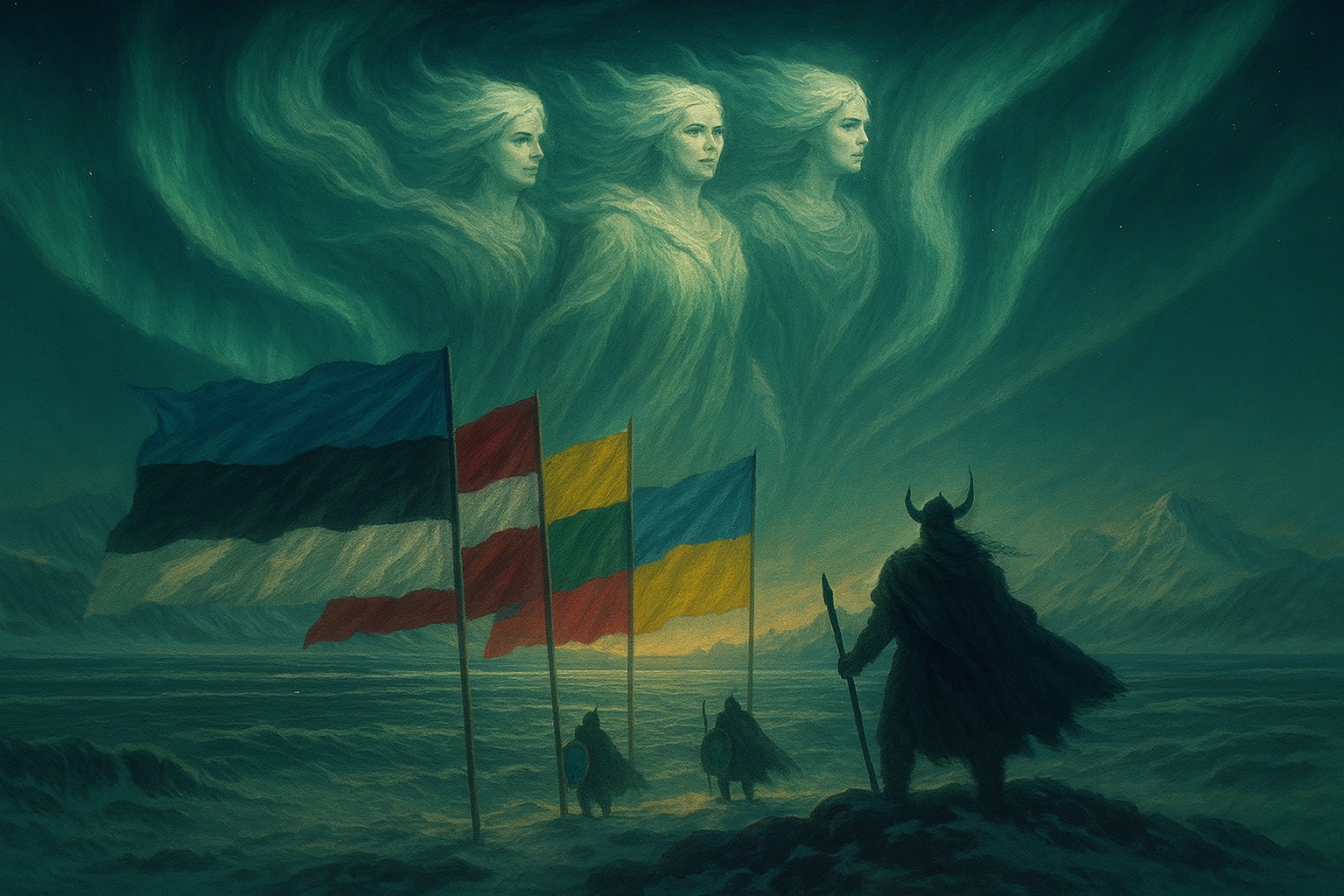
In the fjords of memory
three winds arise —
Estonia, Latvia, Lithuania —
daughters of frost and courage,
born beneath the sign of the aurora
and the steel that cuts through silence.
From the East comes the roar,
a thunder of iron and shadow.
They call it Moscow,
lord of fire and snow,
testing the gods of the West
with unseen spears,
with iron birds that scar the skies,
with lies that echo in sleeping minds.
Small upon the map,
vast in the memory of the fallen,
the three lands-built walls of stone and code,
for they know war comes not only
with tanks and lightning —
but with the breath of deceit,
and the poison that stills the soul.
Towers of digital fire rise,
lines of defense carved in ice.
Men and women march together:
not for glory,
but for an ancient duty —
to guard the soil
where the wind still speaks in a free tongue.
To the south lies Suwalki’s breach,
a scar upon the earth.
The bards call it the throat of doubt:
narrow, fragile,
where the fate of nations may pass
if the eastern dragon crosses the path.
Yet the West has sworn:
an attack on one is an attack on all.
And under that vow,
the sons of Riga, Vilnius, and Tallinn
raise their swords and servers,
their songs and their oaths,
knowing that silence
is the first enemy of freedom.
Old voices join the young:
— “We shall defend every span of land,
every byte of truth,
every flame the frost would smother.” —
And far away,
in the mirror of frozen waters,
Kyiv stands — wounded sister,
yet unbroken,
with the gaze of one who has known empires
and never knelt.
The three northern winds blow on,
and their song spreads across the plains:
there is no peace without watchfulness,
no freedom without remembrance.
And thus the song ends:
when borders fade to echoes,
and peoples call each other brothers,
the ice will open —
not in war,
but in light.
By Palmarí H. de Lucena