
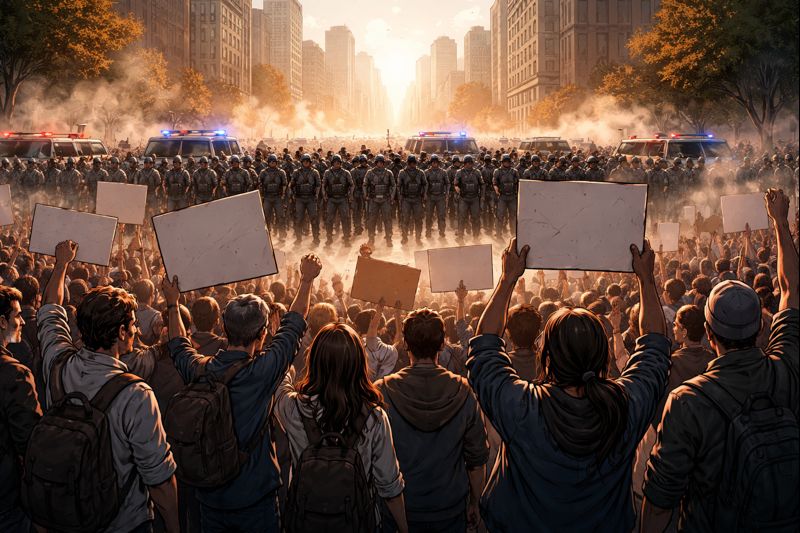
The First Amendment of the United States Constitution rests on a simple but demanding premise: a democratic society must tolerate disagreement, provided it is expressed peacefully and lawfully. Freedom of speech and the right to assemble are not guarantees of comfort or unanimity; they are safeguards designed to ensure that political and social conflict can be articulated without recourse to violence.
In recent years, public debate surrounding federal enforcement actions has renewed attention to these principles. The question raised is neither partisan nor episodic. It is structural: how dissent is exercised under the First Amendment, and how the state responds to that dissent within the bounds of proportionality.
A foundational distinction must remain clear. Peaceful dissent is not incitement. Assembly is not aggression. Criticism of government policy is not an invitation to disorder. The First Amendment exists precisely to protect expression that challenges authority, so long as it does not advocate violence or unlawfulness. Its protections are strongest not when speech is agreeable, but when it is contested.
Nonviolent protest occupies a central place in this constitutional framework. It is a disciplined civic practice grounded in speech, symbolism, and collective presence. Its legitimacy derives from restraint. Protest that rejects violence does not seek to overpower institutions, but to engage them—through visibility, persuasion, and moral argument. When dissent remains nonviolent, it preserves both its credibility and its constitutional protection.
Equally central is the principle of state proportionality. Government authority carries not only legal power, but responsibility. Enforcement actions, even when lawful, must be calibrated to context and necessity. The use of force communicates more than control; it signals how the state understands its relationship with the public. Responses perceived as excessive or indiscriminate risk weakening confidence in institutions, regardless of intent.
Democracy does not require consensus, but it does require measured response. The First Amendment presumes that conflict will occur and entrusts institutions with managing it without escalation. Proportionality, therefore, is not a constraint on authority—it is a condition of its legitimacy. When restraint is visible, trust is reinforced.
This balance places obligations on both sides. Citizens who dissent bear responsibility to do so without intimidation, coercion, or violence. The state, in turn, bears responsibility to distinguish between peaceful expression and genuine threats, responding to each with appropriate measure. Confusing one for the other corrodes the constitutional equilibrium.
This is not an argument against enforcement, nor a justification for disorder. It is a reaffirmation of a constitutional ethic: conflict managed within law strengthens democracy; conflict suppressed through force weakens it. The endurance of democratic systems depends less on eliminating disagreement than on ensuring that disagreement remains civil, nonviolent, and proportionately governed.
In polarized times, the discipline of nonviolence and the restraint of state power are not abstract ideals. They are practical requirements of the First Amendment itself. Democracies endure not because they avoid conflict, but because they insist that conflict unfold without violence—under rules that protect both dissent and order.
By Palmarí H. de Lucena