
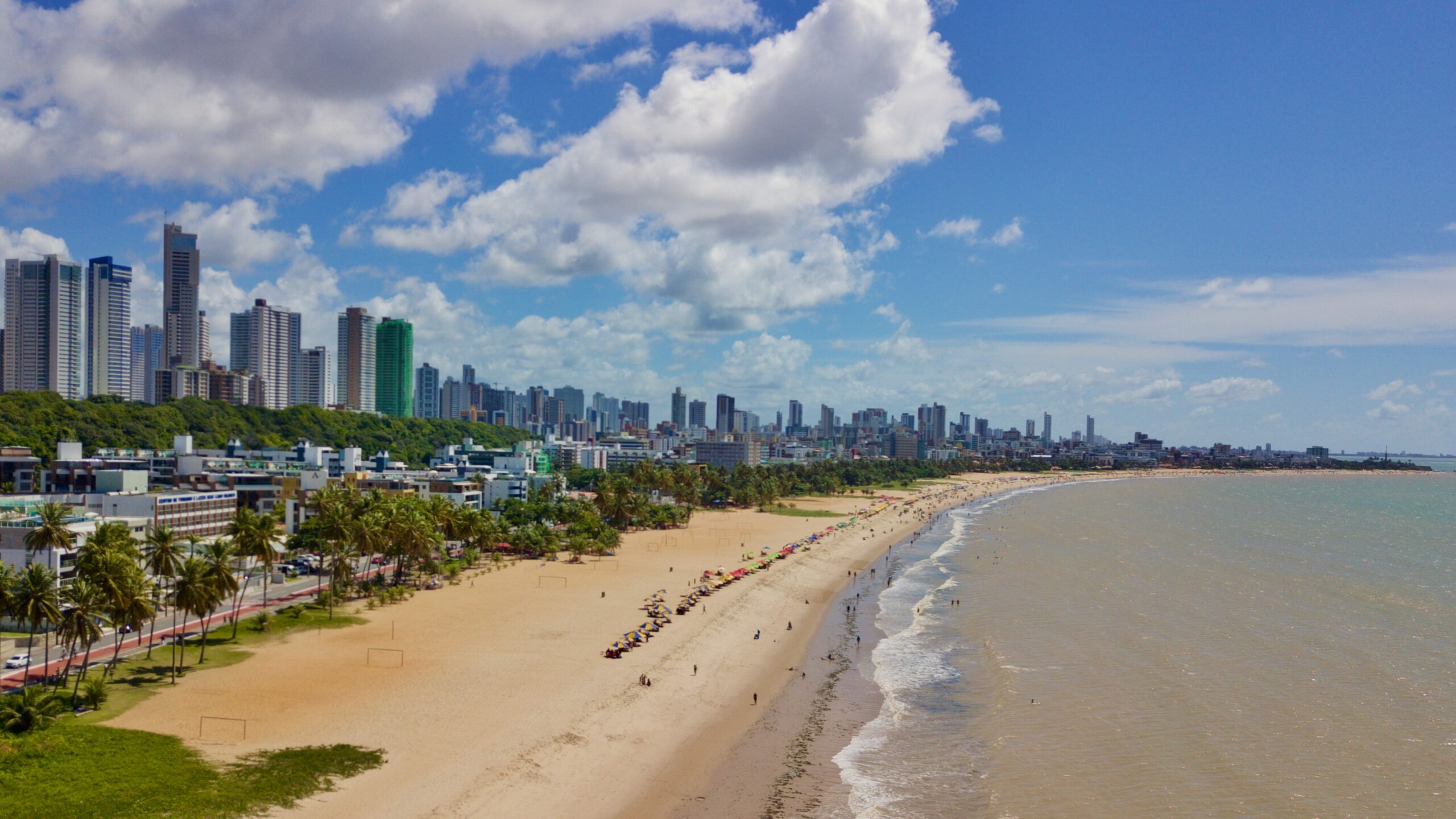
To return to João Pessoa was not to arrive somewhere, but to awaken somewhere.
The awakening occurred before I could name it—at the precise moment when the car curved along the familiar arc of the shoreline and the Atlantic, stretched in its habitual vastness, received the declining sun. It was not the sight alone that unsettled me, but the quality of the light: oblique, honeyed, descending not upon objects but into them, as though it sought to inhabit the concrete and glass, to soften their recentness, to persuade them into continuity.
There are cities whose light illuminates. This one remembers.
Under that late-afternoon radiance, the new towers—disciplined, vertical, ambitious without extravagance—seemed less like declarations of growth than like annotations in the margin of something much older. The bike lanes, freshly painted, the kiosks redesigned with metropolitan intention, the calculated illumination that would later domesticate the night—all of it appeared suspended in a kind of luminous patience.
And then I understood, not intellectually but almost physically, that time does not vanish. It sediments.
The shoreline has changed. It bears the signs of deliberation, of planning committees and economic forecasts. Its geometry has tightened. Its rhythm has accelerated. The sea, once companion to an unhurried adolescence, now reflects the glass of buildings that rise with a contained hunger for horizon.
Yet it was not architecture that pierced me. It was the wind.
That same wind—irreverent, salt-heavy, incapable of obedience—slipped beneath my collar as it once did, disarranging not my hair but my chronology. It carried the faint bitterness of almond leaves and the brackish sweetness of the tide withdrawing. And with it came something that did not belong to the present spectacle but to an earlier vibration within me—a tremor of belonging so elemental that explanation would only diminish it.
Without intending to summon him, I encountered my younger self walking beside me on that same stretch of sand. The city then seemed scaled to breath. The future was not yet obligation but hypothesis. In classrooms we absorbed systems, strategies, the measured architectures of ambition. Along the waterline, however, we learned something more elusive: proportion.
The sea taught distance—not withdrawal, but perspective.
The breeze taught restraint—not fear, but calibration.
The horizon, unwavering and absolute, taught desire.
I left because departure is the grammar of youth.
I crossed other coasts where the sea is gray and introspective, as if burdened by the skies it reflects. I inhabited cities that erased their past with such efficiency that memory itself felt like a zoning violation. I watched ports where water served merely as scenery for haste. In each place, I gathered experiences the way one accumulates maps, convinced that accumulation was equivalent to orientation.
But no map supersedes the first line that ever gave you direction.
Upon returning, I recognized that João Pessoa had grown most boldly where it once seemed most fragile—at the edge between land and immensity. The promenade has become emblem and asset, a visible argument for prosperity. The city breathes differently now—more aware of its reflection, more conscious of its silhouette against the sky.
And yet, as I walked beneath a sunset dissolving into molten gold across the renewed pavement, a curious inversion occurred. I felt not that I was observing the city, but that it was observing me—measuring, perhaps, the distance between the boy who once stared outward in expectation and the man who now stood inwardly accounting.
What have you done with the horizon I gave you? it seemed to ask.
The sensation was not nostalgic. Nostalgia is indulgent. This was something sterner—an appraisal. I realized then that the city of my youth had not been erased by cranes or glass façades. It had been absorbed, folded inward like a hidden lining. And the self who departed had not disappeared; he had thickened, stratified, become layered with weather.
The past is not lost ground. It is foundation.
The sea remained unchanged in its essential gesture—advancing, withdrawing, repeating an ancient syllable indifferent to property lines and skylines alike. Its repetition did not mock the towers; it contextualized them. Permanence and transformation, I saw, are not adversaries but collaborators. The wave erases and confirms the shore in the same movement.
The city matured. So did I.
And what I had anticipated as a sentimental return revealed itself instead as a diagnosis. We do not return to recover who we were; we return to determine whether the axis established in youth still holds beneath the sediment of years. Whether the internal horizon—altered, perhaps obscured—continues to orient us.
João Pessoa changed. That was inevitable.
I changed. That was necessary.
What remains is the line—sometimes faint, sometimes luminous—where sea meets sky and memory meets self.
And whoever preserves that line within does not dissolve in time but deepens within it.
Palmarí H. de Lucena