
In 1982, I went to northern Kenya on a humanitarian mission. A severe drought had settled over the region, and the work was urgent: to help communities whose water, pasture, and livestock were disappearing together. I remember the journey less as a sequence of destinations than as a gradual change in scale. The roads seemed to run into a country with no edges.
Marsabit, Moyale, and Lodwar became names on a map and, more importantly, places in memory. There were dry plains, low mountains, long distances, and roads powdered with dust. The landscape had a severe beauty, but beauty was not what occupied the people who lived there. They were watching the sky. Rain meant pasture; pasture meant animals; animals meant food, security, and the continuation of a way of life.
To someone passing through, the country might have appeared empty. It was not empty. It was full of knowledge: where water might be found, how far a herd could travel, when to move, and how to make a little last. The apparent barrenness of the land concealed a highly developed understanding of survival.
The communities I encountered—the Turkana, Samburu, Rendille, Borana, and Gabra—belonged to different cultural worlds, each with its own language, customs, and forms of social organization. Yet their lives were tied by a common dependence on the land and on the movement of livestock. Cattle, goats, and camels were never simply possessions. They were food, wealth, family security, identity, and memory made visible.
When the rains failed, the damage reached far beyond the loss of an animal. Pasture vanished, herds weakened, and the structure that held family and community life together came under pressure. Drought was not an episode in the weather. It entered the household, the conversation, and the future.
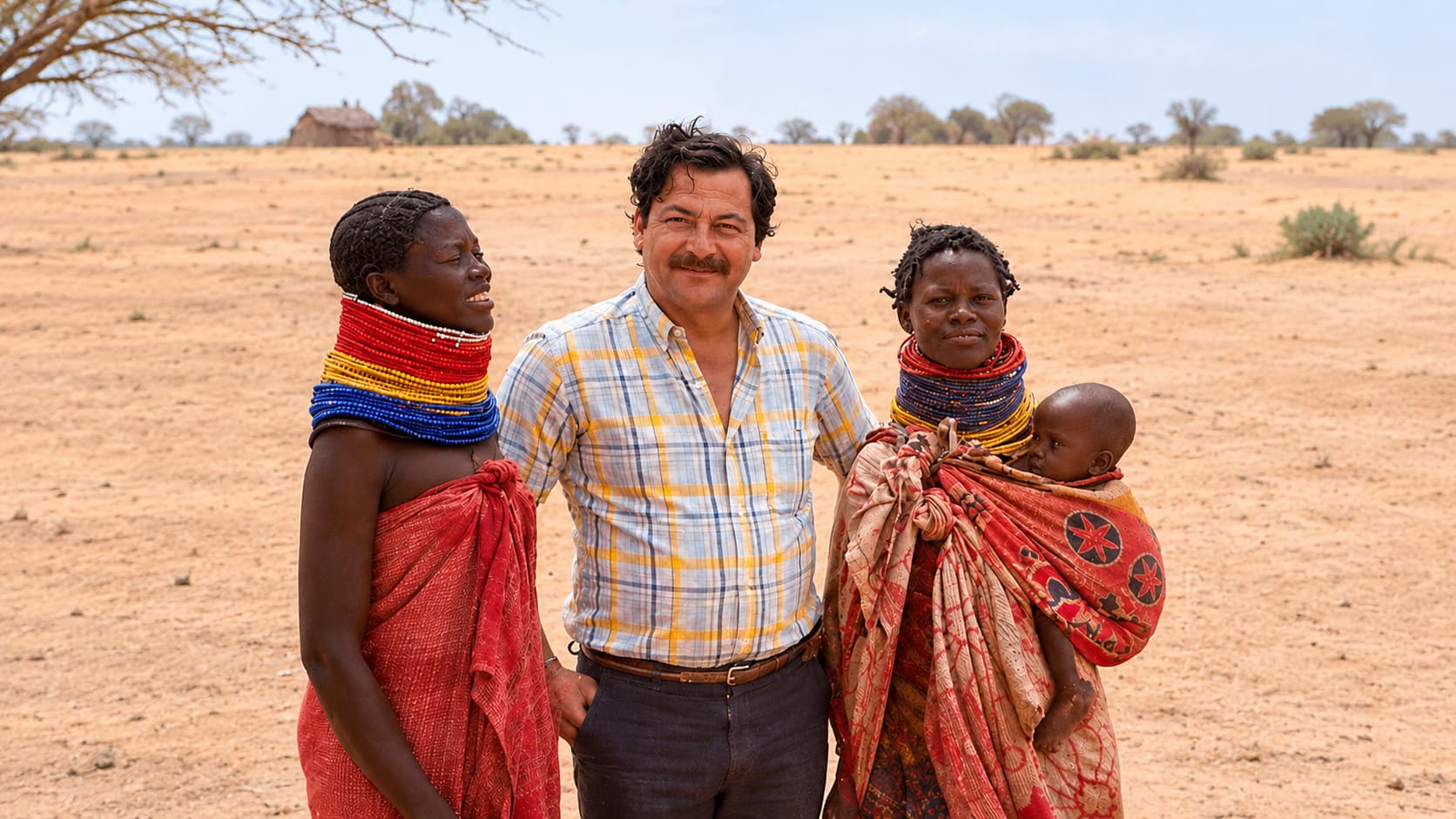
The Turkana made a particularly strong impression on me. I remember the colors of their beadwork, the ornaments, and the care with which clothing and adornment expressed belonging. In one photograph, I stand beside two Turkana women; one carries a child close to her body. The photograph is modest, but it has endured. It brings back not an exotic scene, but a meeting between people in a difficult place.
The scale of the emergency became clear in encounters that needed no briefing. The appearance of a European could draw a crowd. Women, children, and older people came forward, many pressing their hands against their stomachs. It was a gesture at once simple and devastating. Need, anxiety, and hope were all there, without the distance that official language can create.
One phrase stayed with me: “K-a-nyam-it ayong a-koro.” It was translated for me as: “Hunger is eating me.”
The words were brief, but they seemed to describe hunger from the inside. They did not speak of a shortage recorded in a report, or of a figure in a table. They described a physical presence, something that had entered the body and was consuming it. The hands on the stomach completed the sentence. I have carried it with me ever since.
That moment changed the way I understood humanitarian work. Food and water are essential, of course, but assistance is not merely a matter of moving supplies from one place to another. It begins with attention—with seeing the people behind the emergency, and understanding that a crisis threatens not only lives but also family ties, traditions, and the ordinary plans by which people make a future.
Northern Kenya is a meeting ground. Its borders touch Ethiopia, Somalia, and what is now South Sudan. Long before those lines were drawn on maps, people moved through the region along routes of trade, kinship, and pasture. For pastoral communities, movement in search of water and grazing is not a sign of disorder. It is part of the knowledge on which survival depends.
But when water and pasture become scarce, movement can bring communities into competition. Weapons, smuggling, and armed groups add another layer of uncertainty. During my mission in 1982, the concern along the Somali border was associated with the people known as the “shifta. Kenyan authorities used the term for armed groups and individuals involved in insurgency, cross-border incursions, and banditry. The dispute had roots in the claims of some Somali communities in northern Kenya to join the independent Somali state, within the broader idea of a Greater Somalia.
That was the security context I encountered. It belongs to a different period from the later threat of al-Shabaab, which did not yet exist as an organization in 1982. The distinction matters. Places change, and the names given to their dangers change with them; a traveler’s account should not make one era borrow the anxieties of another.
Still, security was only one part of the story. The north was not defined by drought or conflict. Its richness lay in its peoples, their languages, their customs, and their ability to adapt to a demanding environment. The more time I spent there, the less useful any single description of Africa seemed.
More than two decades later, in 2005, I returned to Africa on a United Nations mission in Ethiopia. The work was different. Instead of responding directly to an emergency, I was involved in training national personnel to implement humanitarian and sustainable-development projects.
The contrast with Kenya was instructive. In 1982, the question had been how to respond to immediate need. In Ethiopia, the emphasis was on strengthening local skills and institutions so that people in the country could design, carry out, and monitor projects over time. Relief can ease suffering; lasting development also depends on knowledge, participation, and the ability of local institutions to continue the work.
It was in Ethiopia that another name became part of my African memories: Lucy. In 1974, at Hadar in the Afar region, an international team led by the paleoanthropologist Donald Johanson discovered the fossil remains of Australopithecus afarensis, dated to about 3.2 million years ago. Lucy was found in Ethiopia, not Kenya. Her story gave the landscape another dimension: beneath the immediate concerns of travel and work lay a much older human history.
In Amharic, Dinqinesh means approximately “you are wonderful.” The name seemed fitting. Lucy was more than a scientific discovery to me. She became a reminder of shared beginnings, a way of thinking about human ancestry that made national borders feel very recent indeed.
When I look back, the journey through northern Kenya and the later work in Ethiopia seem to belong to the same story. In Kenya, a woman’s words—“Hunger is eating me”—brought the vulnerability of human life into sharp focus. In Ethiopia, Lucy offered a perspective measured not in years or decades but in millions of years. One memory speaks of our immediate obligations to one another; the other of the ancestry we share.
I remember the roads to Marsabit, Moyale, and Lodwar. I remember the Turkana women and the child held close. I remember the people who came forward with their hands on their stomachs. These images have lasted longer than many of the practical details of the mission. They remind me that a place is never only its landscape, and that a journey is never only the distance between two points.
Africa did not remain behind when I returned home. It stayed in the stories I had heard, in the cultures I had tried to understand, and in the responsibilities that those encounters had awakened. Some journeys end at the airport. Others continue quietly, altering the way we look at the world. The road north in Kenya was one of those journeys.
Palmarí H. de Lucena