
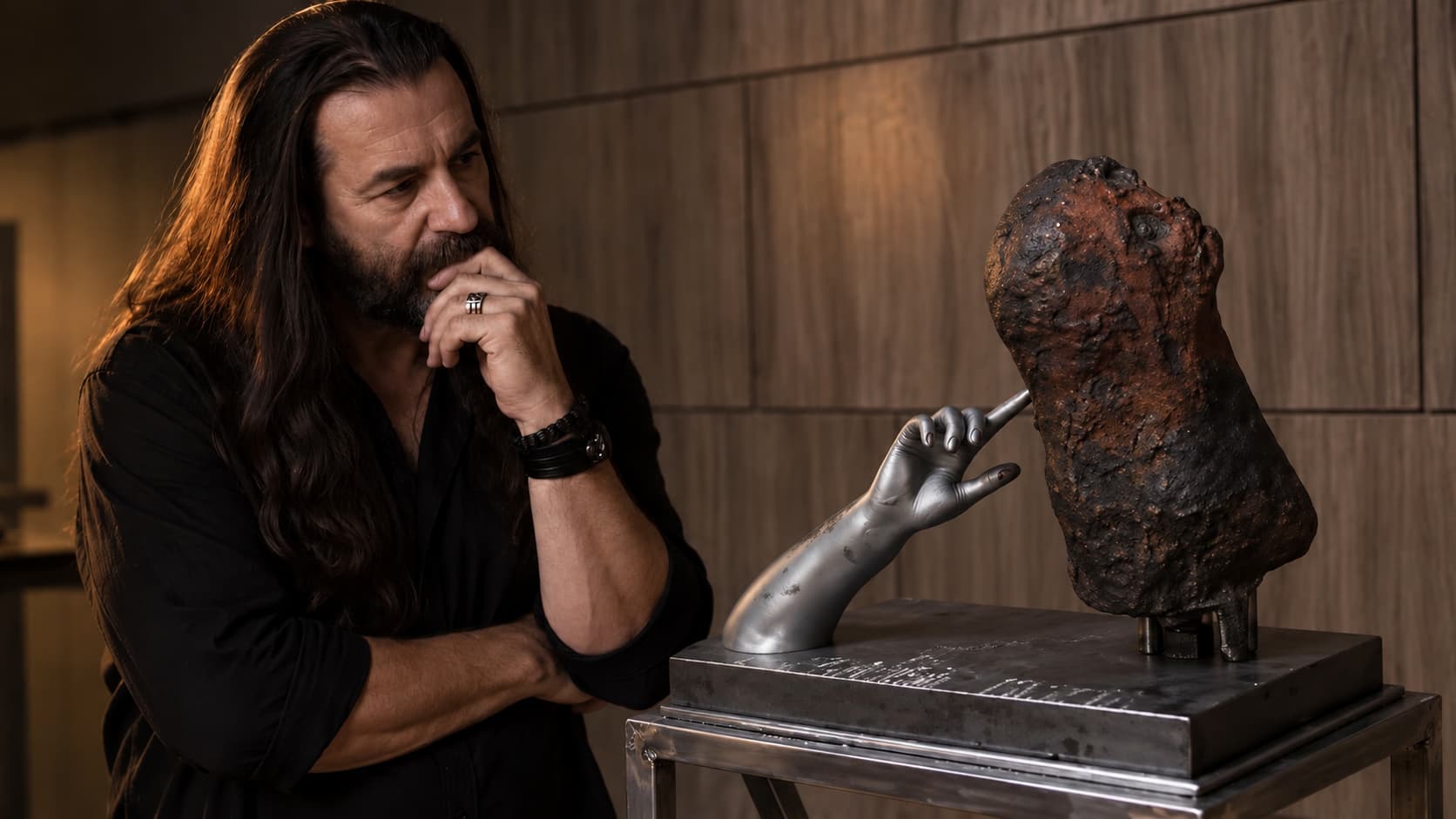
In November 2014, in the Brazilian state of Paraíba, two brothers searching for gold made an unexpected discovery. Edsom Oliveira da Silva and João Jarba Oliveira da Silva were using a metal detector when they came upon a heavy piece of metal in the ground. What they had hoped might be gold turned out to be something far older and stranger: a meteorite.
The object was later examined by researchers from the University of Campinas, the University of São Paulo, and the University of Alberta. It was identified as an iron meteorite of the IIAB group, weighing approximately 26.93 kilograms. Before it acquired any artistic meaning, it had already passed through several forms of knowledge: first as an unidentified object in the sertão, then as a scientific specimen, and eventually as something that would enter the history of Brazilian art.
The transformation began when the sculptor Marcos Pinto de Morais decided to work directly on the meteorite itself. This distinction matters. The sculpture is not a representation of a meteorite, nor was another stone shaped to resemble one. The meteorite is the material. The face was carved from the actual object discovered in Paraíba.
Under the artist’s intervention, the dark, irregular surface began to suggest a human presence. A face seems to emerge from the stone rather than simply being placed upon it, creating the uncanny impression that something was already waiting within the material to be brought into view. The gesture is less about replacing the original object than revealing another possibility within it.
The work belongs to a broader history of Brazilian artists engaging with the material and symbolic presence of celestial objects. Bruno Giorgi’s Meteoro, installed at the Itamaraty Palace in Brasília in 1967–68, evokes the form of a meteorite but was carved from Carrara marble. Bené Fonteles’s Mito da Criação do Mundo, exhibited at the Museum of Art of São Paulo (MASP) in 1990, incorporated a real meteorite found in Paraíba into an artwork concerned with creation, origins, and Indigenous references. In both cases, the meteorite enters the field of art through transformation or incorporation. Marcos Pinto de Morais takes a different path: he carves into the meteorite itself.
There is a quiet irony at the beginning of the Nova Olinda’s story. The brothers who found it were looking for gold. They were searching the ground for something valuable, something that belonged beneath their feet.
Instead, they found something that had come from above.
They were looking for treasure in the earth and found a fragment of the sky.
The reversal is almost too neat for fiction. What they expected to find belonged to the earth. What they actually found had arrived from somewhere beyond it.
From that moment on, the meteorite acquired successive identities without losing its previous ones. It was a discovery, then a scientific object, then a material for sculpture. Each stage added another layer to its history. The stone did not cease to be a meteorite when it became art, just as art did not erase the geological and scientific history embedded in the material.
There is something quietly astonishing in that accumulation. A piece of material found beneath the soil of the sertão could become, without ceasing to be itself, an object of scientific study and then the surface of a human face. The transformation does not diminish the mystery of the original stone. It makes that mystery visible in another form.
The face is familiar. The material is not.
That tension gives the sculpture much of its force. A human face is among the most recognizable forms in the world, yet here it appears on a surface whose history reaches beyond the human scale. The features invite recognition, while the stone resists being fully explained by it. What appears to be a portrait remains, at the same time, a fragment of a much older story.
The wonder lies partly in that coexistence. Nothing in the meteorite’s previous history disappears. The discovery in Paraíba remains there. The scientific identification remains there. The weight, the iron, the classification, the journey from the ground into the laboratory—all remain present beneath the carved surface. Art adds another layer without closing the story.
In this sense, the sculpture does not simply give the meteorite a human face. It gives human perception a new way of encountering the stone.
The Nova Olinda meteorite began its documented journey in the sertão of Paraíba, where two men searching for gold found it beneath the ground. Science identified what they had encountered. Art transformed the way it could be seen.
And so the story arrives at an image both simple and extraordinary: from the surface of a stone whose history began long before ours, a human face looks back at us.
The stone remains what it was.
But it now carries a face.
Palmarí H. de Lucena