
It was night in Iceland.
The cold came softly, sharp but pure —
no snow, no frost, only the breath of the wind
drawing circles upon the window of the small vehicle.
We were a group of travelers, wrapped in silence,
each holding in the heart the same expectation:
the hope of seeing the invisible,
of touching what exists only on the border
between dream and reality.
Reykjavík slept behind us.
The city lights faded one by one,
like embers extinguished by the horizon.
Our guide spoke softly —
his voice carried the rhythm of the old sagas,
as if he recited a secret
handed down from fire and ice.
We knew the Aurora was a daughter
of the Sun and of the Earth,
but there, in the solitude of the plains,
science seemed to fall silent —
and mystery took the wheel.
Our first stop was in an open field,
where the wind made the air hum,
as though tuning an invisible instrument.
We waited.
The sky seemed to breathe,
holding something that had yet to reveal itself.
Nothing happened.
We moved on.
The road stretched into darkness,
and time, our accomplice, unfolded like a veil.
Then the guide raised his arm —
and we all looked up.
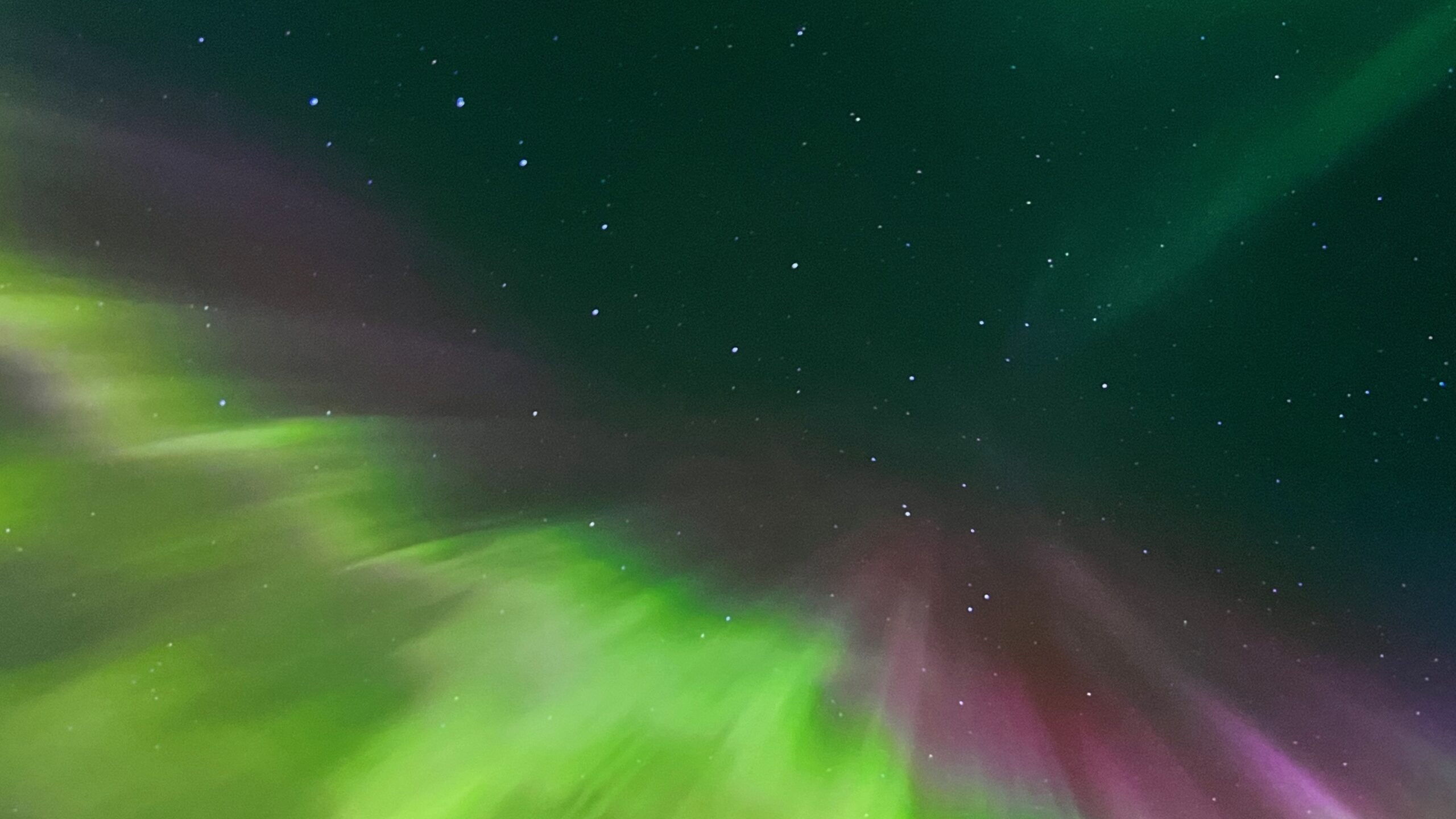
High above, a timid green trace
cut across the firmament.
Then came red flickers,
like small promises.
And the night began to sing.
Colors moved like silk veils blown by gods,
interlacing in slow dances,
hiding, bursting, vanishing.
The cold no longer mattered.
The silence changed its texture —
it was reverence, not absence.
The world seemed to breathe with us,
as if there were between heaven and humankind
an ancient pact renewed in light.
I do not know how long it lasted.
Perhaps an hour. Perhaps a millennium.
When the final trace dissolved,
only a gentle feeling remained —
a warmth not born of the body,
but of something kindled within,
as though the Aurora Borealis, in passing,
had left within each of us
a fragment of their luminous soul.
by Palmarí H. de Lucena