
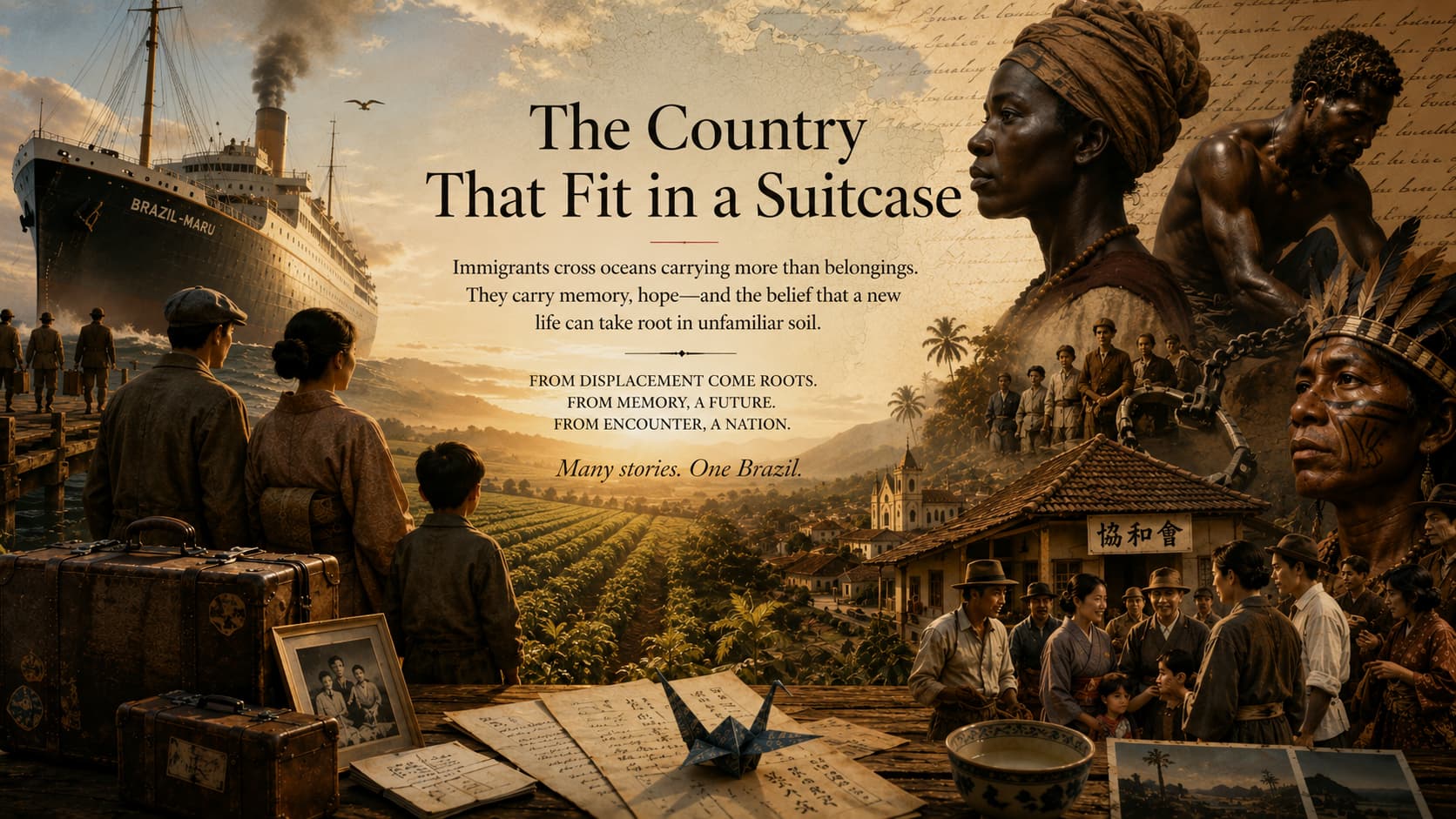
When the first Japanese immigrants arrived in Brazil, they brought far less than they imagined they would need. A few clothes. Family photographs carefully folded between sheets of paper. Letters from relatives they might never see again. Yet they carried something that could not be packed into a suitcase or declared at customs: the hope that life could be remade in an unfamiliar land.
Migration is often told through numbers. How many arrived. How many stayed. How many acres they cultivated. How many descendants remain today. Statistics reveal the scale of movement, but they rarely capture its emotional gravity. They tell us how people crossed oceans, but not what happened after they arrived. They do not explain what it means to wake up one morning and realize that belonging is no longer something inherited but something that must be built.
This is the question that runs quietly through Karen Tei Yamashita’s Brazil-Maru. Her characters arrive in the interior of São Paulo carrying a collective dream. They hope not only to establish an agricultural settlement but to preserve a moral and cultural extension of Japan itself. Like immigrants throughout history, they imagine that distance need not require rupture, that one can leave a homeland without leaving behind the values that define it.
Reality, however, has a way of revising human plans.
The Brazilian landscape alters everything. The climate feels different. The language sounds unfamiliar. Customs that once seemed permanent begin to soften under the pressure of everyday life. Children grow up between worlds. Parents try to preserve traditions. Their sons and daughters reinterpret them. What begins as preservation gradually becomes transformation.
Perhaps this is the deepest truth of migration: people do not simply move from one place to another. They enter a new condition of existence. They become inhabitants of an in-between space, suspended between memory and possibility. The homeland remains present but increasingly distant. The new country offers opportunity but not always acceptance. Belonging becomes a negotiation rather than a certainty.
In Brazil-Maru, memory functions as a form of survival. The characters hold on to language, ritual, and shared history because memory provides continuity when everything else feels uncertain. Yet memory has limits. The second generation learns that identity cannot be preserved unchanged. Children born between cultures inherit not one story but several.
Migration rarely produces replicas of the societies people leave behind. Instead, it creates unexpected syntheses. The Japan that survives in Brazil is not identical to the Japan left across the Pacific. It becomes something distinct: reconstructed through memory, reshaped by local realities, and transformed through encounter.
Yet any discussion of migration and belonging in Brazil remains incomplete if it begins only with those who chose to come. Long before ships carried Japanese, Italian, Syrian, or Lebanese immigrants to Brazilian shores, other ships crossed the Atlantic carrying millions of Africans in chains. Their journey was not an act of hope but an act of coercion.
The same is true of Brazil’s Indigenous peoples, whose histories predate both immigration and slavery. They were the first inhabitants of these lands and the first to confront displacement, dispossession, and the struggle to preserve identity in the face of overwhelming change.
Seen within this larger framework, the experience portrayed in Brazil-Maru acquires a deeper resonance. The novel is not simply about Japanese immigrants in Brazil. It is about a universal human dilemma: how to build roots without erasing origins, how to participate in a new society without abandoning memory, how to belong without forgetting where one came from.
Perhaps every migration story is ultimately a story of reinvention. Individuals reshape the places they enter even as those places reshape them. Nations, too, are transformed by these encounters.
The answer may not be found on a map.
Over time, many discover that home becomes less a fixed location than a network of relationships, memories, and commitments. Home ceases to be solely a place. It becomes an experience.
It is a story that began with suitcases too small to carry everything that mattered—and one that continues to unfold wherever people transform distance into identity, memory into future, and arrival into belonging.
Palmarí H. de Lucena