
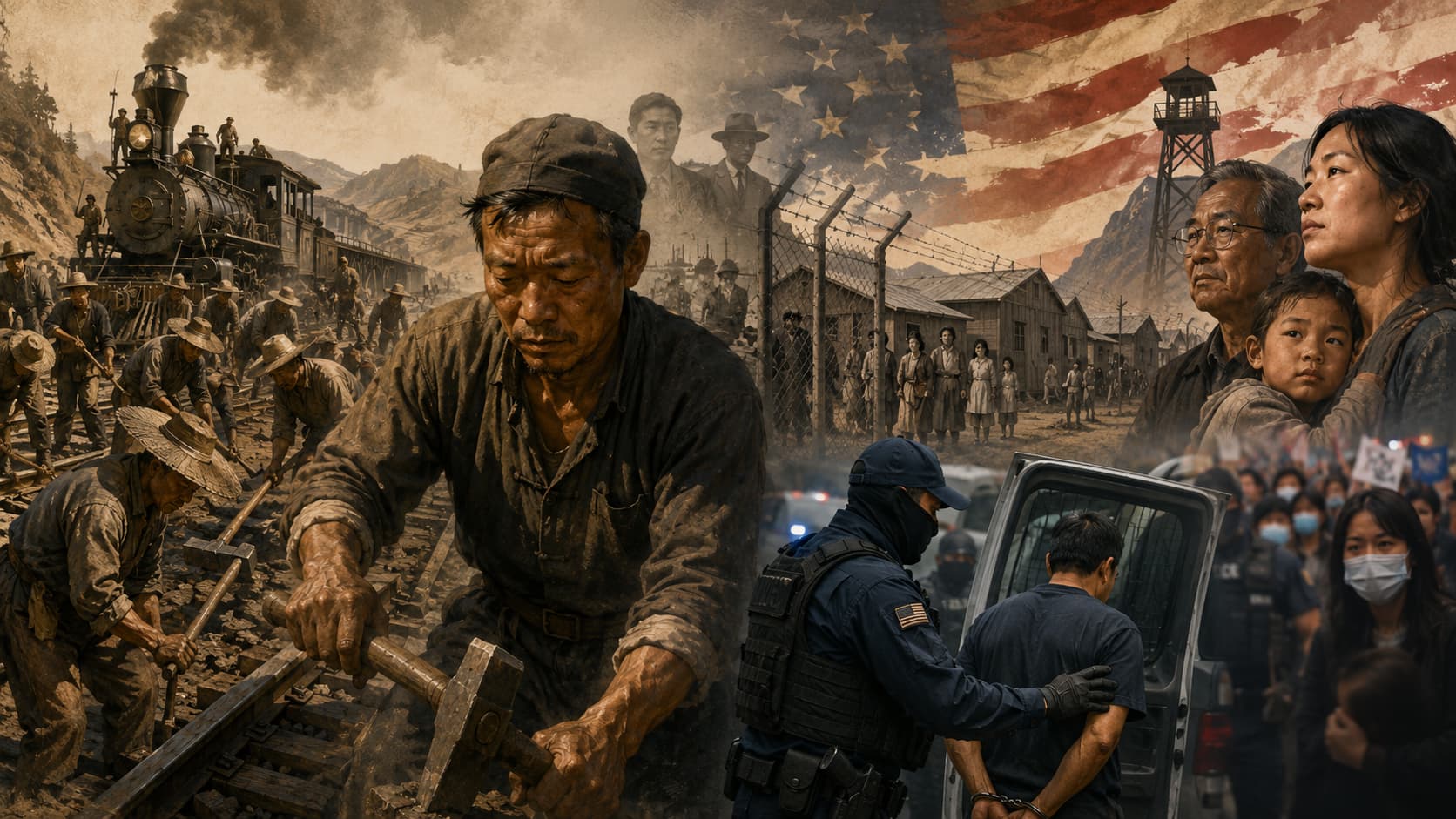
During his recent visit to China, Donald Trump acknowledged the contribution of Chinese laborers to the construction of America’s railroads, praising their role in the country’s economic rise. Yet what was framed as a gesture of historical recognition also revived a familiar criticism: that American memory often celebrates the achievements built by immigrant labor while overlooking the suffering, exploitation, and racism that accompanied it.
Chinese workers — derisively labeled “coolies” in the nineteenth century — played a central role in building the Transcontinental Railroad under brutal conditions. They were assigned the most dangerous tasks, paid less than white laborers, and subjected to punishing work schedules, racial violence, and social segregation. Many historians have described the system as a form of indentured servitude bordering on semi-slavery.
But anti-Asian discrimination in the United States neither began nor ended with the railroads. It was shaped in large part by the ideology of the “Yellow Peril,” a racist narrative that emerged in the late nineteenth century portraying Asians as an economic, cultural, and even biological threat to the West. The theory warned that Chinese and Japanese workers would “steal jobs,” depress wages, and undermine the American national identity.
The “Yellow Peril” became the intellectual justification for exclusionary immigration policies and racial discrimination. Its clearest expression was the Chinese Exclusion Act, the first U.S. law to explicitly bar immigration on the basis of ethnicity. In the decades that followed, Japanese, Korean, and other Asian communities were likewise subjected to institutional discrimination, immigration restrictions, and widespread social hostility.
During the Second World War, anti-Asian prejudice reached another level with the forced internment of Japanese Americans after the attack on Pearl Harbor. Even American citizens were treated as potential enemies solely because of their ancestry, revealing how deeply racial suspicion had been embedded within American society.
In the years that followed, despite advances in civil rights, stereotypes endured. Asian Americans increasingly came to be framed through the myth of the “model minority” — an image that ostensibly praised discipline and economic success while simultaneously obscuring inequality and minimizing the realities of structural racism.
More recently, especially during the COVID-19 pandemic, political rhetoric linking the virus to China contributed to a rise in anti-Asian hostility across Western countries, including the United States. Reports of verbal harassment, physical attacks, and discrimination surged alongside a broader climate of geopolitical tension.
At the same time, increasingly aggressive immigration enforcement measures and expanded operations by the U.S. Immigration and Customs Enforcement agency have disproportionately affected Asian immigrant communities. Recent data indicate a significant rise in the detention of Asian immigrants, including Chinese nationals, during immigration raids and enforcement operations. Community organizations report that many detainees had no serious criminal record, raising concerns about the widening scope of surveillance and deportation policies.
Federal investigations involving allegations of espionage, foreign influence, and clandestine Chinese operations on American soil have further intensified public suspicion toward Chinese and Chinese American communities. Critics argue that while national security concerns may be legitimate, such actions risk reviving the old logic of the “Yellow Peril” by casting people of Chinese descent as inherently suspect or politically disloyal. Civil-rights organizations have also condemned abuses in immigration detention centers and what they describe as increasingly excessive enforcement tactics by ICE in recent years.
To recognize only the economic contributions of Chinese laborers while ignoring the long history of discrimination, exploitation, and violence they endured is to offer an incomplete account of the American story. The history of Asians in the United States is not simply one of labor and progress. It is also a history of exclusion, resistance, and an enduring struggle for recognition, dignity, and equality.