
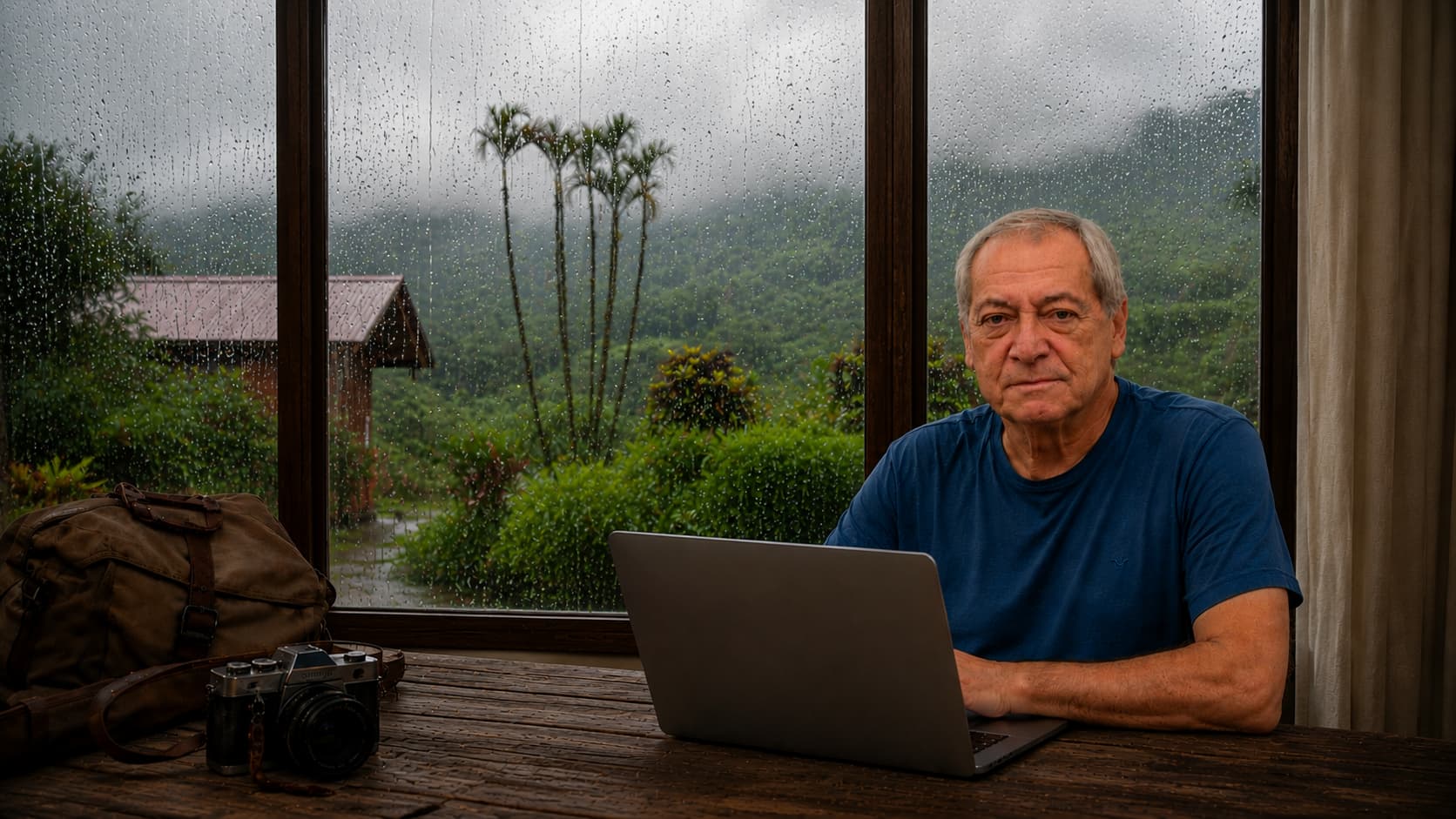
Why do I write so much? The question arrives in many forms. Sometimes it comes wrapped in curiosity; other times with the disguised gentleness of those who watch a man already advanced in age still insisting on gathering words the way one gathers seashells after the tide has gone out. “You still write?” some friends ask. “Where does it all come from?” occasional readers wonder. And I myself, on silent nights, before the open page that resembles a window turned inward, repeat the same question: why?
I have never found a definitive answer. Perhaps because writing is not exactly a rational choice, but a quiet necessity, something akin to the instinct to breathe deeply after a long journey. Those who do not read tend to ask the question. Those who read simply continue the journey beside me, without demanding explanations. They understand that certain words are not meant to persuade; they exist to accompany.
Approaching the age of eighty-five transforms any man into a territory of memory. Time ceases to be a calendar and becomes landscape. Within me I carry vanished cities, faces the world has forgotten, voices of ordinary people who never wrote books but nevertheless helped write life itself. I lived intensely. I crossed decades in which the world seemed to move forward and others in which, disturbingly, it appeared to move backward. I watched technology bring continents closer while distancing people seated at the same table. I saw hopes born in the streets and die inside offices. I witnessed ideologies changing their language without necessarily changing their soul.
Perhaps I write because I was a witness.
For most of my life, I lived inside a Babel. Not only of languages—though there were many—but of customs, beliefs, silences, and ways of understanding the world. I lived among harsh and gentle tongues, words that sounded like music and others that collided like stones against one another. Early on, I learned that human beings may change their clothes, food, prayers, and language, yet deep inside they continue to carry the same fears, desires, and hopes.
Perhaps that is why I never saw difference as a threat. To me, the unfamiliar was always an invitation.
There were periods when I arrived in cities where I could not understand a single word spoken around me. Yet I understood the gestures. The bread offered at the table. The discreet smile of someone welcoming a foreigner. The respectful silence in the presence of pain. I discovered that humanity possesses a subterranean language, older than dictionaries and deeper than borders.
Travel, then, ceased to be merely geographical displacement. It became a spiritual exercise.
Every city taught me a different way of existing. In some places I learned speed; in others, contemplation. Certain peoples taught me discipline; others taught me joy. I met men living in extreme poverty who nevertheless shared what little they had with an almost sacred dignity. I also encountered forms of abundance surrounded by emptiness, loneliness, and fear.
As the decades passed, I began to realize that true wisdom may lie less in judging the world than in welcoming it.
Living among so many cultures dissolved within me the arrogance of absolute certainty. What was considered normal in one place became strange in another. What one people forbade, another celebrated. What some called civilization, others regarded as the loss of the soul. So I learned to listen before concluding, to observe before defining.
It made me lighter.
There is a particular joy in realizing that the world is far too vast to fit inside a single vision. Every encounter expanded my inner horizon. Every language I heard opened another window into life itself. I did not need to master every language in order to understand people; it was enough to walk among them with humility.
Today, looking back, I feel gratitude for having lived among differences. They prevented me from hardening. They kept my curiosity alive. They made me less an owner of truth and more an apprentice of the world.
Perhaps that is why I write.
I write to celebrate this extraordinary human crossing. To record that life, despite its inevitable losses, remains a luminous adventure. I write because I am still capable of astonishment. Because human diversity still moves me deeply. Because I continue to believe that generosity is one of the highest forms of intelligence.
Age has brought me wrinkles, but it has also brought tenderness to my gaze.
Today I understand that living was never about accumulating countries, experiences, or stories to tell. Living meant allowing each landscape to alter me slightly. It meant accepting that we are shaped not only by what we carry within ourselves, but also by what others leave in our souls along the way.
Inside me I carry airports, deserts, harbors, ancient streets, noisy markets, silent temples, and countless human faces. Some disappeared with time. Others remain alive in my memory with an almost painful clarity. Every one of them, without exception, helped shape the man now writing these lines.
And perhaps writing is nothing more than this: one final form of hospitality.
A way of opening the door of memory to strangers. Of offering temporary shelter to those who also cross the world carrying unanswered questions. At eighty-five, I no longer write to prove anything. I write to share the astonishment of having lived. To give thanks for the roads traveled, the people encountered, and the differences that taught me how to enlarge the heart.
In the end, after crossing so many borders, hearing so many languages, and inhabiting so many worlds, I arrived at a simple conclusion: a man’s true homeland may not be a country at all, but the ability to remain human before the immensity and diversity of life.
by Palmarí H. de Lucena