
There are places where nature does not need to raise its voice to be heard. Wagner’s Cover, tucked away among the mountains of Pennsylvania’s Pocono region, is one of them. It seems to have been set aside for those who understand the rare privilege of doing nothing—or perhaps of doing something as old and elemental as fishing.
It is early morning. The day has not quite awakened. A delicate mist rests over the lake, like a silk veil the night forgot to gather. The mountains emerge only partially through the haze, while hemlocks and pines stand along the shoreline like sentinels guarding a quiet kingdom. The lake is a mirror, reflecting the sky, the trees, and the mountains with such fidelity that, for a moment, it is difficult to tell the landscape from its own reflection.
A beaver crosses the water with the ease of someone entirely familiar with the place. He swims without hurry, as though he owns the mirror and the rest of us are merely visitors. His passage leaves two narrow lines on the surface, an aquatic signature that disappears almost as soon as it is made. Perhaps he is the only one there who has figured out what life is all about.
The first sunlight begins to overcome the mist. A ray touches the water like the tip of a diamond, scattering fragments of light across the surface. It is a spectacle without an audience, without an admission fee, and without the slightest need for applause.
This is where my adventure begins.
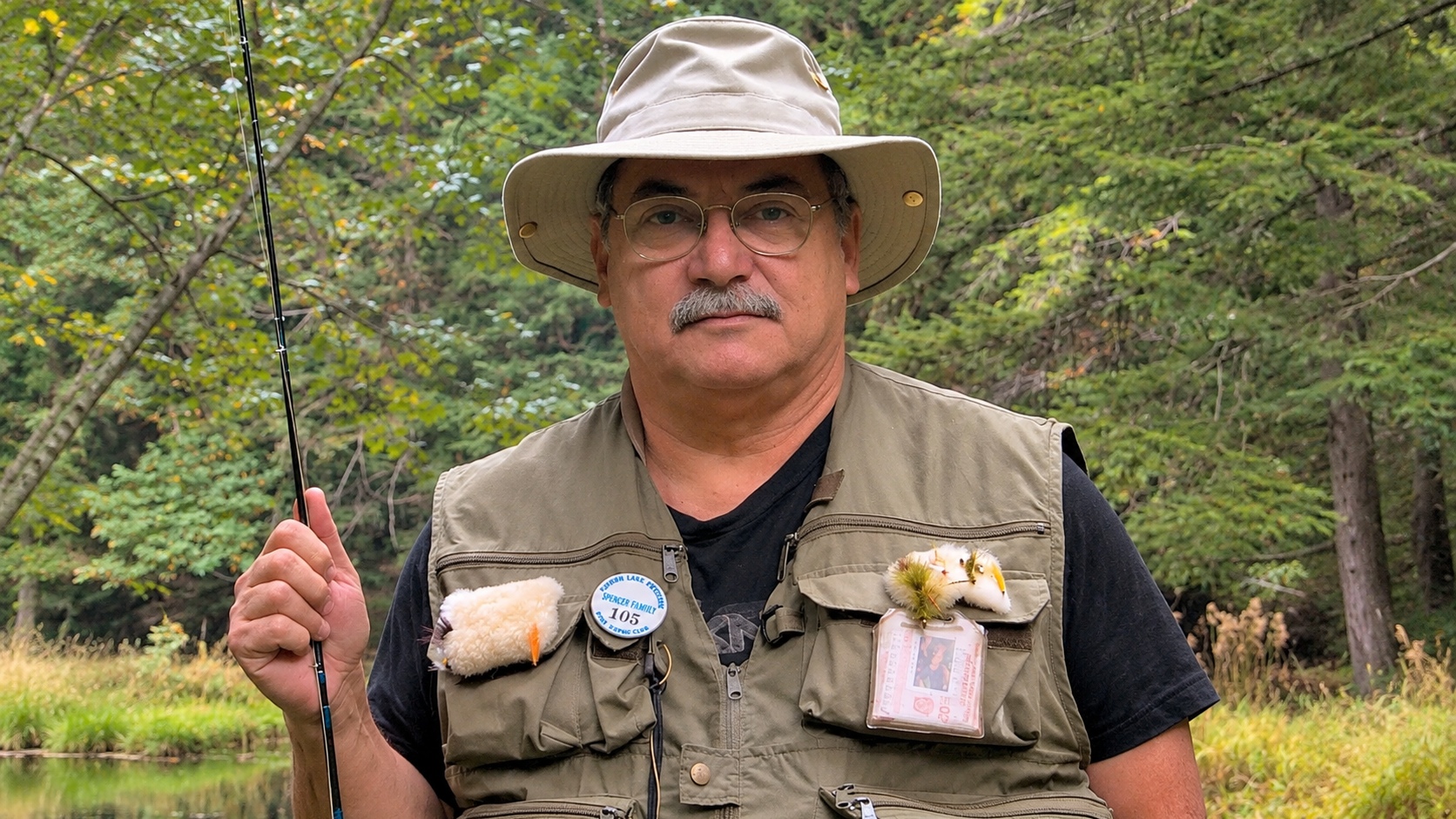
I put on my fishing vest, filled with artificial flies, reels, hooks, and an assortment of small accessories that might seem like the tools of some mysterious profession. I pull on my waders, adjust my equipment, and step into the water. The cold rises along my legs like an old acquaintance. The water reminds me that I am only a visitor here, and that visitors are expected to learn the rules of the house.
Trout fishing calls for observation, patience, delicacy, and humility. A trout does not offer itself out of courtesy. It is wary, elegant, and elusive. It knows the secrets of the current and recognizes anything out of place. One must learn to read the water, study its movements, identify the quiet pools, and imagine where the fish might be waiting.
The artificial fly, so small and seemingly insignificant, becomes the central character of the encounter. It is an imitation of life, a delicate illusion offered to nature. The line draws an elegant curve through the air, and the fly settles on the surface as lightly as a petal.
A game begins between two creatures from different worlds. It is not quite a contest, but rather a silent negotiation in which nature always has the final word.
As I wait, the world grows smaller. I hear the birds, the wind moving through the treetops, and the gentle murmur of the water. A leaf breaks free from a branch and begins its journey across the lake. Everything happens quietly, without commotion, without hurry.
Slow down. Slow down. Slow down.
We live surrounded by urgency. Phones ring, messages arrive, appointments pile up. Time has become something we are constantly trying to catch, much like the fish I am hoping to find. Even here, in the green solitude of the Poconos, civilization insists on reminding us of its restlessness.
From somewhere in the distance comes the rumble of engines—perhaps cars on a nearby road, perhaps a race taking place beyond the mountains. The sound rises and fades, as though a competition of speed were unfolding in another universe.
The contrast is almost amusing. Somewhere out there, men and machines are competing for seconds, curves, and speed. Here, a beaver crosses the lake without knowing that automobile races exist, while I wait for a trout to take an interest in a tiny artificial fly.
Two worlds, separated by a few mountains and by entirely different ways of understanding time.
The noise gradually loses its strength among the trees and is eventually absorbed by the landscape. Not even the engines can quite destroy the calm of Wagner’s Cover.
Then, suddenly, a small movement on the surface.
The line trembles, as though someone had gently touched my fingertips. My heart, until then keeping pace with the unhurried morning, decides to accelerate on its own.
The trout has taken the fly.
The rod responds. The line tightens, and a dance begins, one that demands both skill and respect. The trout fights for its freedom; I try to guide its movements without breaking the delicate balance between us. It knows the water far better than I do, and it makes a point of demonstrating that fact.
For a few moments, we are two adversaries joined by the same experience.
When the fish finally comes close, its beauty surprises me. Its silvery body, tiny red spots, and golden markings seem to hold fragments of the lake’s own light. I hold it carefully, admire its vitality, and realize that this encounter is worth more than any photograph or trophy.
I return it to the water.
For a brief moment, it seems to regain its strength. Then it disappears among the submerged shadows. The water closes over it, and the mirror slowly returns to its former stillness.
Later, as I approach the little bridge, I hear something moving in the foliage along the shore. Leaves stir. Branches crack. For an instant, my imagination conjures the unmistakable presence of a bear among the bushes.
But there is no ferocity in what follows. At least, not in the scene my eyes—or perhaps my imagination—manage to capture. I catch sight of the animal gathering blueberries with a gentleness that seems almost contradictory to its size. It brings its nose close to the branches, selects the ripe berries, and picks them without hurry.
Time to enjoy the blueberries.
Whether the scene is entirely real or partly the work of my imagination hardly matters. It adds another lesson to the morning: even strength can be gentle; even the largest creature in the forest can pause to enjoy a small sweetness.
I find myself wondering whether this is, after all, the finest part of fishing: establishing a connection with another creature in nature and then allowing it to continue its existence without carrying any mark of our passing.
I did not simply catch a trout. For a few minutes, I shared a small chapter of the life of that lake.
Slow down. Slow down. Slow down.
Perhaps fishing is one of the few pursuits in which success does not depend entirely on the outcome. We may return home without a fish, but we rarely return without something else. We carry the smell of the damp forest, the memory of cold water, the delicate shape of the morning mist, the beaver crossing the lake, the rustling in the foliage, and the excitement of that brief encounter with a trout.
Nature asks nothing of us by way of explanation. It asks only that we respect its rhythms.
The trout teaches freedom; the beaver, a certain indifference to unnecessary concerns; the trees, permanence; the water, serenity. And the fisherman discovers that his greatest achievement may well be abandoning, for a few hours, the need to achieve anything at all.
Wagner’s Cover is not exactly a place to escape from the world. The world finds its way there, even if discreetly: in the distant rumble of engines, in the fishing equipment, in the boots sinking into the mud, and in the small worries we insist on bringing along.
The difference is that, in this particular corner of the Poconos, everything seems to lose a little of its importance.
The trout continues to swim, indifferent to our impatience. The beaver crosses the lake as though he had far more interesting things to attend to than our daily obligations. And the bear, if he was indeed among the bushes, has probably finished his blueberries and gone on his way.
None of them seems particularly concerned with making the most of the day, being productive, or getting somewhere.
Perhaps they have understood something that we, despite centuries of civilization, have yet to learn.
I gather the line, put away my equipment, and leave the water behind. The fishing is over, but I have the curious feeling that something else has begun.
I have brought home no trophy, conquered no territory, and discovered no extraordinary secret. I have simply spent a few hours watching life unfold without feeling the need to interfere.
On the drive back, the engines once again become part of the landscape. My appointments are waiting. My phone has undoubtedly accumulated messages. Life is ready to resume its familiar rhythm of urgency and obligation.
But I carry with me something difficult to explain: the memory of a morning when, for a few precious hours, I did not have to arrive before anyone else, win anything, or turn time into productivity.
Perhaps that is the true privilege of fishing.
Not the privilege of catching a fish, but of discovering that, while we wait for something to happen on the surface of the water, something much deeper is quietly happening within us.
Palmarí H. de Lucena