
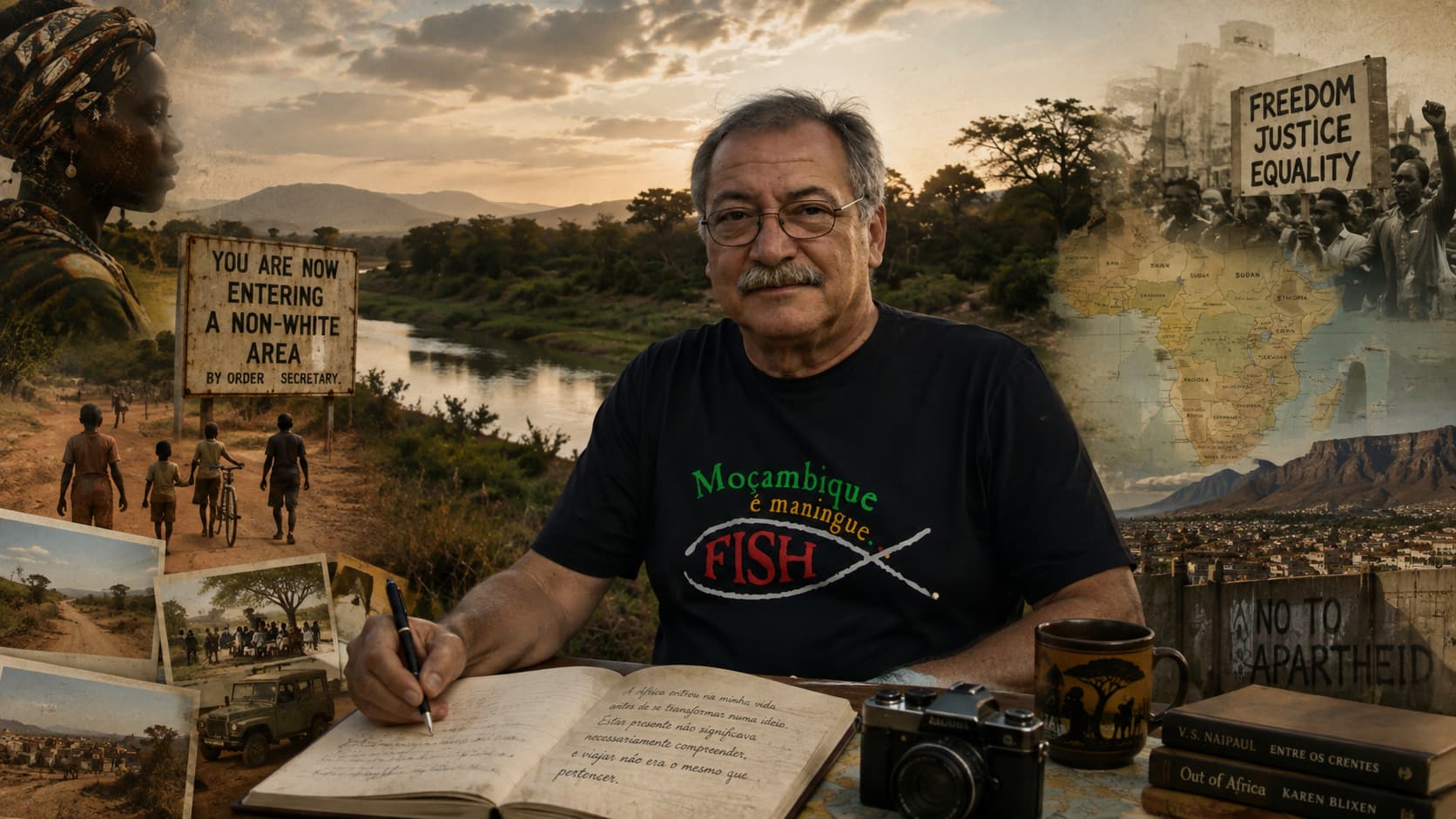
Africa entered my life before it became an idea.
Before the maps, the statistics, and the images intended for those who observe from a distance, there were roads, cities, conversations, waiting, and encounters. There were also silences which, at the time, I may not have known how to interpret.
As the years passed, many certainties lost their firmness.
Being present did not necessarily mean understanding, and traveling was not the same as belonging.
I never came to know Africa.
I came to know places, people, and circumstances.
I passed through certain countries at particular moments, moved through periods of history, and met people whose lives extended far beyond our brief crossing of paths. The continent was too vast, diverse, and historically complex to fit within the field of my own vision.
What has remained with me are fragments: lived experiences, conversations, landscapes, events, and people.
I lived through periods of drought, hunger, war, and political instability. I found myself in contexts marked by coups d’état and encountered situations in which politics ceased to be a distant discussion and entered abruptly into everyday life.
I was close to the conflicts between the Kokombas and the Nanumbas in Ghana. In the border regions between Sudan and Kenya, I encountered circumstances of insecurity in which survival, local disputes, institutional fragility, and violence intersected in ways that were difficult to reduce to a single explanation.
I was close to events that marked me deeply and, at the same time, experienced them differently from those for whom there was no simple possibility of leaving.
I could continue my journey.
Others remained.
For me, certain events became part of memory; for those who lived there, they were part of a history that would continue after my departure.
That difference has never ceased to be present.
There were stories of kidnappings, cattle theft, and losses that did not always find a place in official accounts. There were also the marks left by wars. Some were visible in landscapes and buildings; others appeared in absences, in family relationships, in interrupted conversations, and in silences.
A war may formally end before it has ended in the lives of those who lived through it.
I knew Rhodesia during a period of profound transformation and followed some of the processes that would lead to the independence of Zimbabwe. Later, I witnessed at close hand the struggle against apartheid in South Africa.
Apartheid was not an abstraction.
It existed in the laws, the institutions, the organization of space, work, and in the unequal possibilities distributed among people.
Resistance, too, was concrete.
It did not belong to history books while it was happening.
It was present in people, organizations, families, and movements that refused to accept injustice as a natural condition.
I witnessed a struggle that was not mine and that nevertheless became part of my own history.
I could admire the courage of those who confronted that system without bearing, in the same way, all the consequences of that struggle.
After all this, I might have been left only with memories of violence and catastrophe.
But what returns most often are images of people living their lives.
They worked, raised children, discussed politics, cared for their families, created businesses, made plans, laughed, and became angry.
Everyday life had its own density.
Often, what seemed extraordinary to me was simply someone else’s life.
That difference changed the way I remember what I experienced.
It was easy to arrive impressed by crises and forget that no one lives permanently inside a crisis.
It was equally easy, in the presence of the beauty of a landscape or the intensity of an encounter, to transform what I felt into a quality of the place itself.
A landscape does not exist to confirm the emotion of the person who contemplates it, and a person does not exist to complete the narrative of someone passing through.
It was in that space between proximity and distance that I began to understand patience.
Not as a characteristic of a people or a continent, but as something I encountered in particular people, under particular circumstances.
There was waiting, but there was also action; prudence, but also courage; memory, but also a desire for change.
But what appeared to be patience to my eyes might, for another person, have been weariness, necessity, strategy, or simply the absence of an alternative.
When I think of V. S. Naipaul and Karen Blixen, I encounter other ways of looking at parts of the continent.
Naipaul often directs his attention toward fractures, crises, and difficult historical consequences. His gaze can be severe and critical.
Karen Blixen, in Out of Africa, approaches Kenya through memory, landscape, and personal fascination, in prose whose beauty cannot be separated from the colonial context in which she lived.
My own perspective also occupies a particular position.
There are things I understood and others I only believed I understood.
I passed through certain places without knowing all their histories.
I met people whose lives I knew only for a brief interval.
The passage of years has also altered some memories.
The past does not return intact; it returns through the person we have become.
I distrust images that are too complete.
I distrust an Africa reduced to war, hunger, and poverty, as though crises were its fundamental identity.
But I also distrust an Africa transformed into a timeless landscape, a reserve of authenticity, or a source of spiritual lessons for those who come from elsewhere.
One image can diminish by what it removes; another, by what it invents.
The places I knew were made of conflict and routine, difficulties and ambitions, losses and celebrations.
There were inequalities and injustices, but also humor, work, affection, competition, creativity, and political debate.
The more time passed, the less useful the search for a single explanation became.
I carried my own ambiguities.
I wanted to come closer and knew there was a distance that would not disappear through goodwill alone.
I wanted to understand, but I brought with me my own history, education, and habits of interpretation.
I wanted to avoid the simplifying gaze of the outsider and yet continued to be someone who, in many of those places, stood outside.
I knew suffering without concluding that it defined a society.
I knew violence without believing that it could explain a culture.
I knew fear, but also courage, generosity, intelligence, and humor.
Not every pain teaches.
Not every act of survival is heroic.
Not every beginning again is a victory.
Sometimes people simply continue because continuing is all that remains for them to do.
For a long time, I searched in what I witnessed for signs of hope.
Later, I realized that I, too, needed to find those signs.
Hope may exist, but it should not be demanded of people in order to make their suffering easier to bear in the eyes of those who observe it.
Still, I encountered moments when life began to organize itself again after great hardship.
After drought, the land could receive rain again.
After war, the imperfect work of reconstruction began.
After systems of injustice, possibilities opened that had once seemed impossible.
None of this erased the losses.
Nothing guaranteed a better future.
But it showed that the present was not necessarily definitive.
The Africa that remains in me is not a homogeneous abstraction.
It is cities and roads, conversations and silences, moments of fear and moments of joy.
It is people I knew only in passing and others whose presence remained with me for decades.
It is events I understood only partially and questions that remained open.
The more I think about that past, the less interested I am in reaching a definitive conclusion.
What I experienced left me with memories, doubts, and a clearer awareness of the limits of any individual gaze.
I passed through places that became part of my own history, even though I knew they would never be mine.
What remains is a personal and inevitably incomplete memory.
A memory of proximity and distance, fascination and discomfort, understanding and ignorance.
The people I knew do not appear in it as symbols of an imagined Africa, but as whole people, with lives that exceed everything I could write about them.
It is this memory—imperfect and still unsettled—that remains in me.
Palmarí H. de Lucena, September 1, 2026