
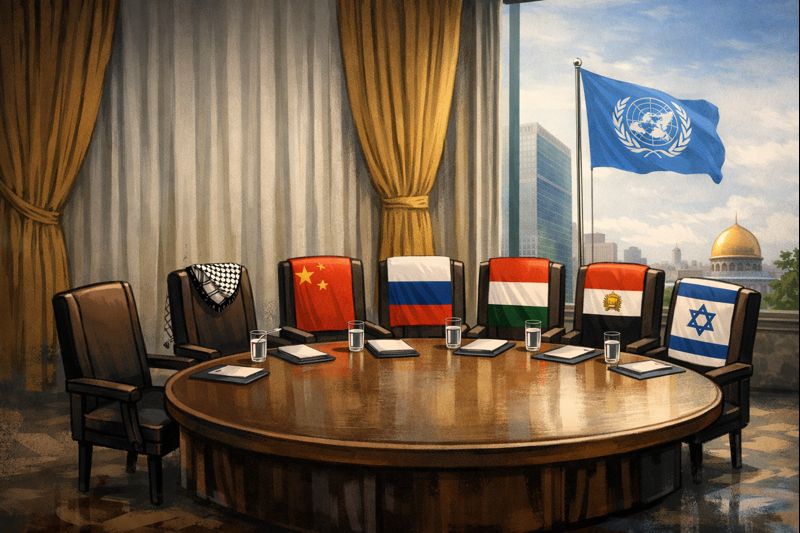
Diplomacy is often defined less by its declared objectives than by its institutional design and patterns of participation. The Board of Peace, introduced by former President Donald Trump as an alternative framework for addressing the Gaza conflict, offers a revealing example. Conceived not as a traditional multilateral forum but as a centralized decision-making body, the initiative concentrates agenda coordination and symbolic leadership in a single chair. The composition of the board—who was invited, who chose to participate, who declined, and who was absent—offers insight into the broader model of international engagement the forum represents.
A defining feature of the Board of Peace is its reliance on executive-level coordination. Participation occurs primarily through governments, with limited avenues for broader societal involvement. Several participating states maintain restrictive travel regimes toward the United States, underscoring the gap between intergovernmental dialogue and public interaction. Within this framework, peace is approached as the outcome of executive negotiation rather than as a process rooted in civic participation or public deliberation.
The political diversity of participating countries further shapes the board’s operating logic. Many governments represented are characterized by strong executive authority, varying degrees of media constraint, or limited electoral competition, as reflected in widely cited international indices. Others are commonly described as democracies with constrained institutional pluralism. Such environments often favor decision-making arrangements that prioritize speed, predictability, and centralized coordination—features consistent with a board-style structure oriented toward efficiency and discretion.
The response of established democracies highlights a contrasting institutional preference. Countries including France, Germany, Spain, Norway, Sweden, and Slovenia received invitations but declined to participate, citing concerns related to legitimacy, governance design, and institutional overlap. In democratic systems, international commitments are typically subject to legislative oversight, judicial review, and sustained public debate—processes that complicate engagement in highly centralized frameworks operating outside established multilateral norms.
A third group of countries adopted a more cautious posture. Brazil, the United Kingdom, Italy, Croatia, India, and Ukraine neither formally joined nor publicly rejected the initiative. Their positions reflect the balancing of traditional alliances, multilateral obligations, and domestic political considerations, a familiar response when new diplomatic arrangements intersect with longstanding institutional commitments.
The scope of participation also defines the forum’s practical limits. The Palestinian Authority is not represented, and the framework does not clearly establish Palestinian statehood as a central element of the agenda. This absence constrains the board’s capacity to function as a comprehensive mediation mechanism. Without the direct participation of one of the principal parties to the conflict, the initiative operates primarily as a venue for coordination among external actors rather than inclusive negotiation.
The initiative also operates outside the United Nations system. While the UN faces well-documented operational and political challenges, it continues to provide recognized mandates, institutional continuity, and procedural frameworks for conflict mediation. Proceeding independently allows for greater flexibility and discretion, while reducing the institutional safeguards typically associated with multilateral processes.
These structural choices help explain the board’s varied reception. Centralized, executive-driven approaches can reduce domestic political friction and accelerate coordination, particularly where authority is concentrated. They may also offer clarity of leadership in moments of crisis, while narrowing the range of perspectives incorporated into decision-making.
The Board of Peace is neither insignificant nor inherently partisan. It reflects an alternative approach to international engagement—one that emphasizes hierarchy, selectivity, and executive coordination over broad institutional participation. This model may facilitate timely agreements and visible results. Efficiency may accelerate negotiations; legitimacy, however, is what allows agreements to withstand time, political change, and the pressures that inevitably accompany any peace process.
by Palmarí H. de Lucena