
I remember arriving at Salaspils, just outside Riga. The wind cut across the open field, each gust carrying what felt like a whisper of mourning. Here, on the grounds of what was once one of the largest Nazi camps in the region, stands a memorial made of concrete, silence, and remembrance.
The Salaspils camp was built in 1941 during the German occupation, designed as a site of forced labor and imprisonment for opponents. It is estimated that 12,000 to 15,000 people—Latvians, Jews, Roma, Soviet prisoners of war, women and children—passed through its gates under inhuman conditions. Many succumbed to hunger, disease, cold, and abuse. Children were torn from their families, subjected to medical experiments, or left to fend for themselves. The camp lacked gas chambers like Auschwitz, but death loomed in silence, present in every corner. It was a place designed for slow destruction.
Today, monumental sculptures rise over the grounds: The Humiliated Man, The Oath, The Mother. These massive stone figures appear frozen, yet alive in the memory of those who gaze upon them. A metronome embedded in the ground ticks steadily, like a relentless heartbeat for those who can no longer breathe. Walking across that barren expanse was to feel history settle into my bones. There were no adornments, only silence—and within it, a cry not to forget.
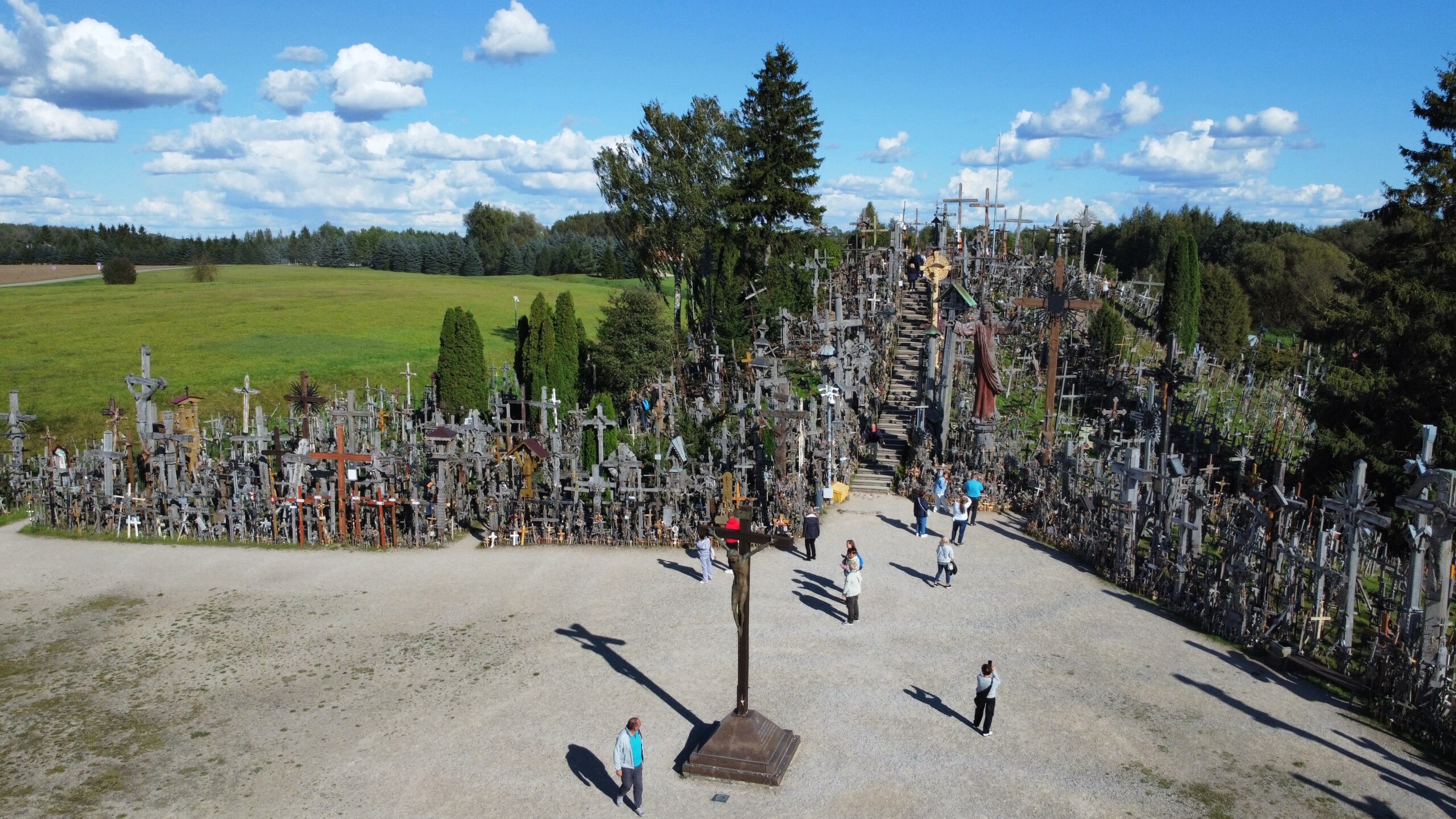
I continued south, crossing the border into Lithuania, until I reached the Hill of Crosses. If Salaspils was silence made solid, here it was sound that ruled: a soft metallic chime carried by the wind, brushing against thousands of wooden and iron crosses. More than 100,000 symbols of faith crowded the hillside, forming a landscape at once surreal and profoundly human.
The tradition began in the 19th century, when families who had lost loved ones in uprisings against czarist rule—often denied Christian burial—began planting crosses on the hill. It was an act of mourning and prayer, but also of defiance and hope. Later, under Soviet occupation, the site became a sanctuary of resistance. Bulldozers leveled the crosses again and again, but each time they returned—multiplied overnight, as if the spirit of the people refused to be erased.
What gives the hill its force is not merely the sheer number of crosses but what each one represents. Large or small, carved from wood, forged from iron, or hewn from stone, every cross carried a personal story of faith, grief, gratitude, or promise. Each was a voice that refused silence, a quiet gesture of courage in the face of tyranny. Standing there was to feel the obstinacy of a nation that, even under the harshest yoke, never surrendered its soul.
Two distinct lessons unfolded before me, bound by a common thread. In Salaspils, the silence imposed by Nazism. In Šiauliai, the insistent chorus of crosses defying Soviet power. Stone and wood. Mourning and hope. I realized that true resistance is not only military or political—it is spiritual, communal, cultural.
In the solitude of those places, it became clear: no invader, however brutal, ever succeeded in crushing what mattered most. Between the concrete figures of Salaspils and the forest of crosses at Šiauliai lies an invisible road, joining Latvia and Lithuania. Along that path runs the certainty that the unity of a people, born of faith and courage, is stronger than any weapon.
By Palmarí H. de Lucena