
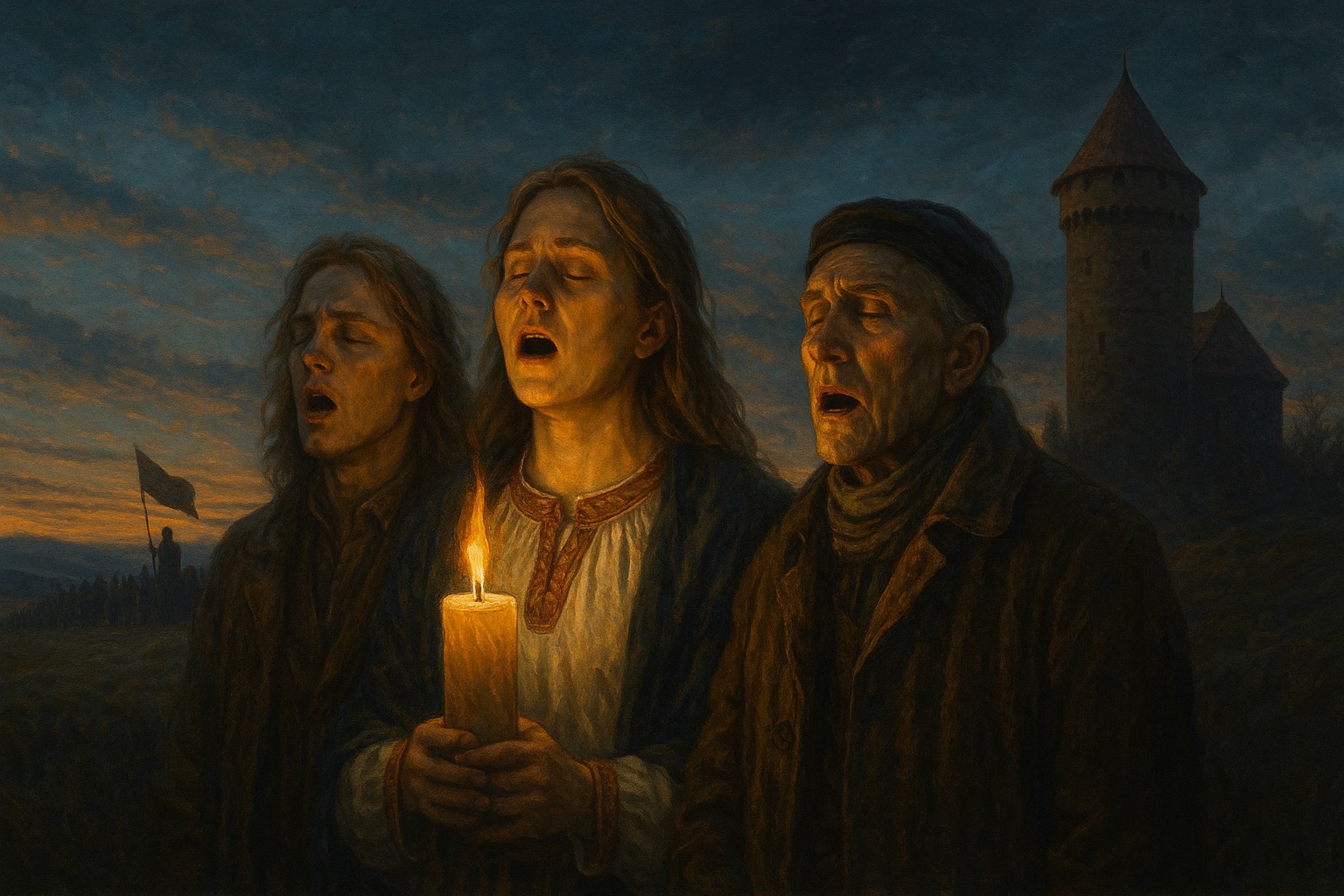
At the edge of the North,
where the Baltic winds carry memories of iron and ash,
three small nations learned to sing
in order not to die.
Beneath the weight of empires,
when language was forbidden
and silence decreed by law,
they kept within their voices
what could no longer be written —
their very souls.
In the squares of Tallinn,
between walls that still recall the crusades,
a chorus of youth arose
like an unarmed army of light.
They sang banned hymns,
hidden poems,
childhood songs that fear had buried.
And the sound that rose from those freed mouths
was stronger than the steel of weapons.
In Riga, under gothic towers,
men and women lit candles.
Hand in hand,
they formed a living chain,
a river of courage linking Vilnius, Riga, and Tallinn.
Six hundred kilometers of faith.
It was the Singing Revolution,
an epic without blood,
the saga of those who won with music.
In Lithuania, the bells tolled alone,
as if summoning the dead of memory.
And mothers, instead of mourning,
sewed flags from fabric of grief and hope.
Each thread, a vow of resistance.
Each color, a promise of return.
When the tanks advanced,
the voices did not retreat.
When power sought to silence,
the song grew louder.
And the world, astonished, saw:
there are peoples who defeat tyranny
without harming anyone.
Then came freedom —
not as explosion, but as dawn.
The Baltic peoples rebuilt without erasing,
remembered without hating.
They kept the ruins
not as wounds, but as warnings.
Destroyed synagogues,
Soviet prisons,
cold stone monuments —
all transformed into lessons.
Today, whoever walks their streets
can hear history breathing.
In the schools, the reborn language.
In the concerts, the forbidden songs.
In the squares, the serene pride of those who triumphed
without shouting.
Tolerance became their fortress.
Culture, their sword.
And patriotism — their song.
For in the Baltic lands,
love of country does not exclude — it embraces.
It does not impose — it shares.
And if one asks
how they conquered without fighting,
they answer with a quiet smile,
as those who know the secret of humanity:
“Freedom is never imposed.
Freedom is sung.”
Thus ends the Saga of the Peoples Who Sang for Freedom —
the story of three nations, small on the map
yet vast in spirit.
They teach us that to resist is to endure,
to tolerate is to rebuild,
and that true power lies in remaining human —
even after everything.
By Palmarí H. de Lucena