
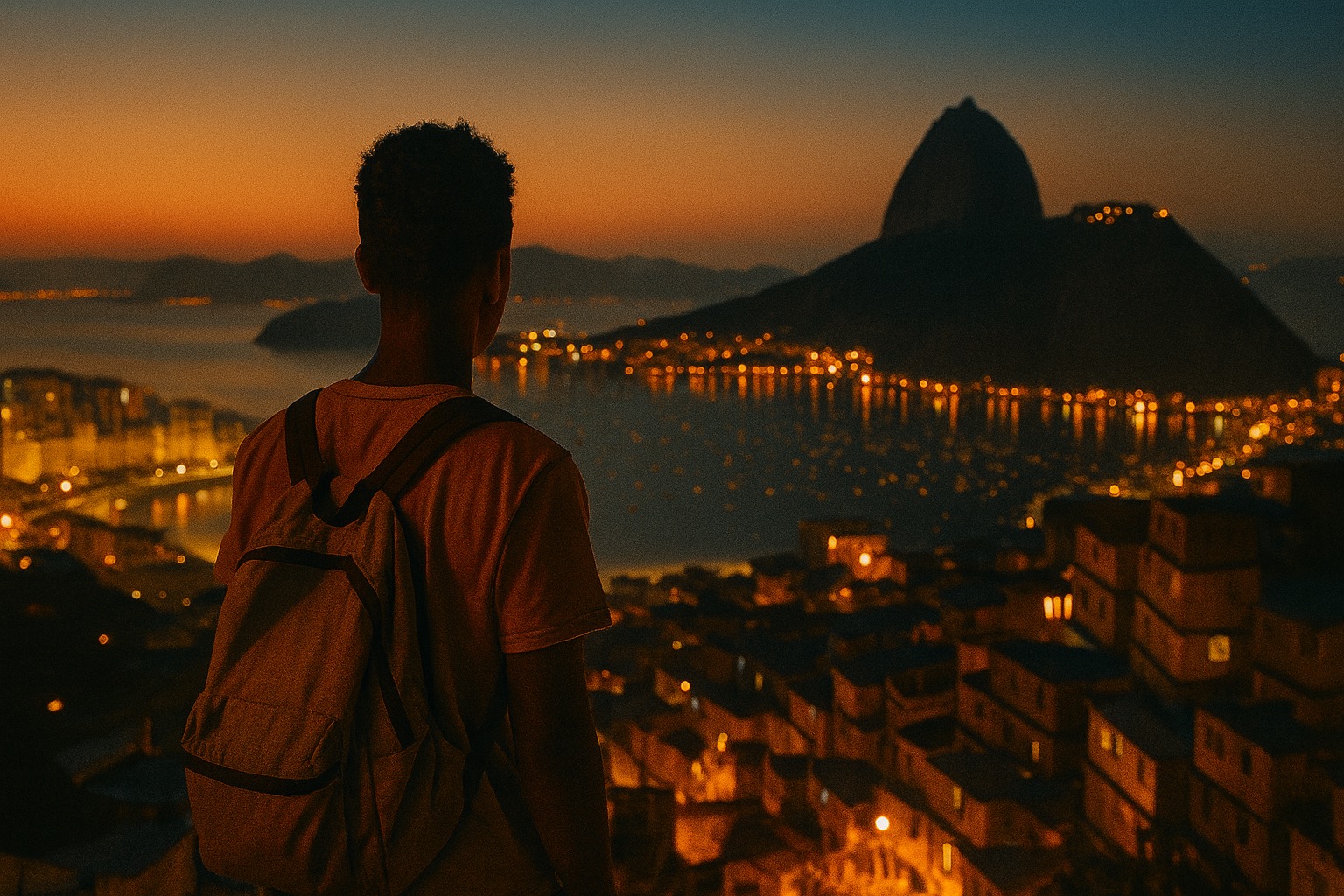
That night, Rio seemed like two cities.
In one, the shoreline glittered like a liquid promise, and the sea returned light to tall balconies. In the other, the hills kept names in small windows, where night entered without knocking and hope learned to sleep with one eye open.
Young people moved through the city as if crossing an invisible minefield. Some with music in their ears, others with fear on their backs. The same bus carried first-journey dreams and the weariness of generations. On the horizon, postcards rose into the sky; behind them, there were kitchens boiling with too little and mothers counting footsteps on the stairs.
But it was not only inequality in the air. There was gunpowder.
Violence was no exception — it was routine. It slipped in through windows with the dry crack of gunfire, rushed through alleys on unmarked motorcycles, entered schools in the shape of absences. Children learned early to read the map of sounds: the shot that tells you to lie flat, the blast that tells you to run, the silence that tells you to pray.
Communities lived among weapons too large for narrow streets. Rifles borrowed from other wars paraded through alleys that could barely hold two embraces. Homemade drones watched rooftops, radios whispered codes, and the night — always suspicious — patrolled even inside dreams.
Then came the clashes, unequal as the ground where they happened. On one side, uniforms and the State; on the other, boys armed with haste and too little life. A war without fields, without borders, without warning. Bullets passed through walls as thin as letter paper — sometimes through the very idea of tomorrow.
I had seen Rio before in other cities. Paris and London carried the same design: bright salons and dark sidewalks, lifted glasses and empty pots, luxury yawning while hunger kept watch. The language of inequality changes; its accent never does. Here, the accent arrived as gunfire.
In the periphery, dawn made promises that morning denied. The future was too wide a word for shallow pockets. Study came by stubbornness, work by miracle, joy by double insistence. And yet there was underground beauty: the soccer game under a tired streetlamp, the girl practicing steps before a cracked mirror, the young man writing verses on a wall for lack of paper and an overflow of urgency to save himself.
And there was anger — first a whisper, then an engine.
It offered belonging when the city turned away, identity when names felt too small, strength when everything weighed too much. Anger embraced like a brother, but charged like an owner: it promised respect and delivered mourning; promised power and gave back absence.
I saw boys trying to become giants too soon. I saw girls grow old from the inside. I saw houses learn the weight of photographs in their frames. And I saw the old mistake repeat itself: turning pain into a weapon, as if pain could aim at the right place.
It took me a long time to understand — longer still to admit — that courage does not live in noisy confrontation, but in quiet endurance. Staying alive is defiance. Studying when you can is rebellion. Working when work appears is resistance. Loving when the world demands hardness is a heroism that never climbs hills nor makes headlines.
The rich city stepped past like someone crossing a puddle — without looking back. But in the alleys, futures the size of ants were being born: small, persistent, organizing the impossible. Where no one bet, someone dreamed. Where everything was missing, someone invented.
If I could gather those young people before me, I would not speak of glory. I would speak of breath. I would not speak of war. I would speak of life. I would say that Rio needs fewer operations and more opportunities; less mourning and more birthdays; less gunpowder and more bread.
And I would say, at last, the words nobody likes to hear but almost everyone needs:
— You were not born to disappear.
Perhaps then Rio, which once seemed like two, would begin — slowly — to become one.
With memory, warning, and hope,
Sydney Carton
Character from A Tale of Two Cities, by Charles Dickens — apocryphal letter conceived by Palmarí H. de Lucena