
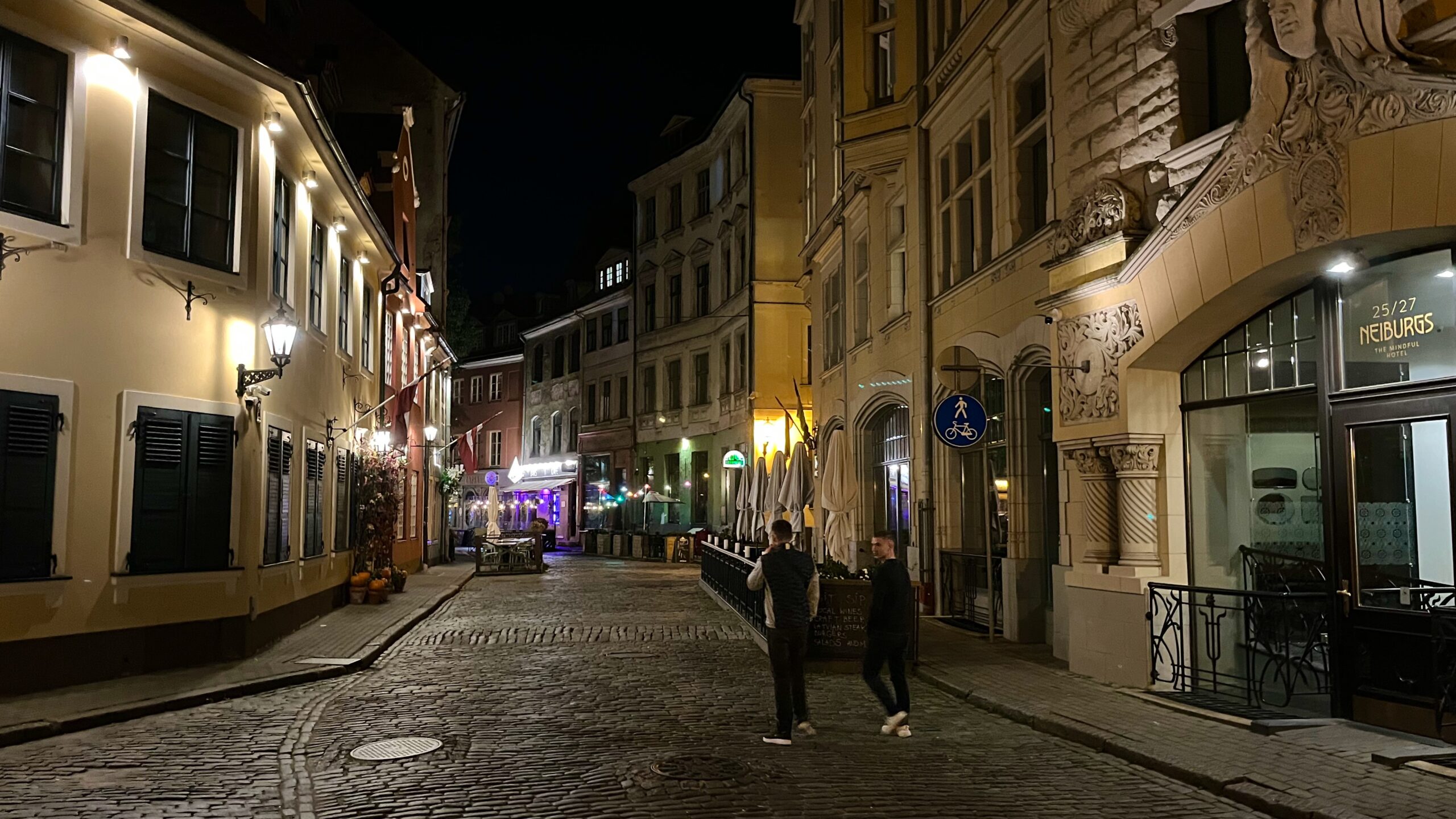
Some cities are born for everyday life, others for eternity. But Riga was born for the camera. From the moment the sun rises over the mirror of the Daugava River until it disappears behind the Gothic spires, the Latvian capital seems always waiting for a director, a scene, a story. Its narrow streets and slanted rooftops hold the charm of a natural film set — a place where time folds into itself and history moves through shadow and light.
The Old Town, with its medieval facades and winding alleys, has long been a stage for love, intrigue, and power. It was here that the German series Sisi found, among baroque columns and lace-curtained windows, the perfect setting to revive the 19th century life of the Austrian empress. For a moment, Riga became Vienna, and the carriages crossing Doma Square seemed to roll straight out of another century. The same spell drew the BBC to film Archangel, starring Daniel Craig, transforming Riga’s squares into Moscow’s cold streets — a feat of light and architecture only a city of many faces could offer.
But Riga also has a raw, human side. The documentary Buy Bye Beauty, shot in the city’s less glamorous corners, reveals its beating heart — the stories of those who live far from the postcards. In Dangerous Summer, set during the Soviet occupation, the city became a silent witness to love and fear intertwined. Even recent productions, like the Korean epic Harbin, have turned to Riga to portray espionage and revolution — proof that the city’s cinematic spirit transcends languages, borders, and time.
Between walks through history and scenes of modern life, today’s traveler finds a haven at Hotel Julius — a place that seems to breathe the same quiet elegance as Riga itself. Just steps from the Old Town, the hotel blends contemporary design with a sense of calm sophistication. Inside, soft light and minimalist lines contrast beautifully with the ornate façades outside. In the early morning, from the tall windows, one can watch the city awaken: bicycles crossing the bridges, church bells echoing through the streets, sunlight spilling over the red rooftops. It feels like a pause between two takes — a gentle intermission in the film of the day.
Across the Daugava, the National Library of Latvia, a gleaming prism of glass and steel, rises as a monument to the country’s modern spirit — a counterpoint to the ancient heart of the city. And along Alberta iela, where Art Nouveau architecture reigns, every building seems to possess a face, a story, a gesture — as if Riga itself were performing for whoever cares to look.
Something in Riga invites both fiction and memory. Perhaps it’s the way each corner holds the promise of a story, or how the northern light caresses the old stones, giving them the texture of dreams. Here, light has the density of remembrance, and the distant bells seem to ring not just for the hour — but for the beginning of a new scene.
And when the traveler finally leaves, they realize they’ve left behind more than footprints. They’ve left a fragment of their own script — for in Riga, everyone becomes, even briefly, part of an endless film.
By Palmarí H. de Lucena