
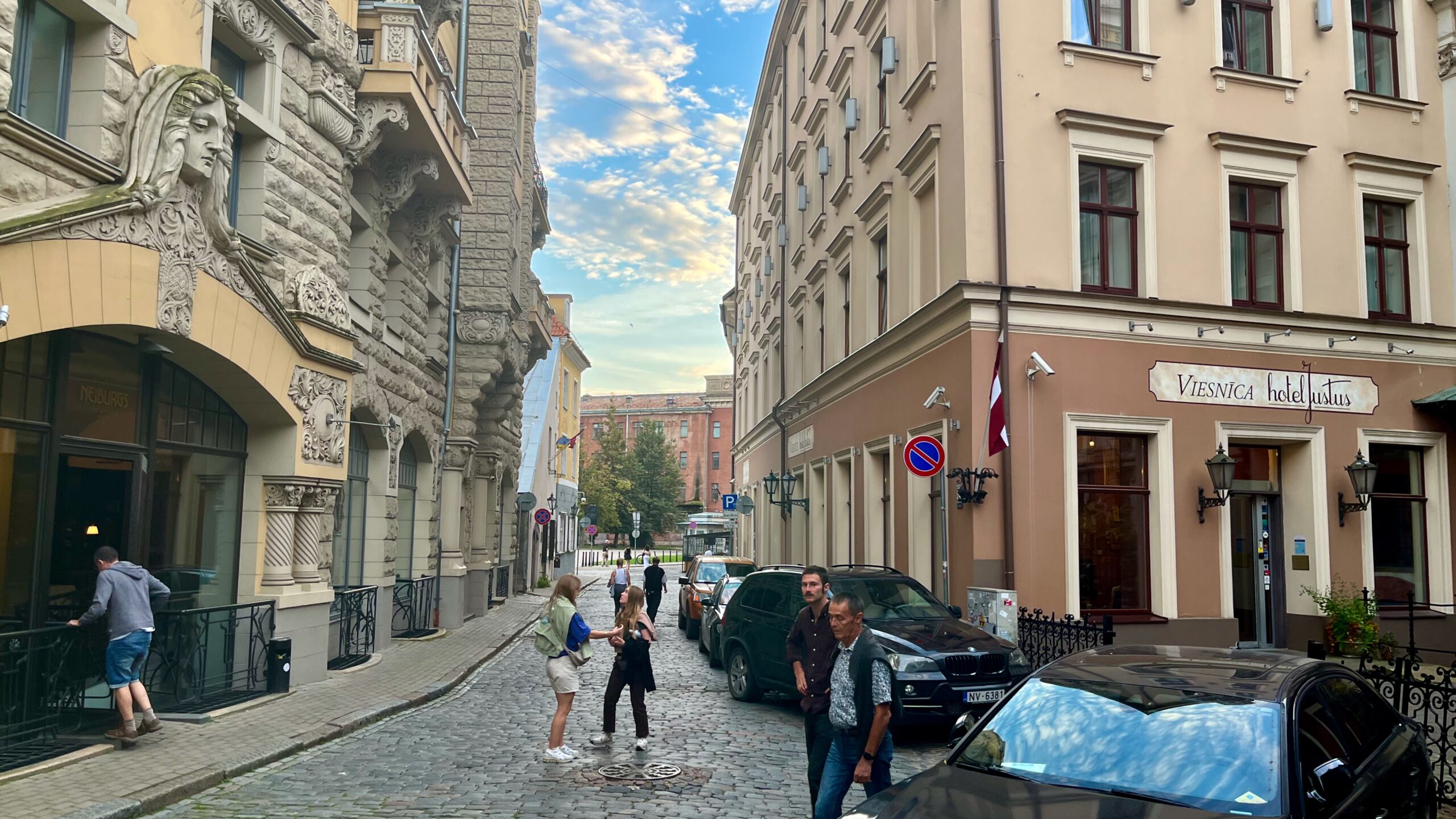
Riga wears its history in stone. The façade of a hotel on Jaunielas Street, preserved since 1874, stands as a quiet witness. Its columns and windows are more than trade places architecture; they read like pages from a book that refuses to end. To walk here is to sense that the city is both archive and stage, a place where memory and imagination with ease.
The site was once the residence of Bishop Albert, Riga’s medieval founder, when the city was little more than a fishing village on the Daugava River. Fire later swept through the wooden settlement in the seventeenth century, reducing it to cinders. Riga rebuilt not in timber but in stone, raising arches and facades that gave its streets the air of permanence.
Those streets have lured more than travelers. Soviet filmmakers turned the neighborhood into a set for cult classics: the espionage drama Seventeen Moments of Spring and the beloved Sherlock Holmes and Doctor Watson. Even today, wandering past the cobblestones, one feels the presence of characters who never quite left the screen.
Yet Riga is more than nostalgia. The city also carries the marks of pain. In the twentieth century, Latvia endured occupation first by the Nazis, then by the Soviets. Each regime sought to erase its identity, but the culture survived in whispered conversations, in the persistence of language, in symbols of faith. National memory was smuggled through silence.
One of the most haunting parallels lies outside Latvia, in Lithuania’s Hill of Crosses. Thousands of crucifixes rise there, large and small, forming a forest of defiance. Each is both prayer and protest, a reminder that resilience often speaks in silence.
Riga’s own memory is kept in the Museum of the Occupation, a dimly lit archive of documents, photographs, and testimonies. Visitors pass through corridors heavy with shadow, but at the end there is always light — proof that freedom, though battered, never vanished.
The Baltic story is not just about survival. It is about how culture can outlast power. Latvia, Lithuania, and Estonia defended their languages and traditions long enough to reclaim independence. In an era when nations across the globe — from Brazil to the United States — wrestle with polarization and assaults on memory, their example feels urgent.
And yet Riga does not force its past on the visitor. Memory here feels less like a burden than a melody in the background. At dusk, the cathedral bells toll over the Old Town, mixing with the aroma of fresh bread and coffee. Tourists meander through cobbled alleys; musicians tune their instruments in the squares; candlelight flickers in cafés where young people gather to talk late into the night. At the central market, the scent of smoked fish and spices drifts from stalls, anchoring the city once more to its river and its port.
What lingers is not only history, but the layering of sensations — the scars of war pressed against the rhythms of daily life. Riga has turned its wounds into beauty, its survival into testimony. To walk here is to discover that a city can endure fire, dictatorship, and war, yet still emerge with its soul intact.
Riga is not simply a destination. It is a lesson in resilience, offered quietly, through stone façades and cathedral bells, through the taste of bread and the hum of conversation. A city that remembers without bitterness, and lives — fully, freely, beautifully — in the present.
By Palmarí H. de Lucena