
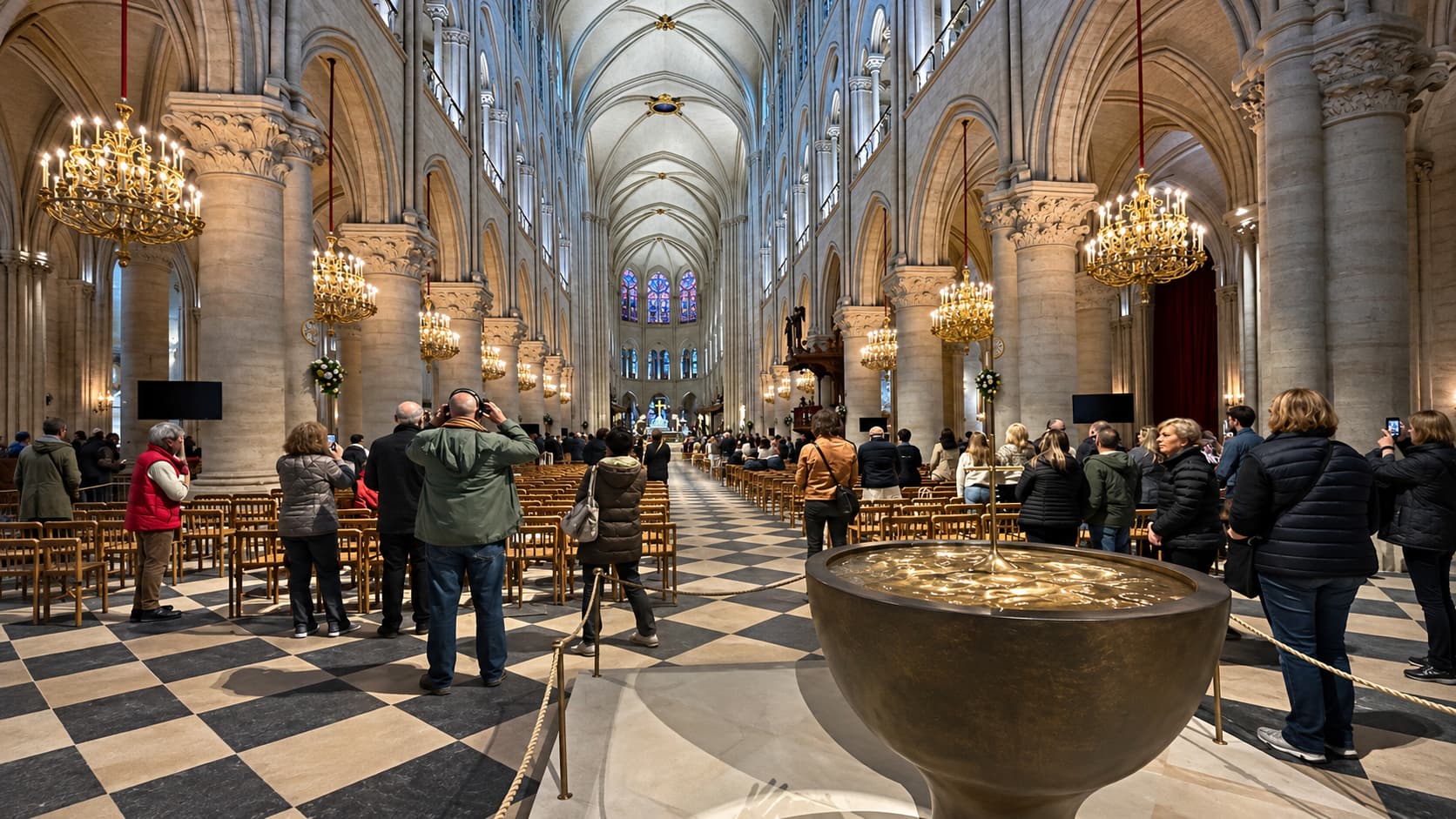
There is something miraculous about the restoration of Notre-Dame. Not merely because its stones, vaulted ceilings, stained-glass windows, and spire have once again reclaimed their familiar place in the Paris skyline, after the fire of April 2019 threatened to reduce them to memory. The miracle lies also in the endurance of beauty—in art’s stubborn determination to survive destruction, the passage of time, and the frailty of humankind.
To stand before the restored Notre-Dame is to encounter something that transcends architecture. Here, matter has become language, stone has become thought, and verticality itself has assumed the character of prayer. Centuries of intelligence, faith, craftsmanship, labor, and human sensibility converged to raise this extraordinary monument. Each arch seems to bear more than its own weight; each stained-glass window captures and releases the light in colors that no reproduction can fully convey. The cathedral is more than a building. It is one of the most remarkable expressions of the human imagination when it sets out to defy impermanence.
And yet, as one watches the crowds drawn to it, a certain uneasiness begins to take hold.
Some visitors arrive, raise their phones, search for the perfect angle, adjust their expressions, smile, and take their pictures. Then they move on. They photograph the façade, the architectural details, their own figures framed against the monument’s grandeur. For a few moments, the cathedral becomes a backdrop, the experience a document, and the journey a public confirmation that they were there.
This is not an argument against photography, much less a plea for some impossible purity of vision. Photography, too, can be an expression of affection, a means of preserving memory, a way of laying a personal claim upon the world. The question is a different one: when the image begins to replace the experience, when the need to record takes precedence over the willingness to feel, something essential is lost. The visitor carries away the photograph but may fail to gather what cannot be contained within it.
We live in an age that mistakes visibility for existence. We must appear, share, and leave evidence of every journey. A trip no longer seems complete without its public display, beauty without publication, emotion without witnesses. Even in the presence of a masterpiece, we are tempted to shift the center of the experience. We no longer look only at the monument; we look at ourselves standing before it.
And it is at this point that the ghosts of Victor Hugo seem to return.
In The Hunchback of Notre-Dame, published in 1831, the French writer did not make the cathedral a mere setting for a tale of love and tragedy. He made it a monumental character in its own right, a repository of the contradictions of its age and a witness to the human condition. Hugo understood that architecture, too, tells the story of mankind: its beliefs, fears, ambitions, violence, and longing for eternity. In his pages, the cathedral breathes and watches. Within the depths of its stones, it seems to preserve everything that official history so often leaves behind.
It is impossible to stand before Notre-Dame without thinking of Quasimodo, the deformed bell-ringer whose appearance inspired revulsion, yet whose inward life held a capacity for love that the world seldom knew how to recognize. He belonged to the cathedral as though he were an extension of its towers: solitary, misunderstood, suspended between heaven and the city below. He knew its bells, its heights, its shadows, and the silences of that vast stone world. Perhaps no one ever inhabited Notre-Dame more completely than he did.
And then there is Esmeralda, with her dancing, her youth, and her threatened freedom. The Romani woman who, in the eyes of a society governed by prejudice and hypocrisy, became an object of desire, judgment, and persecution. Her beauty, far from protecting her, made her vulnerable. Through her, Victor Hugo exposed the cruelty of a society that condemns whatever it cannot control and turns difference itself into an accusation.
Quasimodo and Esmeralda endure because literature has granted them a form of immortality that no monument, however magnificent, could secure on its own. They are fictional beings, yet they embody human truths that have survived the centuries. The first teaches us to distrust appearances; the second, to recognize the violence concealed beneath the conventions of society. Together, they leave us with an unsettling question: what is the value of admiring the outward beauty of a civilization if we remain incapable of recognizing the dignity of those it casts aside?
Perhaps this is the most disturbing dimension of Victor Hugo’s work. The cathedral, whose architectural perfection inspires wonder, shelters a narrative about the moral imperfection of humankind. The splendor of its stones stands in stark contrast to the brutality of human relationships. Artistic greatness does not erase social misery; if anything, it makes that misery more visible.
For this reason, Notre-Dame deserves to be contemplated in its entirety. Not merely as an architectural treasure, but as the expression of an entire civilization; not simply as a marvel of medieval engineering, but as the testimony of a collective sensibility that knew how to transform matter into meaning. Within its walls reside the intelligence of anonymous builders, the patience of craftsmen, the ingenuity of master artisans, the devotion of generations, and the continuity of a legacy that belongs not to France alone, but to all humanity.
In this sense, the reconstruction goes far beyond a technical achievement. To restore Notre-Dame was to declare that destruction would not have the final word. It was to acknowledge that certain works possess a value that cannot be measured by the cost of their restoration, the number of visitors they attract, or the reach of their images. Their worth lies in what they continue to offer the human experience: wonder, memory, knowledge, and beauty.
But beauty does not surrender itself to those who merely pass through its presence. It demands that we suspend our haste, that we make ourselves inwardly available. We must look upward and accept our own smallness beneath the vaults; pause before the stained glass and understand that light, too, can become a language; remember that these stones have endured wars, revolutions, changes of government, passing fashions, and generations of men and women, while we ourselves are only travelers through a fleeting moment.
Perhaps modernity has given us extraordinary instruments with which to document the world, but it has not taught us how to inhabit it with equal intensity. We accumulate images, itineraries, and records; yet we do not always accumulate experiences. We visit the most extraordinary places on earth and, at times, remain strangers to what is deepest within them.
I imagine Quasimodo watching the movement of visitors from some distant tower. Perhaps he would recognize in that crowd the same loneliness he knew in life. Esmeralda, meanwhile, might pass silently across the square, her dance as untamed as ever, while a forest of raised phones sought to capture an apparition that could never be contained within a screen.
It is not visitors that Notre-Dame lacks. It is contemplation that visitors sometimes lack.
Notre-Dame has been rebuilt, but its story does not end with the restoration of its structure. It continues to question us. Its greatness lies as much in what we see as in what it compels us to consider: the relationship between art and time, memory and oblivion, beauty and injustice, the endurance of monuments and the fragility of human life.
As we leave the cathedral, perhaps the most meaningful gesture is not to review the photographs we have taken, but to put the phone away for a few moments and allow the experience to settle into silence. Some forms of beauty ask for no witness; they ask for surrender. Before certain works of art, the finest tribute we can offer is to relinquish, if only for a moment, our need to be seen.
The stones of Notre-Dame have survived the fire. Its bells have once again begun to announce the passage of time. The ghosts of Victor Hugo continue to wander through his pages. And we, so preoccupied with proving that we have stood before History, may need to learn once more how to be fully present before beauty.
For a cathedral is not a place in which to make one’s presence known. It is a place in which to feel the presence of time, of art, and of everything within us that remains capable of being moved.
And perhaps that is the true restoration we still have yet to accomplish.
Palmarí H. de Lucena