
Our journey through the Balkans began in what was then the Socialist Federal Republic of Yugoslavia — a mosaic of contradictions, a mirror of a region where history never sleeps. Empires and ideologies had succeeded one another like recurring seasons of the same harsh winter. Over more than two millennia, this land had been devastated forty-seven times. In the nineteenth century, German socialists coined the term Balkanization to describe the fragmentation strategy sponsored by the Russian czar — divide and dominate. The word has since endured as shorthand for distrust and disunity, for peoples turned into hostile neighbors by the calculus of power.
By the 1970s, that fracture still trembled beneath the surface. The West maintained a relationship of pragmatic ambiguity with the region: praising Tito’s “communism with a human face” and pretending to believe in Ceaușescu’s neutrality, while ignoring the disquiet simmering across the provinces. Serbs, Croats, Bosnians, and Albanians lived in an uneasy equilibrium, sustained by a regime that mistook silence for stability.
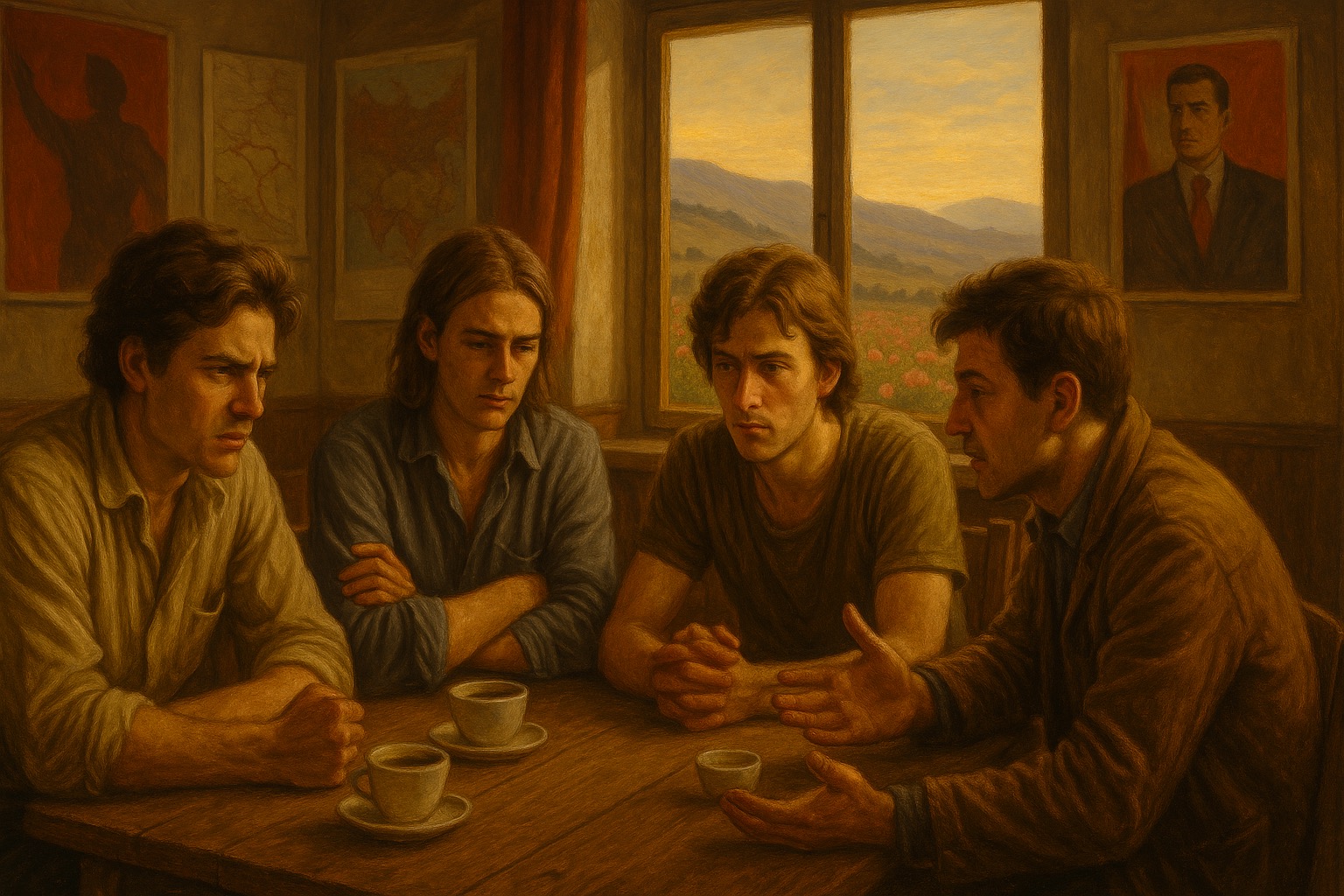
During the month we spent crossing the region, silence reigned everywhere. No pamphlets, no open dissent, not even a hint of irony in public. Propaganda and surveillance had turned conformity into habit. The only trace of rebellion we encountered came from a group of university students gathered in a roadside café between Niš and Sofia. They were furious: drafted into compulsory military service.
They spoke with contained bitterness about lost youth, interrupted studies, and the fear of being sent to guard faraway borders. One, a boy with long hair and melancholy eyes, summed up their despair:
“They teach us that the homeland is everything, but the homeland never asks what we want from it.”
The sentence stayed with me — a whisper of clarity amid the ideological fog. It was the voice of a generation without a voice, children of a system that granted security but stole the dream.
We left Serbia behind and drove toward Bulgaria, chasing the fabled Valley of Roses. The landscape seemed to offer redemption from human hardness: hills draped in flowers, air heavy with perfume, the sun dissolving borders. Women wove roses into their hair, and market stalls overflowed with liqueurs and jams — tokens of national pride. It was a festival for the senses, yet beneath its beauty lingered a quiet melancholy, as if the earth itself were trying to hide the weight of its history.
We continued toward the Romanian border, heading for Drobeta-Turnu Severin, a city on the Danube beside the great Iron Gates hydroelectric dam. There, reality returned with force. A long line of horse-drawn carts blocked the road — police, shouts, restless animals, and a single word repeated in scorn: tsigani — gypsies. A Romani caravan had set up camp on the highway, protesting their expulsion from the city’s outskirts. We photographed discreetly until officers surrounded us. Our cameras were confiscated; the film, exposed to light. “The gypsies are not part of our culture,” said the commissar, expressionless. We were escorted back to our car, knowing we had just glimpsed the other side of utopia.
Later, one of the caravan’s leaders confided: “They call us wanderers, but it’s the world that has never given us a place.” His words echoed the same pain I had heard from the young conscripts — different faces of the same exclusion.
The term Gypsy, a corruption of “Egyptian,” was born of a historical misunderstanding: the Romani people had not come from North Africa, but from northern India. Their history is a long itinerary of displacement — slavery, exile, extermination. In Romania, Romani slavery was abolished only in 1855; under Nazism, half a million were murdered. After the war, communist regimes imposed forced assimilation, erasing their language and customs in the name of equality.
Only in 1979 did the United Nations formally recognize the Romani as a distinct ethnic group, entitled to their own language and cultural protection. In 2007, the Catholic Church published its first official document dedicated to them — belated, but significant.
Traveling through the Balkans is to learn that every hill and every face holds an interrupted story. Between the fragrance of roses and the silence of repressed voices, the traveler comes to understand that the true maps of the region are not drawn on paper but engraved in memory — in the recollection of those who were silenced.
And perhaps that is the greatest lesson of all: in lands where power demands unanimity, the simple act of thinking differently is already an act of courage.
Romania, 1973
By Palmarí H. de Lucena