
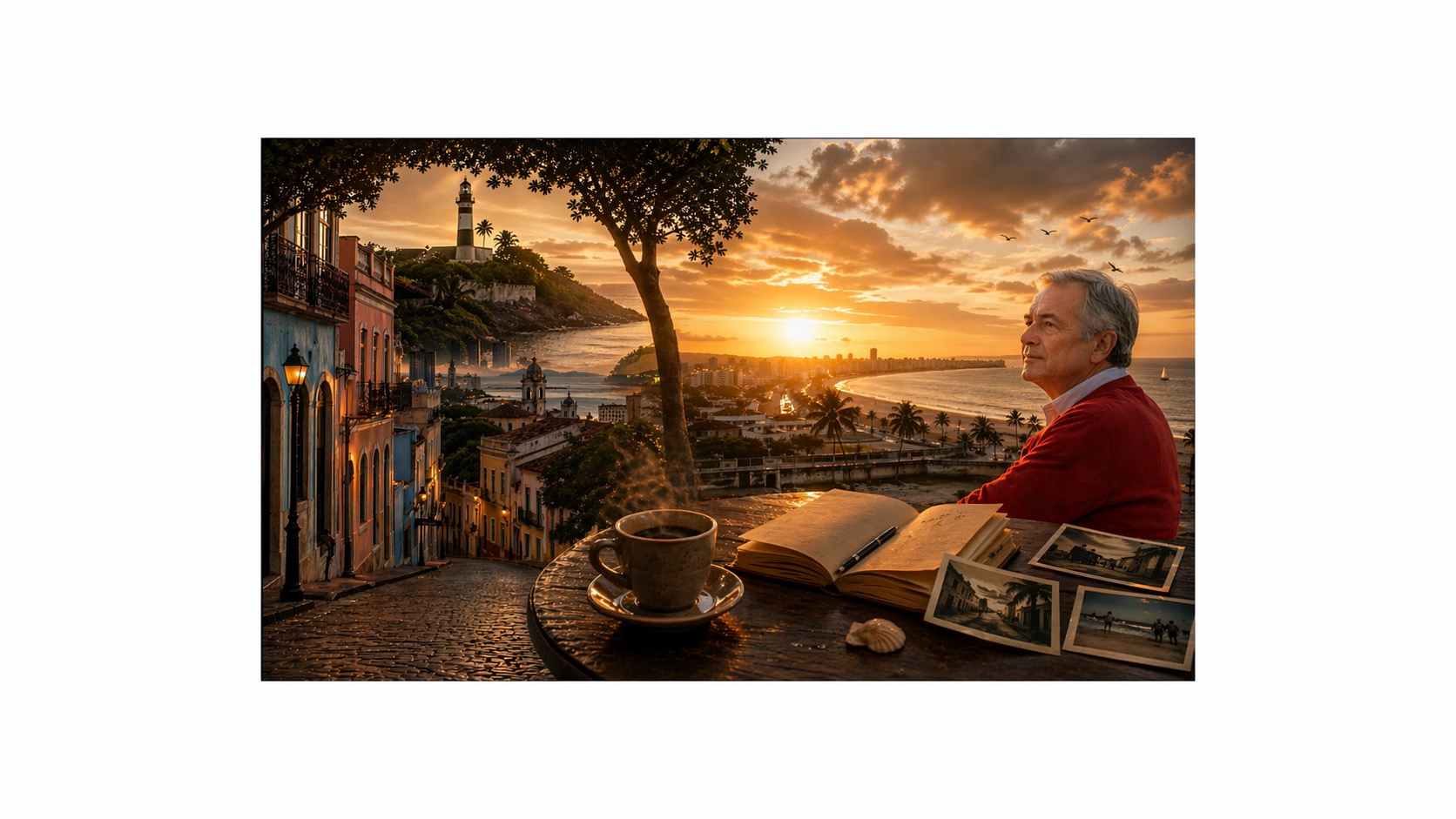
For forty years I lived far from João Pessoa, and during that time I learned what only distance can teach: to leave does not mean to abandon, just as to remain does not mean to possess. I lived in foreign cities, endured severe winters, learned to recognize the melancholy of gray skies and the quiet discipline of people who turn reserve into a form of elegance. I lived among languages that were not mine, among seasons that did not belong to my childhood, among streets that never learned to pronounce my name with intimacy.
And yet, sometimes all it took was the unexpected aroma of stronger coffee, the sound of a wave breaking in the distance, or the angle of a certain golden light falling across the afternoon, and without warning I would cease to be where I was and return, with almost cruel clarity, to the city where my life had begun.
Because João Pessoa never truly abandoned me; it merely withdrew into that deepest chamber of memory where essential things remain asleep, patiently waiting for the moment of their resurrection. It was not an organized memory, nor a narrative I could recount with precision. It was, rather, a sensation—an invisible fabric woven of heat, salt, familiar voices, old streets, and long afternoons where time seemed less like a line and more like a breath.
Sometimes it appeared without warning. In the smell of strong morning coffee, I was carried back to the kitchen of my childhood. In the distant sound of a wave, I returned to the beaches of Tambaú Beach and Cabo Branco Beach, where the horizon seemed to promise everything and time moved with the generous slowness of eternal things. A single golden light at the end of the afternoon was enough to remind me of that city where the sun rises first and where life seemed to maintain a silent intimacy with the sea.
I remember the mornings in Tambaú, when the sea still belonged to silence and the city awakened slowly, as if unwilling to disturb the delicacy of dawn. Light arrived first upon the water, then upon the sand, and only later upon the men and women who walked the shoreline without haste, as though obeying an ancient liturgy. At that time, I did not know that happiness was that. Only later, in absence, did I understand that happiness is almost always recognized too late.
The houses of the historic center, with their weathered facades and intact dignity, remained within me like silent relatives. When I returned many years later, it was not they who seemed aged, but I. There was in them an almost severe permanence, as if they were silently asking what I had done with the time I had been given. To walk those streets was to encounter not only places, but former versions of myself: the boy who dreamed of leaving, the young man who believed the world always began somewhere else, the man who discovered, too late, that certain departures are merely delayed forms of return.
In the streets of Jaguaribe where I once ran as a child, I still hear footsteps that no longer exist. At old corners, I find voices erased by time, family laughter, youthful promises, endless afternoons from a world that seemed not to know farewells. Every stone, every old veranda, every shadow cast upon those houses seems to preserve not only the memory of the city, but the memory of who I was within it.
But when I returned to João Pessoa, I rediscovered not only streets, beaches, and the ancient murmur of the sea; I rediscovered my own language, and perhaps that was the deepest return of all.
For forty years I lived surrounded by a foreign tongue, by the useful and cold precision of Anglo-Saxon speech, by that efficient language that organizes the world but rarely consoles it. I learned to think in English, to negotiate in English, to survive in English. For decades, my words wore another skin, and little by little I realized that it was not only my vocabulary that had changed, but the very breathing of the soul.
There are languages that explain life, and there are languages that serve to feel it. English gave me roads; Portuguese returned to me the abyss.
Only upon returning did I realize how disciplined my voice had become, almost domesticated, trapped inside a rational architecture that impoverished excess, ambiguity, and vertigo—the very things that make Portuguese a home rather than merely an instrument. Portuguese does not settle for saying; it suggests, hesitates, circles, sighs. It knows longing before longing even exists. It understands that certain sorrows require music in order to be endured.
To rediscover Portuguese was like opening an old window in a house long closed. Suddenly, the air entered. Forgotten words returned, the accents of childhood, silences full of meaning, expressions no translation can ever reach. Back came the long sentences like Northeastern afternoons, the verbs heavy with destiny, the melancholy sweetness of saying “perhaps,” the fierce delicacy of saying “who knows.”
I realized then that exile had not been merely geographical, but verbal as well. I had left my city and, without noticing, I had also left my own music. My verse, my inner song, had been slowly harnessed to a foreign syntax, to a discipline that distanced me from the necessary excess of poetry. I wrote correctly, but I no longer bled.
And it was João Pessoa, with its old sea air and its almost sacred slowness, that began to untie that knot. Portuguese returned not as a language, but as liberation. Every recovered word seemed to remove a layer of rust from memory. Every sentence written in my native tongue restored not only style, but belonging.
I discovered that certain truths will only consent to be born in Portuguese. That childhood cannot be translated. That saudade admits no equivalent. That love, when spoken in another language, may arrive correct, but never whole.
At Cabo Branco, before the sea, I understood what no foreign philosophy had managed to teach me with equal clarity: we belong less to the countries we choose than to the landscape that first shaped our gaze. The ocean remained indifferent, as always, to my absences, to the passing decades, to the languages learned, and to the quiet failures every life accumulates. And in that indifference, there was a kind of mercy, because the sea demands no explanations; it simply remains.
The smell of salt air still returns me to childhood with a force no photograph can reach. The wind that crosses Cabo Branco still seems to carry the names of those I loved and those I lost. And when the sun rises first over that stretch of Atlantic, I feel that it is not merely a new day beginning, but an old fidelity being renewed.
Perhaps that is what belonging means: knowing that even in absence, one was never truly far away. For forty years I crossed continents, languages, winters, and silences, but there was always within me a street in João Pessoa waiting to be rediscovered. An open window to the past. A veranda carrying the scent of coffee. A Sunday morning still untouched.
Today I know that I did not return merely to the city—I returned to myself.
And if one day someone asks where the truest part of my soul resides, I will not name an address, nor a country, nor a house. I will simply say: it lives where the sun first touches the Americas, where the sea converses with memory, where childhood never completely ends.
It lives in João Pessoa.
And so, after so many departures and returns, I understand that João Pessoa was never merely a city on a map, but a kind of inner homeland, a secret territory where time does not destroy—it only ripens.
To return after forty years was not to recover what had passed, because the past is never returned; it was to recognize that it remained alive, breathing silently within me, like the tide that withdraws only to return again. Every street, every old facade, every breath of wind coming from the sea seemed to say, with the delicacy of permanent things: you were never truly far away.
The city where I was born preserved, without haste, what the world could not erase: my first idea of beauty, my first experience of absence, my first understanding of love and loss. João Pessoa was the beginning of everything, and perhaps for that very reason, it continues to be, also, a form of destiny.
There comes a moment in life when we stop searching for new horizons and begin, quietly, to search for origins. Not out of nostalgia alone, but because we understand that what we once were continues to sustain what we are. And in that late, almost sacred return, we discover that certain cities do not belong to the past—they belong to essence.
If Marcel Proust found in a small madeleine the entire path back to childhood, I found mine in the salt of the wind, in the golden light of late afternoons, in the old perfume of rain upon warm pavement, in the endless sea of Cabo Branco that continues to look upon the world with the same serenity as always.
And then I finally understand that it is not a matter of returning to João Pessoa, because one never truly leaves it completely.
Some cities leave memories.
Others become, forever, our very memory.
For me, João Pessoa is both.
by Palmarí H. de Lucena