
A quilombo is a self-governing community in Brazil founded by descendants of enslaved Africans who escaped bondage and preserved their autonomy, land, and cultural traditions.
In Brazil, quilombola communities are often treated as remnants of the past—legally recognized, yet quietly confined to history. The experience of Caiana dos Crioulos, in the country’s northeastern interior, challenges that logic. It shows that culture does not survive through isolation, but through circulation.
Caiana was founded by descendants of enslaved Africans who sought refuge on a steep escarpment surrounded by sugarcane plantations. Geography offered protection; culture provided continuity. In a region shaped by monoculture and exclusion, music and dance became social infrastructure. Fife bands, circle dances known as cirandas, and coco rhythms were not ornamental traditions. They organized collective time, transmitted memory, and reinforced belonging where formal institutions were often absent.
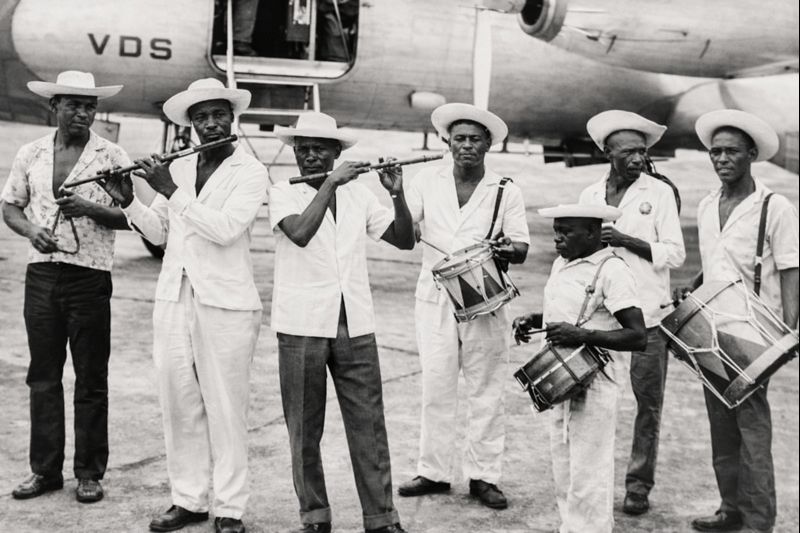
A single photograph captures this dynamic with striking clarity. Poorly digitized, it shows six Black musicians standing on an airport runway, instruments in hand, moments before boarding a flight to Brasília. The image records more than travel. It marks a cultural threshold—the moment when the sound of a quilombo prepared to cross the country, not as folklore packaged for consumption, but as a living expression of national identity.
Among the musicians was Mestre Firmo Santino, part of a lineage in which the fife player functioned as more than an artist. African griot Hassane Kouyaté describes such figures as mediators—musicians, storytellers, and organizers of social life who use sound and speech to maintain balance within a community. In Caiana, that role was not exceptional. It was foundational.
This journey did not happen by accident. Cultural mediators such as Tenente Lucena understood that promoting popular culture did not mean turning it into spectacle, but allowing it to circulate without being emptied of meaning. Academic institutions, particularly the Federal University of Paraíba, reinforced this ethic by documenting and accompanying these traditions rather than extracting them.
The effects of that circulation were not merely symbolic. Years later, the same photograph resurfaced in Caiana, recognized by the children and grandchildren of the musicians it depicted. Memory reactivated itself. Tradition had not been broken—it had been transferred. Younger generations began to value learning the fife and entering the ciranda because they saw their culture acknowledged both at home and beyond it.
Caiana dos Crioulos offers a lesson often ignored in cultural-policy debates: preservation is not stasis, and protection is not silence. Quilombola culture remains sustainable only when it is practiced, transmitted, and allowed to move. In a society inclined to treat Black rural history as something finished, Caiana reminds us that culture is not what survives the past—it is what carries a future.
by Palmarí H. de Lucena