
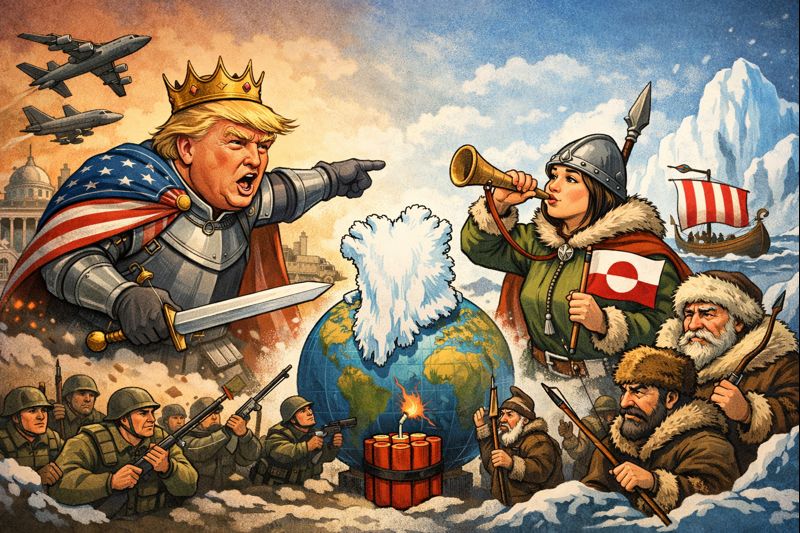
In The Mouse That Roared (1959), a nation so small it barely fits on the map declares war on the United States for sound economic reasons. Losing would be profitable. Winning would be unthinkable. The comedy, naturally, lies in the fact that the unthinkable happens — and exposes the entire architecture of global power as a gentleman’s agreement held together by nerves and ceremony.
Donald Trump’s fascination with Greenland suggests that the joke has aged remarkably well. The notion that a territory larger than Western Europe might be “acquired” like a distressed hotel betrays not imperial ambition but real-estate reflex. Strategy is replaced by instinct; diplomacy by appraisal.
In the original film, nuclear balance collapses because a mouse accidentally picks up the loudest toy in the room. In the contemporary remake, no such accident is required. A gesture suffices. Greenland becomes a blank, icy stage onto which fantasies of leverage, dominance and television ratings are projected.
The charm of the situation is that excess performs its own sabotage. The louder the threat, the smaller it sounds. Allies are reduced to polite coughs, experts to raised eyebrows. The mouse, sensing opportunity, does not roar — it merely clears its throat while the lion rehearses his lines.
British comedy has always understood this better than most: power rarely falls to rebellion; it trips over its own confidence. Authority collapses not under attack, but under explanation.
The film ends with the world discreetly embarrassed, keen to restore order without admitting how flimsy it was to begin with. Today’s audience recognizes the pattern. When foreign policy becomes performance, the empire does not conquer — it auditions.
And somewhere in the Arctic, the mouse adjusts its crown and waits.