
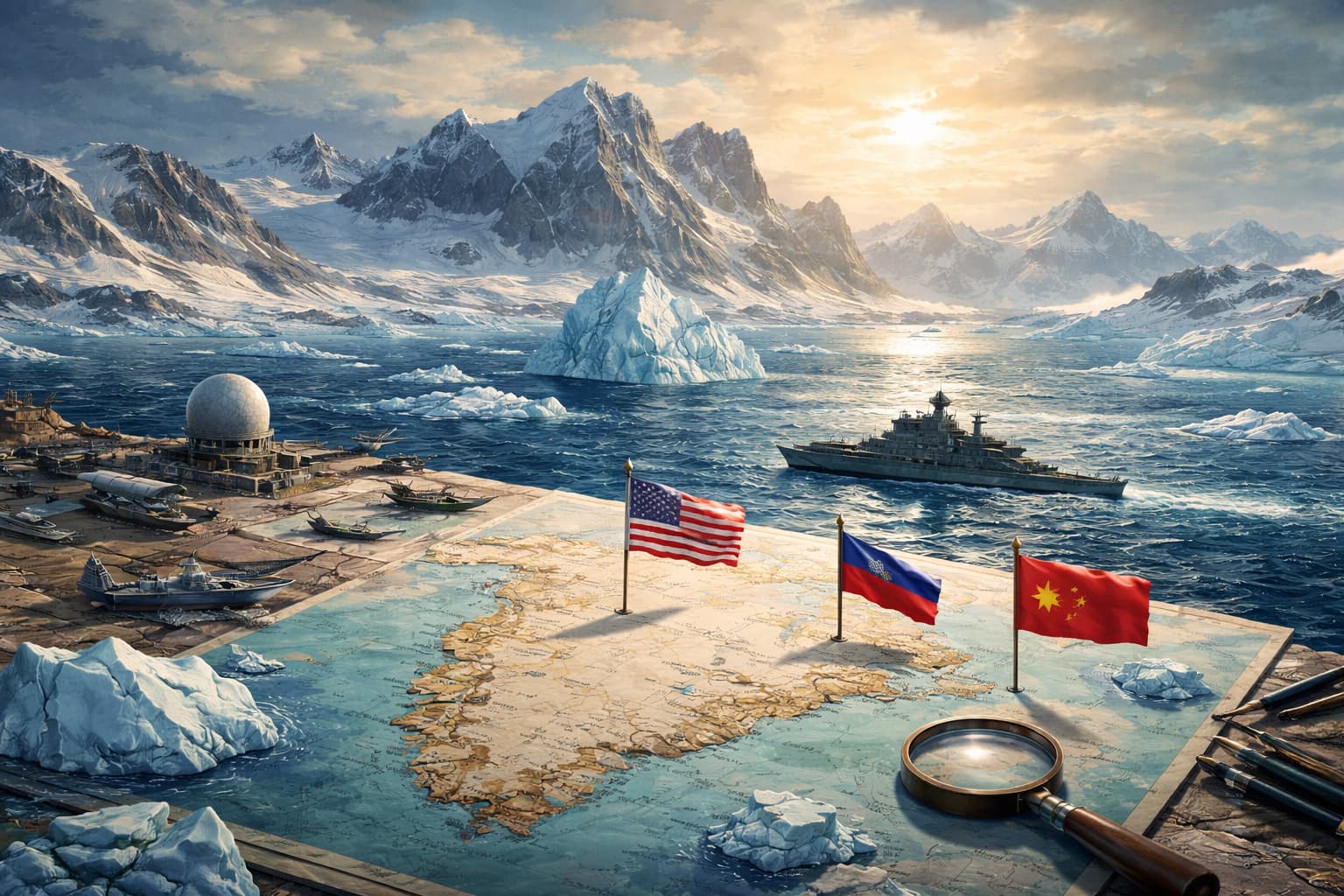
Some places seem fated for the margins of the map — expanses of ice and distance that feel more symbolic than strategic. For much of modern history, Greenland appeared to belong to that category: vast, sparsely populated and peripheral to the world’s urgent dramas. Yet at pivotal moments, the island has reemerged at the center of great-power calculation. The interest shown by Adolf Hitler in the 1930s and, decades later, by President Donald Trump was not a historical curiosity. It was a reminder that geography never truly retires.
Comparisons between Nazi Germany and contemporary America require caution. Hitler’s regime was built on coercion, expansion and the doctrine that force justified possession. When Trump suggested in 2019 that the United States might purchase Greenland, he did so within the framework of a democratic system and through diplomatic channels, however unconventional his tone. There was no mobilization of troops, no formal threat of annexation. Denmark rejected the proposal outright, diplomatic tensions flared and a planned state visit was canceled. The episode was awkward, not aggressive. Precision in drawing these distinctions matters.
Still, the underlying logic in both cases reveals something enduring about international politics: territory, resources and strategic position remain the currency of power.
Hitler’s interest in Greenland evolved from youthful fascination with Arctic exploration into calculated strategy once the Nazi state consolidated control. The island held the world’s largest known reserves of cryolite, a mineral indispensable to aluminum production — and therefore to aircraft manufacturing and military strength. In a Germany strained by tariffs, economic isolation and an ideological commitment to self-sufficiency, securing raw materials was not optional. It was essential to war preparation. The Arctic’s remoteness did not diminish its relevance; it enhanced its value.
Greenland’s significance today rests on a different, though equally consequential, foundation. The island occupies a pivotal position in the North Atlantic defense architecture. The U.S. military presence at Pituffik Space Base (formerly Thule Air Base) anchors early warning systems and missile defense across the polar corridor. Meanwhile, Greenland’s subsoil contains rare earth elements, uranium and iron — minerals critical to advanced technologies and modern supply chains. As Arctic ice recedes, new maritime routes shorten distances between Asia, Europe and North America, reshaping global logistics. The once-frozen periphery is becoming navigable terrain.
The strategic environment has also shifted. Russia has expanded its Arctic military infrastructure, reopening bases and modernizing capabilities along its northern coast. China, self-described as a “near-Arctic state,” has invested in polar research, infrastructure and mining ventures, seeking both access and influence. The Arctic is no longer an afterthought. It is a theater.
Trump’s proposal, often dismissed as impulsive spectacle, reflected a structural anxiety shared across administrations: how to reduce dependence on strategic rivals for critical minerals and how to secure geopolitical advantage in emerging domains. The method was controversial; the underlying concern was not. In an era defined by technological competition and supply-chain vulnerability, control over territory rich in strategic resources carries renewed weight.
The reaction from Copenhagen underscored another pillar of modern international order. Greenland is an autonomous territory within the Kingdom of Denmark, and its future cannot be negotiated as if it were an uninhabited asset. Sovereignty is not a commodity. The firm rejection reaffirmed a post–World War II principle: borders are not to be redrawn or territories transferred at the convenience of powerful states. That norm emerged from the catastrophes of the 20th century and remains central to global stability.
Yet principles coexist with power realities. Geography does not disappear because legal frameworks exist. Nor does strategic rivalry dissolve in the presence of diplomacy. What connects the 1930s and 2019 is not moral equivalence between regimes but continuity in the way leaders respond to perceived vulnerability. In moments of economic strain or geopolitical transition, attention returns to the map. Remote spaces become strategic solutions. Ice turns into infrastructure. Minerals become leverage.
The Arctic today is undergoing not only environmental transformation but geopolitical redefinition. Climate change accelerates accessibility, even as it destabilizes ecosystems. Emerging shipping lanes promise economic efficiency while inviting military calculation. Satellite surveillance, submarine routes and missile trajectories converge over polar expanses once considered unreachable. The far North is no longer distant from global competition; it is woven into it.
Greenland, in this sense, functions less as an object of desire than as a signal. When major powers focus on a place long treated as peripheral, it suggests a shift in the architecture of rivalry. Power adapts to terrain, and terrain, in turn, reshapes power. The island’s sparse population and harsh climate do not insulate it from relevance. They amplify its strategic clarity.
In the frozen quiet of the Arctic, the ice may appear motionless. But the forces gathering around it are not. History teaches that no territory is truly marginal when geography intersects with ambition. The map is not merely a representation of space; it is a record of priorities and anxieties, of routes imagined and resources coveted. Greenland’s reemergence in global discourse is less about novelty than about continuity.
Geography endures. So does the logic of power.
by Palmarí H. de Lucena