
The phrase, commonly attributed to Horace Greeley, traveled across generations like a summons to motion. In the nineteenth century it meant frontier, expansion, reinvention. A century later, without fully understanding the weight of the idea, I too was heading west.
I write these pages before memory begins erasing the important details. I write for those who traveled with me and for those who will inherit only fragments of this long crossing. Perhaps this is less a book than a residue — an attempt to impose some order on the continuous movement of a life.
My journey began on December 16, 1964.
That morning, I boarded a Panair Caravelle at Guararapes Airport in Recife. Perez Prado was playing over the loudspeakers. I carried a few books, documents, the paperwork for the coveted American green card, a dark suit bought for an academic ceremony that would never take place, a bottle of Celeste wine, Água Rabelo miraculous water, Phebo soap, and a restlessness I could not yet name.
For some time, I did not understand that emigrants carry small objects the way survivors preserve the final traces of a disappearing homeland.
Recife receded slowly beneath the clouds. The old colonial buildings shrank until they disappeared altogether. Without realizing it, I had entered a journey that would occupy most of my life.
I crossed America on a Greyhound bus from Miami to California. The bus moved through the night like an Apache arrow cutting across deserts, industrial towns, and gas stations glowing in the early hours before dawn. There were soldiers returning home, migrant workers, silent drifters, old men carrying worn paper bags, young people fleeing places they could no longer endure.
I remember a woman lending me a coat after noticing the cold slipping through my thin northeastern Brazilian clothes. We spoke very little. Certain gestures require no explanation and remain in memory longer than faces.
The stops were frequent, and money was scarce. Temporary jobs extended the journey. Through the window, America unfolded like an uneven film: swamps, motels, mountains, deserts, smoke-covered cities, and endless highways dissolving into the horizon.
California became my first harbor. Fresno, Morgan Hill, San Jose, Los Angeles, San Francisco, El Centro, Calexico. Farther south, the border towns — Mexicali, Tijuana — seemed suspended between two worlds. It was there that I first understood how little maps explain about the people living between imaginary lines.
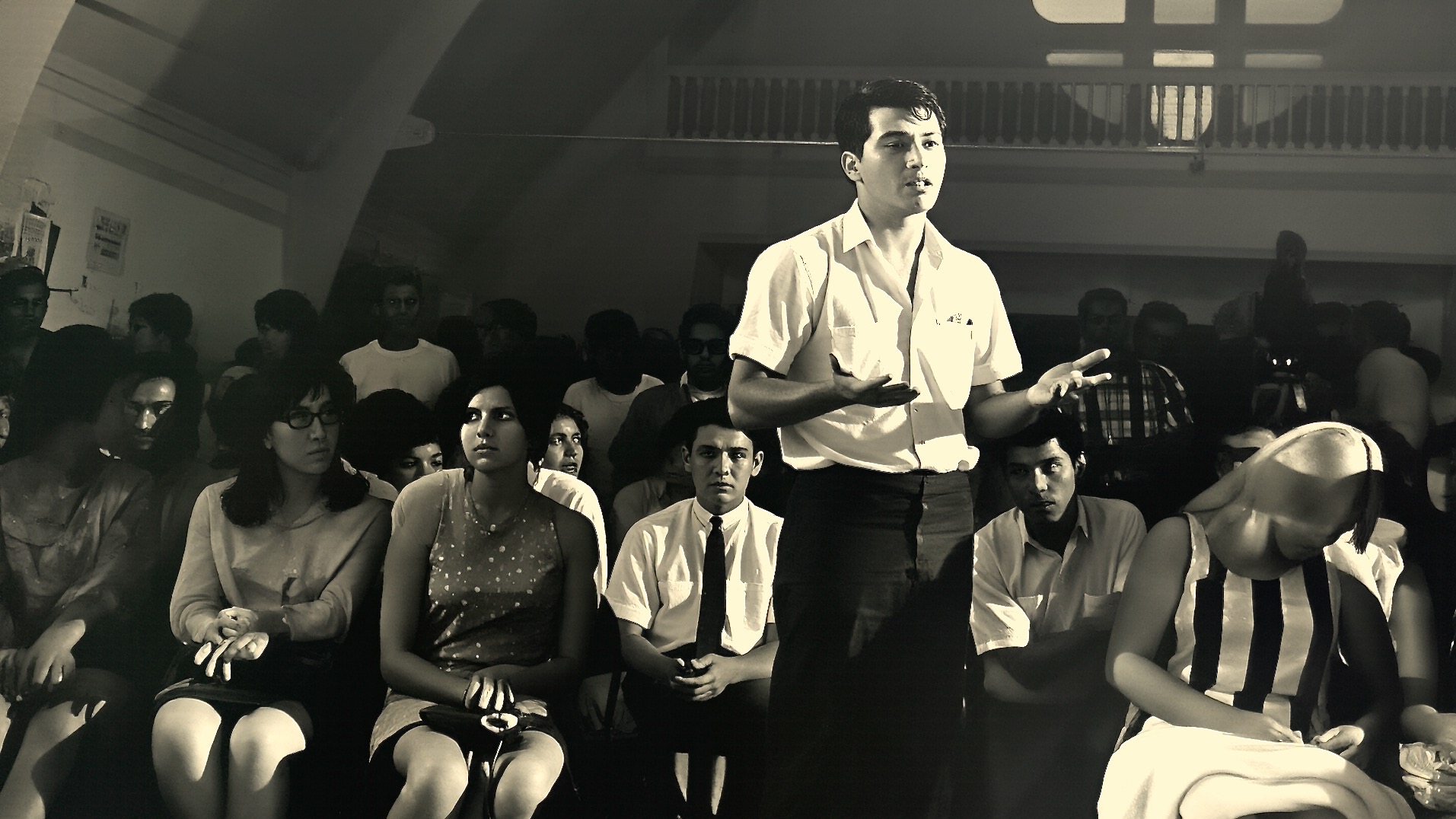
California in the 1960s was boiling with protest, racial conflict, and demonstrations against the Vietnam War. Everything felt provisional. Everything seemed on the verge of becoming something else.
Still trying to understand the country, I helped create an organization called Mission Rebels, working with young Latino Americans caught in drugs, violence, and urban gangs. We had no experience and no resources. Only the sense that indifference itself was a form of failure.
The work grew quickly and brought me into the orbit of Lyndon Johnson’s War on Poverty programs. The idea was deceptively simple: poverty could not be confronted through material aid alone; it also required social organization. The invisible had to be found.
I learned early that poverty is rarely accidental. More often it is organized abandonment.
The work took me into California’s agricultural regions, among migrant families and field workers living in conditions that recalled The Grapes of Wrath. We organized communities, improvised cooperatives, and small forms of everyday resistance. In rural America, poverty possessed a different silence.
In 1968 my daughter, Michiko, was born.
For years I thought of her birth merely as an American root left behind while I continued moving from country to country, language to language, landscape to landscape. Yet her presence remained motionless somewhere inside memory — distant but never absent.
At the time I called it coincidence.
Today I think of it as kismet.
Years later I came to understand that some people cease to occupy a physical place in our lives and begin to exist in another way entirely — as a quiet presence moving through time without ever fully disappearing.
Though distant, her absence became permanent within me, composed of brief dreams, scattered memories, and the persistent feeling that part of my life had remained suspended in that beginning.
In time I learned that children never completely leave our lives. Even from afar they continue traveling with us — silently present in the cities we cross, the decisions we make, the memories we carry without noticing.
Sometime after Michiko’s birth, there came a small interruption in my Californian life.
A brief pause between highways, social conflict, and the permanent noise of America in those years.
I traveled to Japan.
At the time I could not entirely understand what drew me there. Now I think I was searching for silence.
After the combustion of America — protest, poverty, violence, urgency — Japan appeared before me as another speed of time altogether. Everything seemed guided by an invisible delicacy: restrained gestures, silent gardens, the distant sound of water, disciplined streets, reverence for empty space.
I was deeply seduced by it.
I surrendered to Japan with the intensity of someone trying to learn another way of existing. To the soft cadences of the language, the incense drifting through temples, the discreet melancholy hidden inside ordinary things, the aesthetics of simplicity, and the almost spiritual stillness I needed at that moment in my life.
In Kyoto I visited the Golden Pavilion.
I remember the motionless surface of the water reflecting the silent gold of the temple. Nothing seemed to require explanation. For the first time in many years I sensed that peace might not be the absence of conflict, but simply the ability to remain still for a few moments before the impermanence of the world.
The enchantment did not last long.
But certain journeys continue unfolding within us long after we have returned.
Years later, whenever I remembered Japan, I would also return to the voice of Madama Butterfly waiting beside the sea: Un bel dì, vedremo… One beautiful day, we shall see. Perhaps every long absence preserves something of that quiet hope — the feeling that somewhere, in some hidden corner of time, someone is still waiting for our return.
Looking back now, I realize my journey was never merely geographical. While crossing airports, deserts, borders, and provisional cities, I was trying to understand something more difficult than distance itself: the invisible lines separating belonging from exile, memory from forgetting.
After so many years, only one conclusion remains possible.
Perhaps a man’s true homeland is made up of the people, absences, and places he was never entirely able to leave behind.
And perhaps every long journey is nothing more than a slow and imperfect attempt to return to the exact place where a part of us remained behind, waiting in silence.
By Palmarí H. de Lucena