
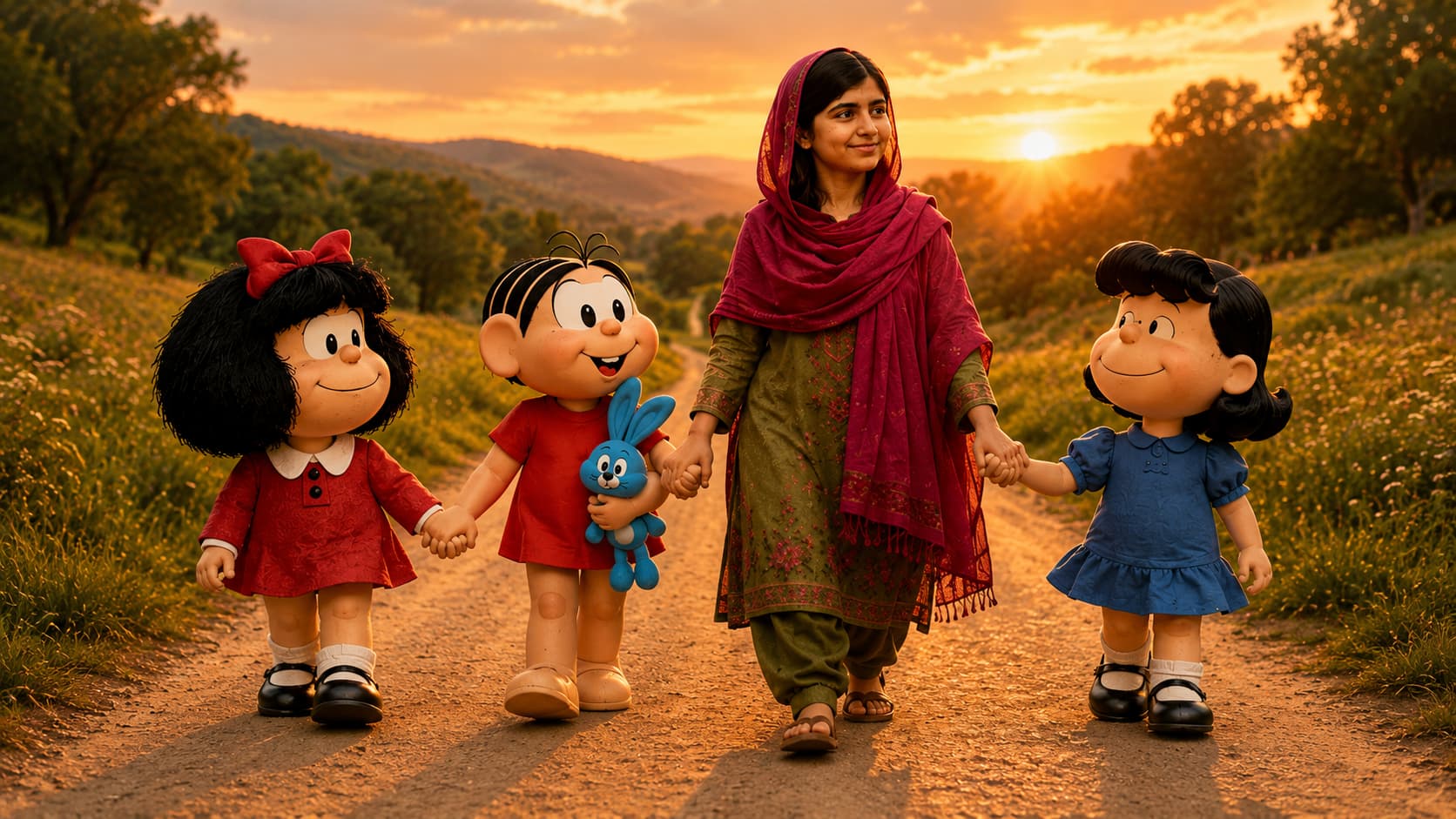
Some revolutions begin almost invisibly. Not in the streets or in manifestos, but in small comic strips printed in the corners of newspapers, where drawn children say what adults can no longer express honestly. Long before concepts such as autonomy, equality, and critical consciousness became central to contemporary debates, Mafalda, Monica, and Lucy van Pelt were already quietly staging a profound cultural transformation.
Coming from different universes, these characters share something rare: the ability to transform childhood into a lens for understanding the world. In their comic strips, childhood ceases to be treated as a passive stage of existence and instead reveals intelligence, restlessness, and moral perception. They are not presented as exemplary heroines or programmatic symbols. They are complex, contradictory, and deeply human children.
In the stories created by Quino, Mafalda observes the world with philosophical astonishment. Wars, inequalities, social conventions, and political inconsistencies appear filtered through the eyes of a child who has not yet learned to normalize absurdity. Her humor emerges from the tension between lucidity and innocence. Every seemingly simple question contains a silent critique of adult complacency. Mafalda understands early on that thinking itself can be a form of resistance.
Monica, created by Mauricio de Sousa, transforms the everyday world of childhood into a territory of self-assertion. In streets, backyards, and games, she occupies the center of the narratives with undeniable presence. She leads, confronts, protects, and reacts without ever reducing her own intensity to meet external expectations. Her strength goes beyond the caricature of the blue stuffed rabbit: she symbolizes the refusal to accept fragility as an obligatory identity. In her stories, existing fully never requires permission.
Lucy, in the melancholic universe of Charlie Brown created by Charles M. Schulz, introduces a more psychological dimension of childhood. Ironic, demanding, and emotionally ambiguous, she seems to understand early that human relationships are shaped by insecurities, disputes, and desires for recognition. Lucy does not seek to appear perfect; she seeks to survive her own contradictions. And perhaps that is precisely why she endures: in the courage to reveal vulnerability beneath the appearance of control.
Together, these three characters form a kind of cartography of modern childhood consciousness. Mafalda questions. Monica occupies space. Lucy interprets the invisible tensions of affection and power. Each of them, in her own way, demonstrates that childhood has never been the absence of thought, but one of the first places where human beings learn to negotiate social rules, identity, and freedom.
It is impossible not to connect this perception with the perspective of Malala Yousafzai, whose journey transformed the right of girls to thought and education into a contemporary symbol of human emancipation. From this perspective, comic strips cease to be merely graphic entertainment and instead become small narratives of intellectual autonomy. What these characters share is the refusal of imposed silence and the conviction that thinking freely is itself a form of existence.
Perhaps the enduring relevance of Mafalda, Monica, and Lucy lies precisely in the delicacy with which they anticipated questions that still shape the present. Through a few lines and brief dialogues, they revealed that humor can also be philosophy, that childhood also produces consciousness, and that seemingly simple characters may contain sophisticated interpretations of the human condition.
In a time saturated by rapid discourse and instant certainties, their comic strips preserve something rare: the intelligence of doubt. Mafalda continues asking what the world avoids answering. Monica continues refusing any diminishment of her own presence. Lucy remains a reminder that growing up means learning to live with ambiguities without entirely losing authenticity.
In the end, Mafalda, Monica, and Lucy van Pelt endure less as children’s characters and more as lasting metaphors for the formation of human consciousness. In each of them survives an essential lesson: the courage to question, the dignity of occupying one’s own space, and the honesty of existing without concealing contradictions. Through the lucid perspective of Malala Yousafzai, these trajectories converge toward a simple yet profoundly contemporary truth: every childhood carries an intellectual and moral potential that the world too often underestimates.
By recognizing in children the capacity to think critically, question injustice, and affirm their own voices, we understand that freedom, consciousness, and humanity do not begin in adulthood. They are born much earlier — in the silent moment when a child discovers that she, too, can interpret the world, disagree with it, and perhaps even transform it.
By Palmarí H. de Lucena