
An Autumn Walk through the Place des Vosges and an Encounter with Victor Hugo
Some places seem to hold time within their walls. Not simply the time recorded in history books or marked by dates, but something quieter and harder to explain: the accumulated presence of lives once lived, conversations long forgotten, encounters that came and went, and memories that somehow refuse to disappear. The Place des Vosges, in the heart of Paris, is one of those places.
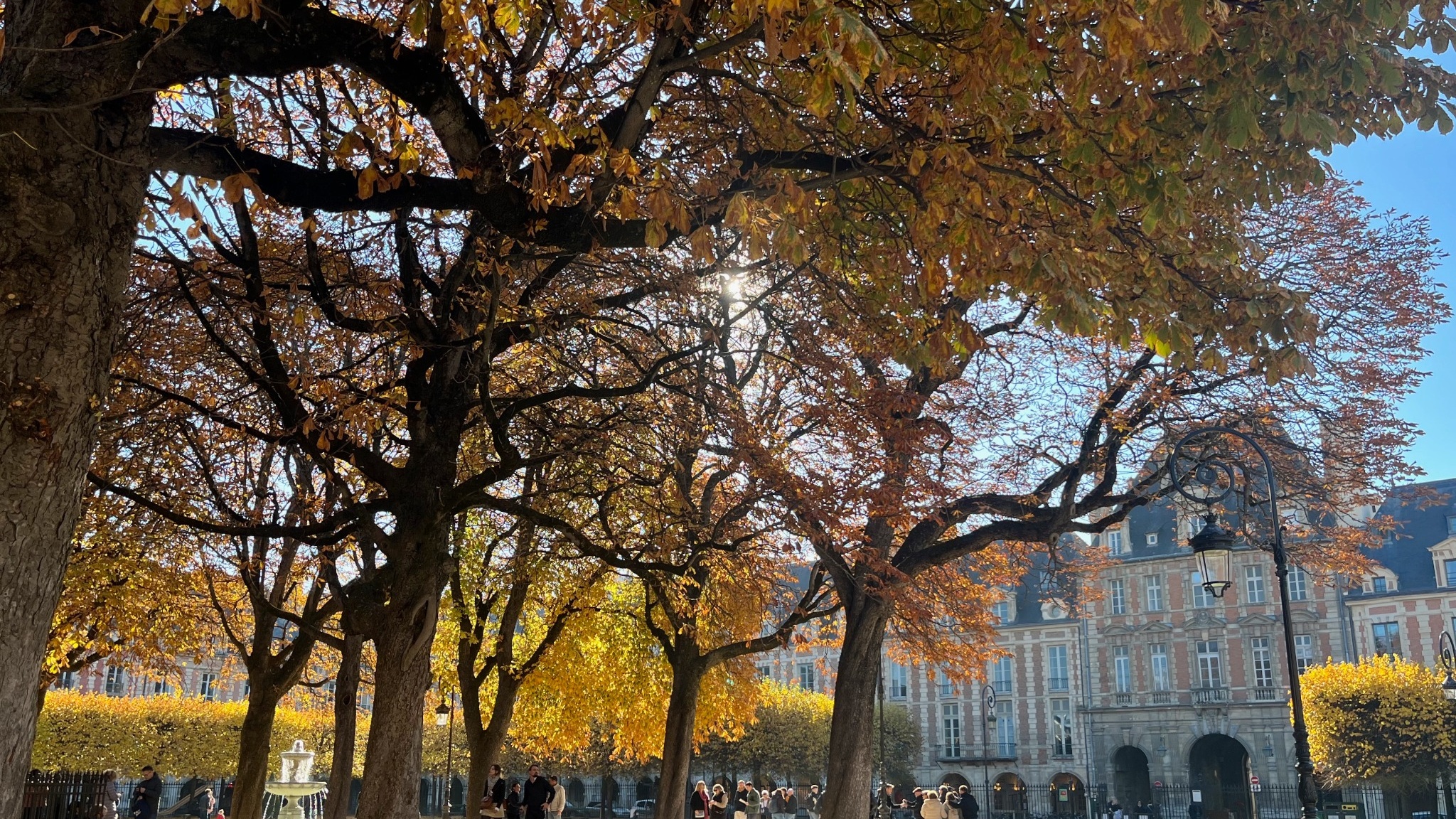
I began to sense this on an autumn afternoon, while walking through the square. The season had given the landscape the colors of an old painting: golden leaves, copper tones, ochre, burnt red, and the last traces of green clinging to the branches. Some leaves had already settled along the pathways. Others still hung in the trees, as if reluctant to let go.
The colorful foliage stood in striking contrast to the red-brick façades, the elegant arcades, and the quiet dignity of the old stone buildings. Sunlight filtered through the branches, casting shifting shadows across the ground. Nature and architecture seemed to be engaged in a conversation that required no words. Past and present occupied the same space, while the buildings stood silently, bearing witness to lives and generations that had long since passed.
Perhaps autumn makes us more aware of these things. It is the season when nature reminds us that change is not an interruption of life but one of its essential conditions. Leaves turn color before falling; trees that appear suddenly bare are already preparing for another cycle. There is a certain melancholy in this process, but also a quiet kind of beauty. Even what is leaving us can be complete in its own way.
Against this backdrop, visiting Victor Hugo’s former apartment took on a particular meaning. Walking through the rooms where the writer once lived, now preserved as a museum, felt like approaching a presence that time had failed to erase. The furniture, books, personal objects, and traces of domestic life were more than historical artifacts. They were fragments of an existence.
There is something deeply moving about entering a home knowing that someone once thought, wrote, loved, suffered, welcomed friends, and looked out at the world from those very rooms. We do not actually meet Victor Hugo there. What we encounter are the traces he left behind. The house remains, but its inhabitant is gone. The objects have survived, although their meaning has changed. What was once ordinary has become memory; what belonged to one man’s private life has become part of our shared cultural inheritance.
Standing in those rooms, I found myself wondering what truly remains of a person after death. Certainly, there are books, ideas, and works of art. But there are also the places people inhabited, the objects they touched, and the landscapes they once looked upon. Things carry their own quiet memories. They bear witness without having to speak.
It was then that I remembered a reflection by Victor Hugo, recorded in his notebooks in 1861, about the curious resemblance between rocks and clouds:
“There are ghosts in granite, just as there are in smoke. What seems most immovable is changing and deceiving us, just as what appears most fleeting does.”
The thought has an extraordinary philosophical delicacy. Hugo brings together two things we instinctively place at opposite ends of the spectrum: stone and cloud, permanence and transience, solidity and movement. He invites us to question appearances. Stone, too, is changing, although on a scale of time our eyes can barely register. A cloud may vanish in minutes, yet its image can remain for years in the memory of someone who happened to look up at the right moment.
The ghosts in the granite suggest that every material thing carries a history. Every surface bears the marks of an earlier time. What we call stillness is often only movement unfolding beyond the limits of human perception.
After that recollection, the Place des Vosges seemed different to me. The buildings, which had appeared to defy time, now seemed to reveal the history they had quietly absorbed. Those façades had witnessed generations, political upheavals, revolutions, encounters, and farewells. The architecture had endured, but the world around it had never stopped changing.
Even the objects in Hugo’s apartment seemed to acquire a different significance. A chair was no longer simply a chair, nor a book merely a book. Each appeared to contain a small narrative, as though the house itself were inviting us into a conversation with the past.
This sensitivity to time and memory runs throughout Hugo’s work. In The Hunchback of Notre-Dame, the cathedral is far more than a magnificent structure. Its stones hold the collective memory of a city and a civilization. Architecture becomes both a character and a witness to the passage of time.
In Les Misérables, Hugo turns his attention to the human condition, exploring its social and moral complexities. Jean Valjean, marked by punishment and suffering, discovers through generosity and compassion the possibility of rebuilding his life. No human being, Hugo seems to suggest, should ever be reduced to appearances, past mistakes, or the circumstances that define a particular moment.
There is a profound connection between this humanist vision and his meditation on stone and clouds. Just as we should not mistake the apparent stillness of matter for an absence of change, we should not mistake a person’s present condition for the whole truth of who that person is. Behind every appearance lies a history. Behind every difficult circumstance, there may be another possibility. And beneath what we think we understand, there is often a humanity we have simply failed to recognize.
In Les Contemplations, nature, memory, absence, and grief become ways of exploring the deeper questions of existence. What disappears physically does not necessarily cease to exist. Some presences survive precisely through absence.
Perhaps this is also a way of understanding our own lives. We are made of things that endure by changing and things that change while leaving lasting marks. Experiences we once considered temporary become permanent parts of our memories. People who are no longer with us continue to shape our decisions and influence the way we see the world. A sentence spoken decades ago may still echo in our minds, while entire years seem to vanish without leaving a trace.
Memory has a peculiar power: it turns what has disappeared into an inward presence. A demolished house may remain standing inside us. A voice we can no longer hear may still sound perfectly clear. A landscape glimpsed for only a few moments may acquire, with the passing years, an unexpected depth.
Autumn offers its own gentle metaphor for this condition. Not every farewell is a disappearance. Some things leave our sight but continue to work upon our consciousness. Others must surrender their former shape before something new can begin.
We live, however, in an age that seems to have lost its patience with contemplation. Everything must happen quickly, be made visible, photographed, shared, and consumed. We visit places, take pictures of monuments, record moments, and move on. But how often do we actually stop and look?
There is a difference between seeing and looking. Seeing means recognizing the shape of things. Looking means allowing them to reveal something of their meaning. Perhaps this is one of the lessons Victor Hugo still has to offer us: the importance of moving beyond the surface and recognizing the complexity hidden in what might otherwise seem ordinary.
The ability to look deeply also carries an ethical responsibility. If we learn to recognize the history hidden in things, perhaps we can learn to look at people beyond their appearances, circumstances, and moments of difficulty. The same sensitivity that discovers ghosts in granite may also help us recognize humanity where indifference sees only differences or apparently fixed destinies.
As I left the Place des Vosges, I had the feeling that the visit had not really ended at the museum door. The square was still there, its trees dressed in autumn colors, golden leaves scattered across the paths, and red façades absorbing the last light of the afternoon. There was a sense of farewell in the landscape, but no sadness. Its beauty did not depend on permanence. It came from the awareness that everything changes.
Perhaps that was the greatest lesson of the walk. Beauty is not found only in what remains, but also in what changes before our eyes. Autumn does not diminish the trees by taking away their leaves; it reveals another expression of their existence. Stone is not remarkable simply because it endures. It bears witness to a passage of time that continues to act upon it. And places become unforgettable not only because of their architecture, but because of the experiences and questions they awaken in us.
In the end, we are made of the same contradictions. There is something of granite in the convictions that hold us together, and something of cloud in the feelings that continually transform us. We preserve memories as though maintaining old buildings, yet we reinvent ourselves with every experience that passes through our lives.
Perhaps the real value of travel lies not simply in the places we visit, the photographs we bring home, or the monuments we admire. It lies in what those places change in the way we see the world. Some cities offer us landscapes. Others offer us history. And a few, like Paris, leave us with questions that continue to accompany us long after we have gone.
After Victor Hugo, stone is no longer just stone. Nor is a cloud merely a cloud. Both carry something of ourselves: our desire to remain, our unavoidable need to change, and the mystery of continuing to exist even when we are no longer quite the same.
There are places we visit. And then there are places that find a way to live inside us. The Place des Vosges has become one of those places for me. And Victor Hugo, in his own remarkable way, continued the conversation long after I had walked out of his home.
Palmarí H. de Lucena