
Some things travel across centuries without making a sound.
Not empires, armies, or treaties. Gestures. Words. Songs. Sometimes, a dance.
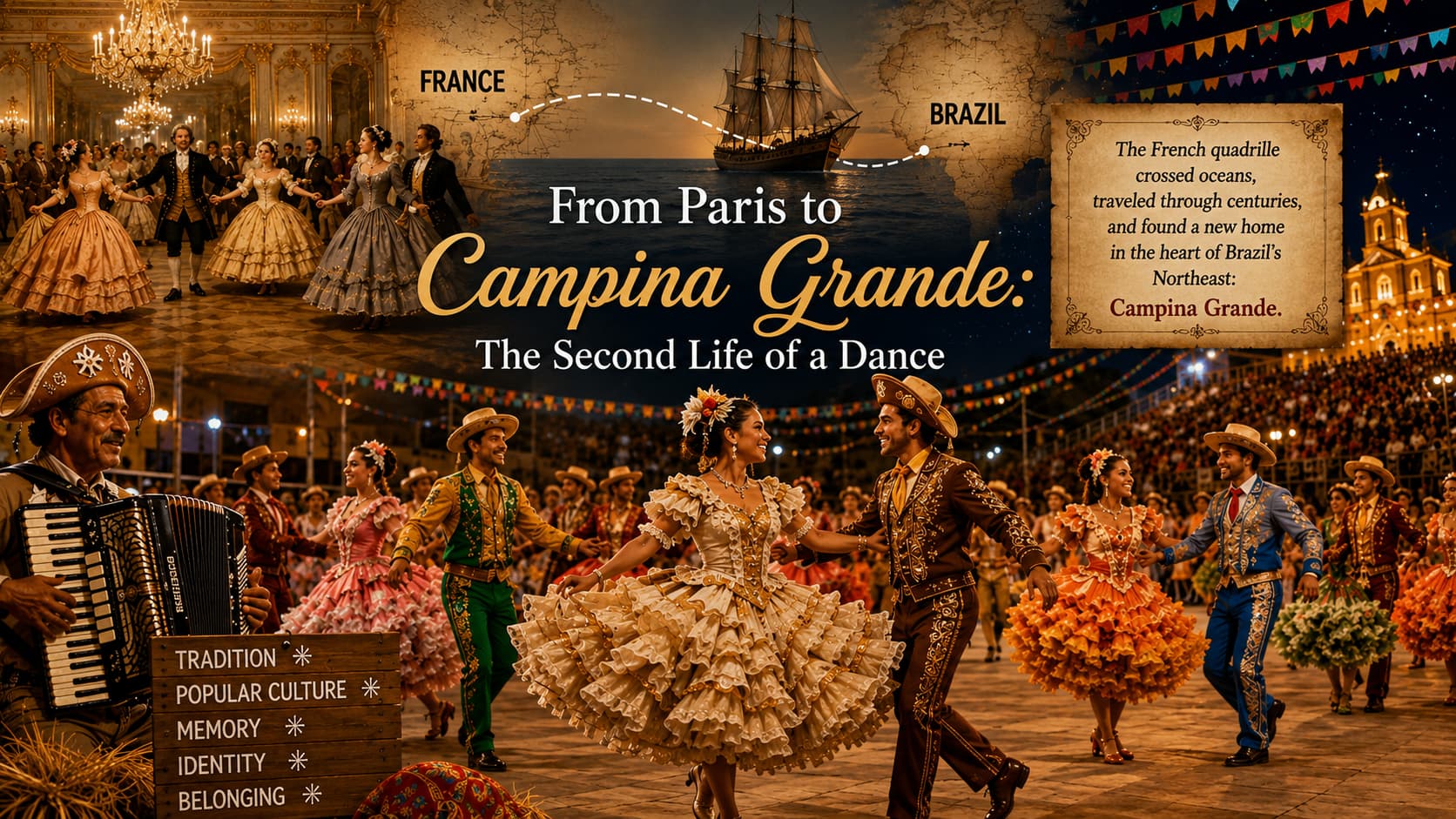
No one knows exactly when the quadrille decided to leave France. Perhaps it slipped away on a winter night, escaping the glittering salons where ladies and gentlemen traced elegant patterns across polished wooden floors. Perhaps it crossed the Atlantic hidden among the cargo, soldiers, and imperial ambitions packed into the holds of ships bound for distant shores.
What is certain is that it left.
In the eighteenth century, it was known as the quadrille. It was a child of etiquette, geometry, and order. Four couples moved according to figures so precise they might have been designed by architects. Everything possessed measure, rhythm, and symmetry. The dance reflected the society that produced it.
But the world has a habit of transforming whatever it carries.
When the quadrille arrived in Brazil, it encountered a land where the seasons obeyed a different calendar, where celebrations blended devotion with joy, and where people possessed the rare talent of reinventing whatever they received. The dance gradually began to acquire a new accent.
It lost its rigidity.
It gained laughter.
It abandoned chandeliers in favor of bonfires.
The grand salons gave way to open courtyards. Aristocratic gestures learned to coexist with popular spontaneity. French commands survived as aging travelers of memory—anarriê, balancê—their passports long expired, already belonging to another world.
And so the quadrille became the quadrilha.
Yet its journey was far from over.
Some traditions, it seems, are destined to discover their truest form far from where they began.
Every June, Campina Grande transforms itself into a kind of imagined capital of Brazil’s Northeast. For several weeks, the city’s clock appears to keep time not by minutes but by the accordion. The nights glow beneath strings of colorful flags fluttering in the wind like fragments of sky stitched to the earth. The scent of roasted corn mingles with cinnamon. The crackle of bonfires answers the rhythms of forró. And crowds gather to celebrate something that is at once festival, memory, and ritual of belonging.
It is here that the quadrilha reveals its second life.
To watch it enter the arena is to witness far more than couples dancing.
One sees a narrative.
One sees a people telling their own story.
The dresses whirl like storms of color. Partners cross paths, separate, and find one another again. There are romances and farewells, harvests and promises, droughts and hopes. Each performance gathers fragments of Northeastern history and turns them into movement.
The dance no longer recalls only France.
It recalls the sertão – the Brazilian backlands
It recalls the cattle drivers who followed dusty trails beneath the fierce sun of the Borborema Plateau. It recalls farmers who learned to celebrate even in difficult years. It recalls women who embroidered, sang, and carried traditions from one generation to the next. It recalls accordion players who transformed longing into a form of music.
Perhaps that is why Campina Grande does not preserve the quadrilha the way one might preserve a rare artifact behind glass.
It reinvents it.
Year after year.
As though tradition were less an object from the past than a fire that must be continually fed to remain alive.
When the festival ends, when the lights dim and the final notes dissolve into the Paraíba dawn, a curious impression remains: the sense that the quadrilha continues dancing even after the music has stopped.
Because some journeys never truly end.
The dance that was born among French mirrors found, in the heart of Brazil’s Northeast, something greater than a stage. It found a people capable of adopting it without merely imitating it, transforming it without destroying it, and loving it without forgetting that culture itself depends on movement.
And perhaps that is the secret of Campina Grande.
Not that it preserved a foreign inheritance.
But that it gave it a new soul.
After all, there are travelers who pass through the world. And there are travelers who discover, somewhere along the way, a place to begin again.
Palmarí H. de Lucena