
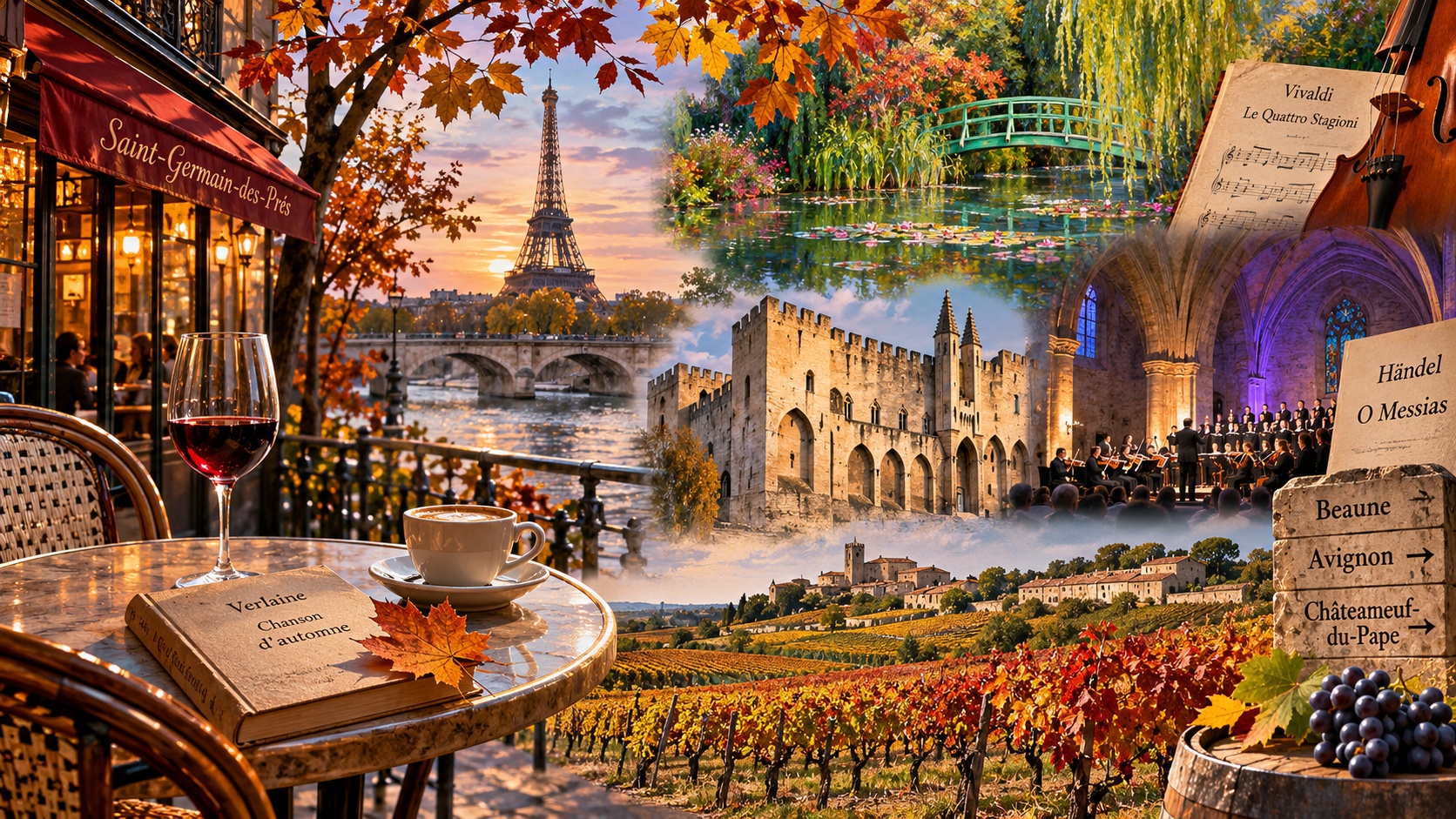
A Literary Journey Through Landscapes, Borders, and the Emotional Geography of Travel
Some journeys begin at the airport. Others begin much earlier, with an image that takes hold without asking permission: a rain-soaked street, a window glowing at dusk, the glint of a wineglass against the dark wood of a table. France had been accompanying me in this way for years, assembled from memories, books, and images accumulated over time. The country I had imagined traveled alongside me; the real one was waiting, perhaps, to challenge that image—and to surprise me.
We left Recife on an October evening. After a connection in Lisbon, we arrived in Paris late in the afternoon. The slanting light settled over the façades, lending even ordinary streets the suggestion that they concealed some private secret. Autumn had already begun to announce itself in the trees: yellow, ocher, and russet leaves outlined against a low, occasionally golden light.
I found myself thinking of Paul Verlaine and the opening lines of his Chanson d’automne: Les sanglots longs des violons de l’automne—the long sobs of autumn violins. The season seemed to be answering the poet. There was melancholy in the air, but no real sadness; rather, the delicate beauty of things that change and, precisely because they do, become precious. Autumn would be the quiet music accompanying us throughout the journey.
In Saint-Germain-des-Prés, we went looking for a café. I wanted first to recognize the sound of the city: a spoon touching porcelain, a chair scraping across the floor, the murmur of conversations, a waiter who seemed to know every table by heart. Nothing extraordinary was happening. And yet I had the impression that an entire life could fit inside that moment. Perhaps literature begins this way: when the ordinary, observed without haste, reveals a hidden passage into something larger.
In Giverny, I encountered a landscape I had first known in spring. Now yellow, copper, and crimson descended from the trees toward the pond. The Japanese bridge remained where it had always been; the willows leaned their branches over the water. But the garden was telling a different story—or perhaps I was the one arriving with a different way of listening.
I thought of Monet, forever trying to capture what refuses to remain still. Light offers itself for an instant and then withdraws. In spring, the garden seems full of promise; in autumn, it seems to remember. To return to a place is to discover that memory can preserve a landscape but cannot hold its breath. I left with the feeling that to look is both to say goodbye and, somehow, to remain.
At La Chapelle, a concert devoted to Vivaldi’s The Four Seasons offered another way of experiencing time. Music transformed the changing natural world into sound. I thought about the kinship between music and painting: both attempt to hold still what is perpetually passing. Music, however, disappears even as it is being made, and perhaps that is why it settles so deeply into memory.
We left Paris for a while and traveled to Beaune. Its streets, shops, and ancient walls seemed to invite a slower pace. The town did not need grand dimensions to command our attention. The past remained woven into the present, while autumn poured its golden light over the old stones.
In Avignon, the city walls and the Palais des Papes asserted the enduring presence of stone. The palace contains centuries of power, faith, and conflict. It recalls the period when the city became a center of Western Christendom, but it also led me to consider the relationship between religion and politics: when faith draws close to power, it acquires an address, an institutional structure, and influence.
It was in Avignon that we experienced one of the most moving moments of the journey: a performance of George Frideric Handel’s Messiah at the Church of Saint-Symphorien-les-Carmes. I remembered a winter evening in New York, when I had first heard the work. Since then, it had become part of our Sunday mornings. Years later, I learned that my daughter had also sung it in San Francisco. I had not been there to hear her, but the music had begun to connect memories from different times and places.
Inside the church, ancient walls received the voices and instruments. The solo voice seemed to approach in a tone of intimacy, almost confession; during the great choral passages, the music took possession of the space, setting the very stone in motion. By the time the Hallelujah chorus arrived, the emotion could no longer be separated from the architecture.
Messiah speaks of suffering, hope, and redemption. Against the background of wars, violence, and the abuse of power, I found myself thinking about the distance between promises of consolation and the reality of so many wounded lives. The words of Isaiah—“For unto us a child is born, unto us a son is given”—brought to mind the children growing up in devastated territories, deprived of safety and of any reliable sense of the future.
I do not expect music to stop a war or repair an injustice. Art cannot take the place of political responsibility, but it can prevent us from becoming reconciled to the intolerable. It can remind us that human dignity is not a negotiable commodity. In the choir, every voice retained its own identity; harmony emerged, nevertheless, from the act of listening and from the willingness to meet. I left the church deeply moved, but also unsettled.
After Avignon, we continued to Châteauneuf-du-Pape. The vineyards traced a different relationship between time and nature, one shaped by the cultivation of grapes and the patient making of wine. A bottle contains the geography of a particular patch of earth, the temperament of a season, the labor of many hands, and the decisions of those who oversee the fruit’s transformation.
Viticulture demands attention to soil, climate, water, and vines. Above all, it demands patience. From pruning and flowering to harvest, each stage follows its own rhythm. The tradition, observed in some agricultural practices, of taking the phases of the moon into account reflects an older body of knowledge and a particular attentiveness to the natural world. Wine is a form of liquid memory: it preserves, in aroma and flavor, traces of a place and a moment in time.
In Alsace, Colmar welcomed us with its canals, colorful houses, and façades that seemed to have emerged from a painter’s box of colors. Along the Petite Venise, the water returned the buildings in trembling reflections, extending their colors into the current. Beauty resided as much in the composition of the squares as in the shimmer of a window above the river.
Eguisheim, with its half-timbered houses, gardens, and brightly painted façades, possessed an almost domestic delicacy. Neuf-Brisach offered a different geometry. Its fortifications, designed by Vauban during the reign of Louis XIV, imposed a landscape of precise lines, angles, and defensive walls. What had once been built to protect a border had become a place of historical inheritance. There is something moving about seeing old barriers transformed into sites of encounter.
Alsatian identity is shaped by affinities as well as tensions. French and German inheritances coexist in the streets, the names, the architecture, the language, and the food. Borders have shifted, but coexistence has endured—in a recipe, a word, the design of a window. In autumn, the leaves and the golden light added their own music to the landscape.
We also crossed into Germany and Switzerland. In Freiburg, the small streams known as Bächle ran alongside the sidewalks, while the Gothic cathedral presided over the square. Bicycles, market stalls, and residents gave the streets their everyday movement; Oktoberfest brought music and a spirit of conviviality. I also carried away the kindness of those who helped us along the way. Monuments impress the eyes. Hospitality reaches somewhere more intimate.
In Basel, the Rhine opened the horizon. The reddish cathedral and the old streets seemed to hold their histories within the stones, while the river continued its course, indifferent to the borders drawn by human beings. France, Germany, and Switzerland appeared less separate than any map might suggest. Each place preserved its language and customs, yet architecture and gastronomy revealed centuries of contact. Preserving one’s identity does not require closing the door to someone else’s.
Late in the afternoon, we returned to Colmar. Golden light enveloped the façades, the canals reflected the houses in small, wavering mirrors, and the aromas of Alsatian cooking mingled with the scents of the region. The farewell was already beginning there, made of beauty, memory, and hospitality.
Back in Paris, the city no longer seemed quite the same as the one that had welcomed us. To encounter a familiar street or façade again is to recognize that every place carries the shadow of its first appearance. We returned to the Marais, where historic buildings, shops, galleries, and cafés coexist with the energy of contemporary city life.
At Place des Vosges, the harmonious façades, arcades, and slate roofs created an atmosphere of quiet elegance. We visited the former home of Victor Hugo, now a museum. The author of Les Misérables and The Hunchback of Notre-Dame, Hugo gave a voice to the forgotten, denounced injustice, and defended freedom and human dignity. Walking through his former residence brought me closer to the man behind the books and reminded me of the part literature plays in the life of a society.
The Musée de l’Homme offered another perspective. After so many cities and traces of civilizations, contemplating the history of our own species—its origins, differences, and cultures—changed the scale of the journey. The museum returned us to an essential question: What does it mean to be human beyond borders, languages, and historical periods?
At another moment, the Eiffel Tower appeared through the rain. The gray sky and mist did nothing to diminish its beauty; perhaps they made it seem more approachable, almost confidential. Some places do not depend on blue skies or perfect light to reveal their grandeur. The tower remained there, steadfast, sharing the rain and the passage of time with us.
We had reserved Notre-Dame for the final chapter of our time in Paris. On the Île de la Cité, the towers, sculpted portals, rose windows, and soaring Gothic lines gathered together an essential part of the city’s memory. The cathedral has endured centuries, revolutions, and transformations. The fire of 2019 and the subsequent reconstruction added another dimension to its history: one of fragility, but also of the human capacity to begin again.
To enter Notre-Dame is to enter an essential part of Europe’s collective memory. Faith, art, history, and the experience of generations meet within its walls. The light passing through the stained glass, the height of the vaults, and the delicacy of the architectural details invite a kind of pause that requires neither religious belief nor explanation. Some spaces simply ask us to slow down and listen to the silence.
After our visit, we had dinner at Le Procope. Among the tables, the decorative details, and the intimacy of the dining room, the meal took on the character of a closing ritual. It was more than our final dinner. It was our way of thanking the city and gathering the memories we had accumulated along the way. The farewell lingered at the table, between the memory of Notre-Dame and the echoes of other centuries.
Standing before the cathedral and, later, sitting at a table at Le Procope, I felt that the journey had arrived at its own synthesis. We had traveled through towns protected by walls, contemplated palaces and cathedrals, listened to Vivaldi and Handel, walked among vineyards, and crossed national borders. At every stop, something had spoken to us about the passage of time and the persistence of memory.
In November, the time came to leave. The airport returned the journey to its familiar vocabulary of schedules, suitcases, and departure gates. But no departure coincides entirely with an ending. Giverny remained with me in two different lights: the spring I had known before and the autumn now added to that memory. Avignon held Handel; Châteauneuf-du-Pape, its vineyards; Alsace, the canals of Colmar and the fortifications of Neuf-Brisach. The Rhine continued on its way, while Paris took leave of us through the luminous stone of Notre-Dame.
Perhaps traveling means setting out in search of a country and returning with moments that resist being neatly arranged. France does not reveal itself completely, nor does it need to. It leaves its traces in water, stone, wine, music, and light. Europe reveals itself less as a collection of borders than as an old conversation among peoples, landscapes, and histories.
I did not bring home a definitive version of the places we visited. What I brought back was the memory of having paid attention to the world: to the beauty of a façade, the silence of a church, the vibration of a choir, the water in a canal, the generosity of a stranger, and the light that persists even on rainy days.
Perhaps this is what remains of a journey: not the number of cities crossed off an itinerary, but the quiet transformation of the way we see. We travel, too, to recognize something of ourselves in the world.
Palmarí H. de Lucena