
There is a Brazilian temptation to turn travel into an accomplishment. Three countries in one day sounds pretty good. France for breakfast, Germany for lunch, Switzerland before dinner. You can almost hear the itinerary congratulating itself.
Our journey began in Colmar, in Alsace, as part of a small-van tour led by Catharine Paccoud, a very experienced, knowledgeable, and thoughtful guide. From the beginning, her way of conducting the tour made the difference. She combined an impressive understanding of the region’s history, culture, and traditions with a genuine sensitivity to the places we visited. Rather than simply taking us from one destination to another, she helped us understand the connections between them, making the day both informative and thoroughly enjoyable.
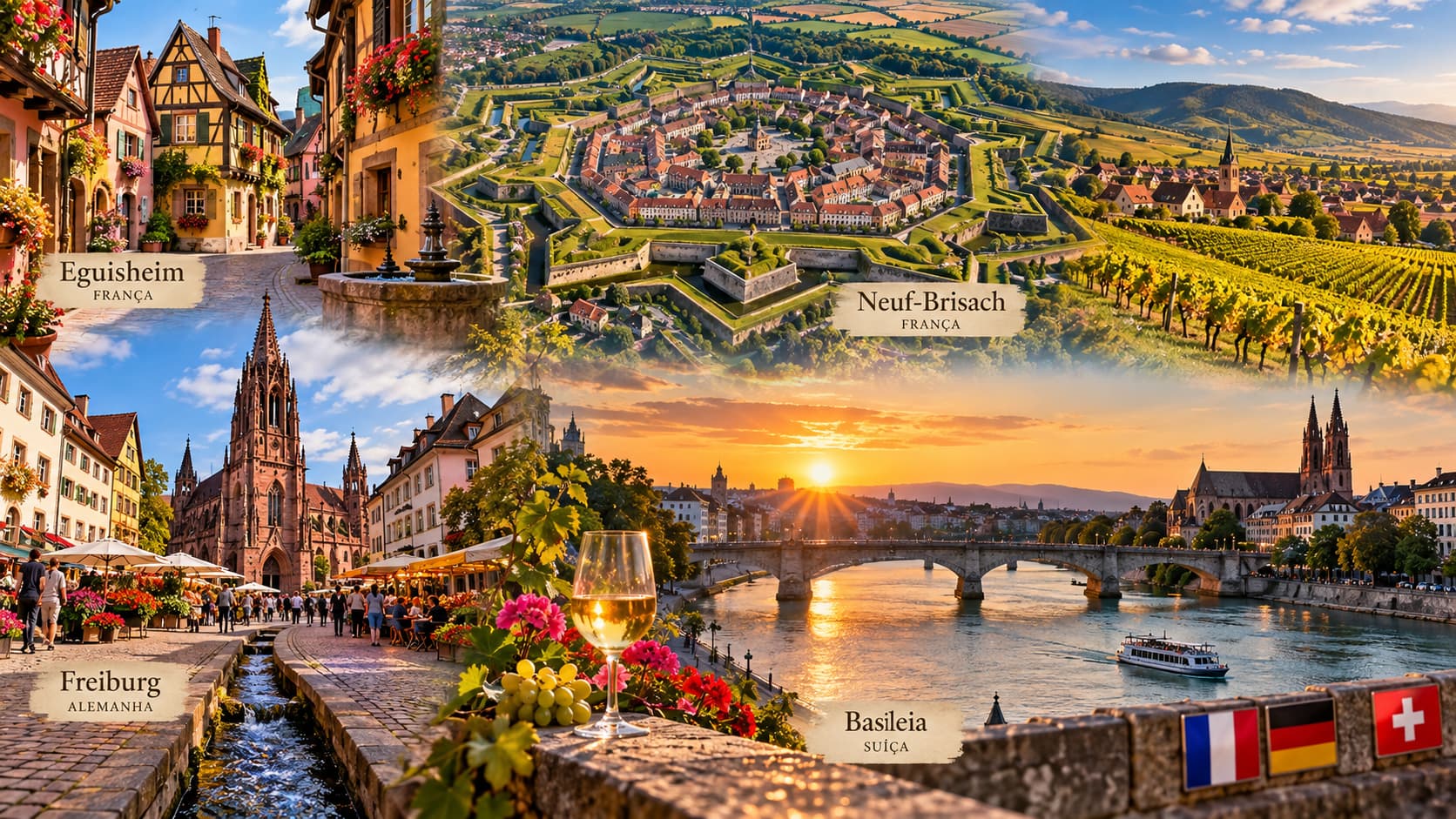
Eguisheim was like that. The houses were painted in soft shades of yellow, pink, and blue. Flowers crowded the windows, and the streets curled around the village in circles. You could walk for ten minutes and end up almost where you started. In most places, that would be bad navigation. Here, it was a good reason to keep walking.
Alsace has spent centuries caught between France and Germany. You can see the history in the architecture, hear it in the names, and taste it in the wine. Borders may look tidy on a map, but culture is rarely so cooperative. People borrow words, recipes, building styles, and habits from their neighbors. They do it for generations, then argue about whose tradition it is.
A glass of Riesling or Gewürztraminer makes the argument seem less urgent. The wine is local, but the story behind it crosses borders. You don’t have to be a wine expert to appreciate that. In fact, a little ignorance can be an advantage. You spend less time explaining what you taste and more time enjoying it.
At Neuf-Brisach, the mood changed. Vauban designed this fortified town during the reign of Louis XIV, when France took its borders seriously enough to surround them with elaborate systems of stone and earth. The walls and bastions are impressive, and the town’s geometry is almost unnervingly precise.
Today, people arrive to admire the defenses, take pictures, and look for somewhere to have lunch. The old fortifications have found a second career in tourism. What once kept people out now gives them a reason to come in.
There is something reassuring about that. History is full of structures built to divide people that eventually become places where people meet. We may not always learn the lesson, but at least we know how to sell tickets to it.
The drive into Germany was less dramatic than the history might suggest. No grand announcement, no sudden change of scenery. The signs changed, the language changed, and the road went on. Vineyards gave way to fields, villages appeared between the hills, and church towers rose above the rooftops.
Freiburg was lively without seeming hurried. Its Gothic cathedral stood above the market square, where people bought flowers, fruit, and food. Along the sidewalks, small channels of running water known as Bächle gave the streets an unexpected feature. Children watched them; adults stepped around them. Local legend says that anyone who accidentally falls into one will eventually marry someone from Freiburg. It is an ingenious way to turn a drainage system into a romantic prospect.
The city also had the energy of October celebrations, with music, traditional clothing, food, and beer. People gathered under festival tents, talking over the bands and raising their mugs. For a visitor, it was a reminder that a city is not just what was built centuries ago. It is also what its residents do on a Saturday afternoon.
By the time we reached Basel, the Rhine seemed to offer a different kind of lesson. The river passed through the city without any visible interest in the national borders along its banks. France, Germany, and Switzerland had their own rules and identities. The water kept moving.
Standing beside the Rhine, I thought about how much effort people devote to drawing lines on maps. Some borders are necessary; some have been fought over for generations. Yet in this corner of Europe, three countries meet so closely that the landscape makes separation look like only one part of the story.
By late afternoon, we were back in Colmar. The light had softened, the houses seemed warmer, and the smell of Alsatian cooking made further sightseeing less appealing. After a day spent trying to see as much as possible, the simplest pleasure was to stop moving.
I came away with photographs of villages, fortifications, canals, cathedrals, and the Rhine. But the best memories were less organized: a kind gesture from a stranger, a street we hadn’t planned to visit, a view that made us pull over, a glass of wine that seemed to belong exactly where we were drinking it.
Three countries in one day makes a good story. The better story is what happens between the stops. The road passes through landscapes that do not announce themselves as attractions. People go to work, buy bread, tend vineyards, and get on with their lives. The traveler passes through briefly, but for a moment gets to see how the pieces fit together.
Europe does not become simpler when you cross more borders. It becomes more interesting. And sometimes, after a long day on the road, the whole continent seems to come down to a simple proposition: take the scenic route, pay attention, and never underestimate the value of a good glass of wine.
Palmarí H. de Lucena