
I returned to Africa in 1980, this time to stay. The decision began far from there, in a small column buried in the New York Times: a director was wanted for a humanitarian program. We later learned it was run by a Catholic agency. That was enough. It wasn’t charity that drew us — that word is too blunt, too easily misplaced — but the desire to be present, to share time and uncertainty. We applied. We were accepted. We left.
Accra offers no transition. The airport is a collision: overlapping voices, languages crossing mid-air, the thick smell of palm oil, music appearing without visible source. Porters assume control of your arrival. Nothing asks permission. The city does not explain itself; it asserts itself.
Scarcity was evident, but not definitive. There was a practical intelligence at work — an economy of improvisation. Cloth became clothing; clothing became something else again. In Akan, they called it obruni waawu — “dead white man’s clothes.” Said without drama, as one might describe the weather.
The body followed different rules. Breasts were not a subject; they were function. Crossing one’s legs, however, could be read as provocation. Small inversions that unsettled our maps.
Months later, a container of bras arrived — the result of distant good intentions. Too small, almost all of them. They were accepted anyway. Cut, sewn, reimagined as handbags. The foreign labels displayed as value. Sold across the border in Togo. With the money came water, tools, shelter. No speeches — only solutions.
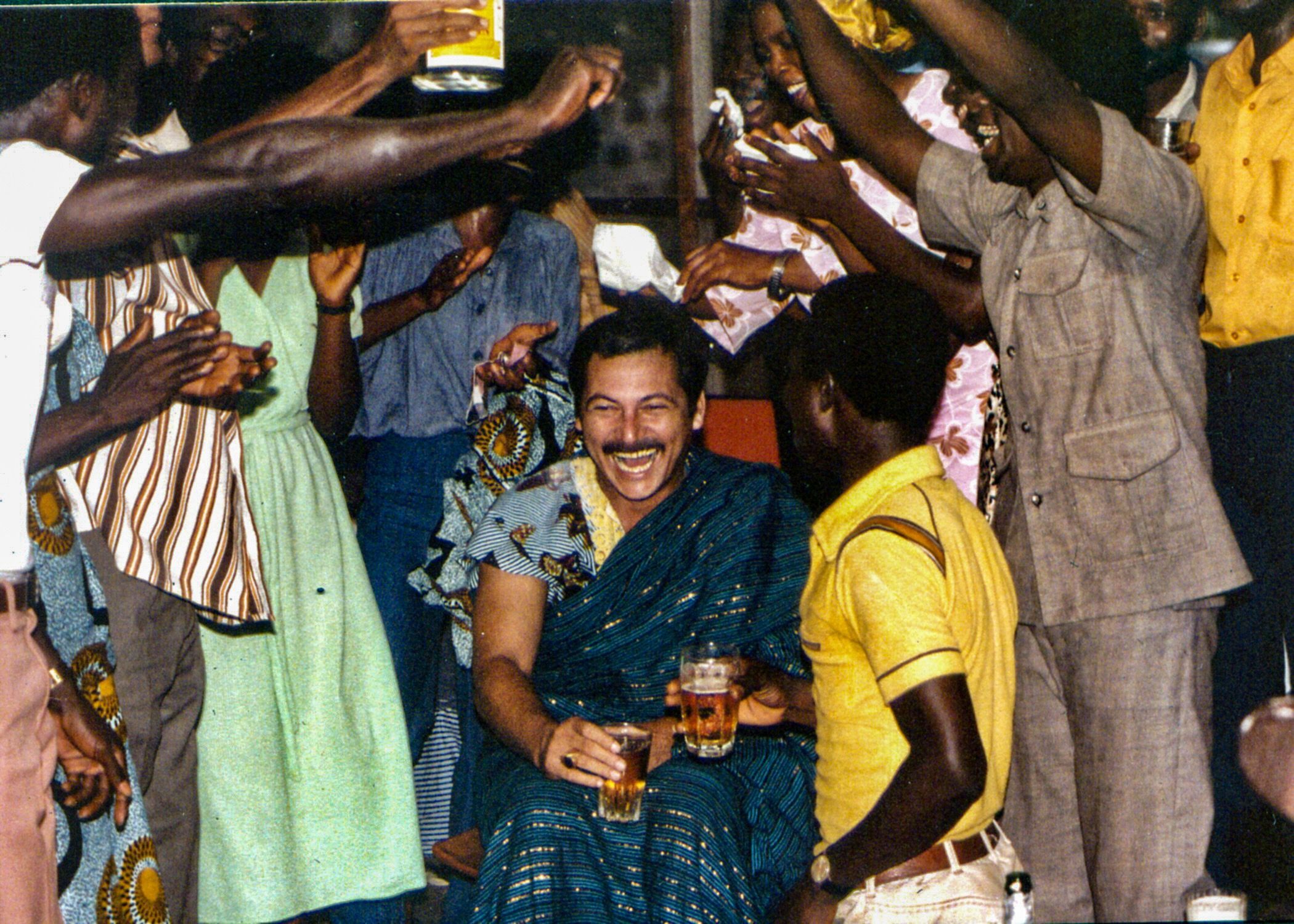
In time, I understood that even where very little existed, the gesture remained. A readiness for the other, offered without ceremony. One day, our house was overtaken by a group of Ghanaians — laughing, speaking loudly, purposeful. I was led to a nearby village. They dressed me in cloth, covered me in ash, sang. No explanation preceded it. I was given a name — Nana Kwame Palmarí. An honorary chief. A provisional belonging, yet real while it lasted.
If there was welcome, there was also hardness. The country bore the marks of decisions that refused to reconcile: state companies multiplied, agriculture neglected, inflation eroding wages back to another decade. Between the ambition of Pan-Africanism and the facts of daily life, a gap opened. In that gap, a word circulated: kalabule. It began with trade — inflated prices, hidden goods — and came to name a method: the constant adaptation to systemic failure.
On the road, we saw the method at work. A man on the ground, surrounded by a crowd. Jacques, our driver, crossed over with an iron pipe and struck him until the scene dissolved. He returned as if completing a task. We protested. “Thief,” he said. That seemed to settle it.
Lynchings were not exceptional. It took only the right word at the right moment. Military roadblocks appeared to collect passage. Cargo disappeared. Ships were looted. The black market ceased to be marginal and became the rule.
In 1981, another coup rearranged fear. We returned to a country of silence and boots. The shelves emptied completely. We learned the road to Lomé, in Togo, as one learns a habit of survival.
On one of those returns, we were stopped at a checkpoint. Carbines aimed. We stepped out. Led to a small hut. Accused of crimes against the economy. There was no process — only a minimal theatre of authority. Hours passed with metal against the head. The guard relaxed. Asked for a cigarette. Studied our shoes. “They stay,” he said.
An officer arrived. Papers turned, brief questions. We were free to go. Our shoes were returned. As we moved away, we heard the shout. The same guard was being beaten — rifle butts, kicks, blood. We went back on instinct. The officer cut us short: punishment. “Thief.” Justice. Everything contained in a single word.
Another day, in the north, a war over yam fields — Konkombas and Nanumbas — left the usual trail: dead, displaced, burned ground. Aid moved in fits, halted by improvised tolls and shifting loyalties. Nana Adjei brought the news: forty tons of food lost; the driver, killed by an arrow tipped with crocodile bile. Improbable — and yet acceptable in that frame. Among expatriates, the rumor turned to panic: no antidote, they said, not even in Washington. Fear filled the gaps.
Weeks later, the claim was waived. Months later, at our departure, Nana supplied the missing piece: the driver was alive. Married. On the other side. There was no correction, only another layer.
And yet, a phrase persisted, quiet and sufficient: Ebe yε yε. We will manage. Not consolation — a practice. A way to continue without guarantees.
Years later, I recognized the same logic in football. In 2010, the continent played at home. It was no surprise that it surprised. Zambia — nearly erased by a plane crash in 1993 — had returned. In Lusaka, I watched a match. When Kalusha came on, he was more than a player — he was proof that one can begin again with what remains. The goal came late. As it should.
Africa resists reduction to a single story. It moves by juxtaposition: welcome and risk, invention and breakdown, gesture and rupture. I learned less to explain than to accompany.
Travel ceased to be movement. It became attention.
In the end, I understood it was not about staying.
Africa continued the journey with me.
Ebe yε yε.
By Palmarí H. de Lucena