
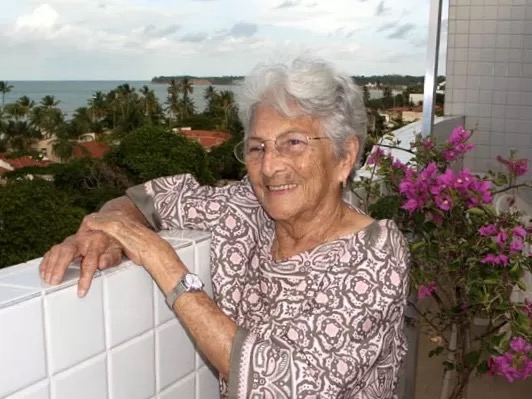
She moved the little ottoman aside
and brushed her hand across the seat—
a graceful, wordless gesture,
an invitation that said,
“Sit here, my son.”
Then came the snack,
a glass of water,
the familiar kindness of routine.
It was her afternoon ritual:
the captain’s report from her ship,
anchored in the armchair
at the center of her quiet room.
She spoke of children,
grandchildren, great-grandchildren,
of journeys, and the modest triumphs
that fill a long and tender life.
To everyone she was Dona Neusa,
to me, simply Mother.
We wandered through our memories—
hers and mine, gently intertwined.
We recalled the friendly neighborhoods
where families sat on porches
and the world still fit inside a backyard.
Eyes would follow the shining trail
of the Sputnik across the sky,
while children played on dirt streets
that turned to magic carpets at dusk.
Neighbors replayed World Cup matches
on old vinyl discs,
their cheers echoing with familiar joy.
And in the local cinema,
the newsreel showed winter fashion in Paris
under the scorching Paraiban sun.
Those were the days when novelty arrived slowly—
and we savored it as if it would last forever.
A small world,
yet filled with imagined greatness.
We moved to the veranda—
the heat had become almost a presence.
Among the scent of bougainvillea and coffee,
she remembered an old book of poems
called Emoções (Emotions)
by Dr. Osório Paes—
a dentist by trade,
a poet by fate.
The bard of Rua da Areia
had once gifted the young admirer
a signed copy.
Time, as it does,
took it away.
We searched the bookshops and stalls,
but the volume lived only
in her bright, unageing memory.
Then she closed her eyes,
tilted her head back,
and from some quiet chamber of the mind—
or perhaps the heart—
she began to recite:
O spotless, holy paleness,
The quiet pallor of thy face,
That has so often been my curse,
And yet my life’s own grace.
Piteous eyes, assassin eyes,
Bright with the pain they can’t erase,
A beacon on the reef of dreams—
I lift my prayer into their blaze.
We went searching for the poet’s office
on Rua da Areia—the only clue
to his days in the city.
But nothing remained.
His world had been erased,
swallowed by a monstrous thing
called the Expressway.
Urban renewal—so often cursed—
had buried the last traces
of the place where he wrote his verses.
All that endured were the words,
etched in the memory of Dona Neusa,
the girl who carried through life
the songs of a poet.
And as the sun sank behind the mango trees,
I understood—
the poetry was never lost.
It was living in her.
(In memory of my mother, Neusa,
born October 23, 1916.)