
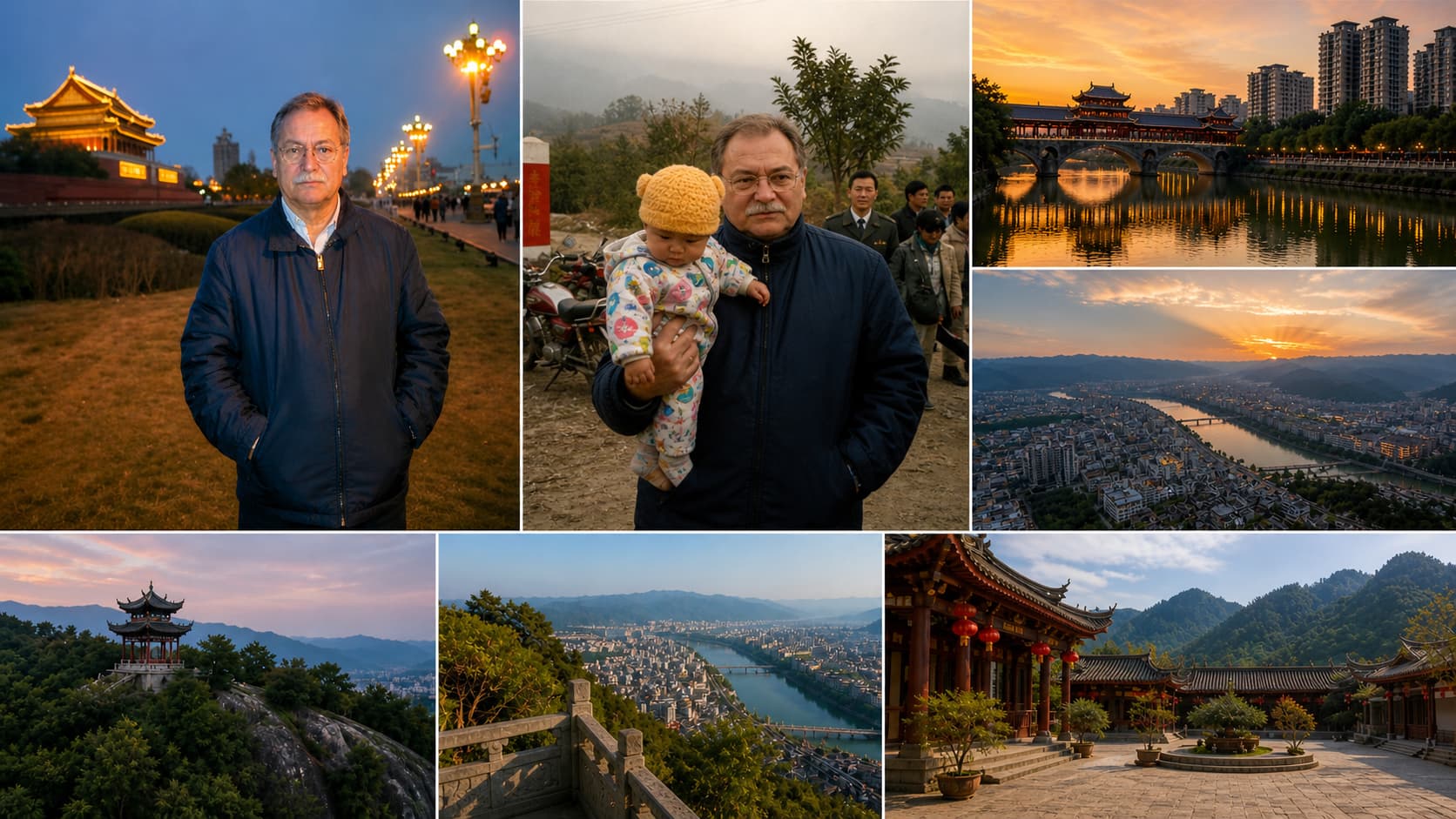
The invitation did not explain China—and, looking back, that was the closest thing to an explanation I would ever receive.
It arrived without ceremony, almost like a note left in haste, in the Year of the Monkey, 2004. I had been asked to deliver seminars on procurement rules—how the United Nations buys goods and services, how transparency is enforced, how contracts are awarded. China’s participation in that system was, at the time, unexpectedly small. The assignment seemed technical. It was anything but.
In China, I would learn, rules are never the whole story.
The country presented itself first as scale—physical, human, economic. But scale alone does not explain movement. What struck me was rhythm: a sense of coordinated urgency, as if millions were advancing along parallel paths, aware of one another without needing instruction. Poverty, still visible at the margins, seemed to be receding under a steady pressure of effort. Contradictions coexisted without friction: coal and solar panels, rigid planning and entrepreneurial improvisation, ancient habits folded into modern ambition.
Our seminars moved quickly through this landscape. They were recorded, translated, reproduced. What was said in the morning would reappear that afternoon, reframed for a different audience. There was little interest in theory for its own sake. The question was always practical: how to enter the system, how to participate, how to compete.
In Guangzhou, it became clear that we were not speaking the same language, even when we were using the same words. I spoke about procedures. My listeners were trying to understand relationships.
In Western systems, contracts are designed to fix obligations in place. In China, they do something else. They acknowledge a relationship that must remain flexible. When conditions change—and they always do—the agreement changes with them. Problems are not escalated; they are absorbed, negotiated, rebalanced. Lawyers are rarely the first call. Intermediaries are.
The word that surfaced repeatedly was guanxi—a term often translated as “connections,” though that barely captures its meaning. Guanxi is not a network in the transactional sense. It is a structure of trust built over time, maintained through reciprocity, and tested through circumstance. It cannot be formalized, but it governs outcomes.
Without it, little moves.
Our work took us south to Fuzhou, a city once described by Marco Polo as a place of marvels. The marvels were still there, though of a different kind: landscaped lakes, early-morning tai chi, a skyline assembling itself in stages.
From there, we boarded a train inland. The departure was delayed by ceremony—the national flag had yet to be lowered—and so we waited. Even time, here, followed protocol.
The journey began with improvisation. A member of our group used a wheelchair that could not pass through the narrow train corridors. We carried her instead, moving slowly, awkwardly, learning the physical limits of design through necessity. At some point along the way, we discovered that a money belt containing several thousand dollars had gone missing.
The response was immediate, if not predictable. Calls were made. Cigarettes were lit. Information moved through channels we could not see. Hours later, the message came back: the belt had been found in the hotel room, returned by a cleaner who, we were told, had been promoted for his honesty.
By the time we reached Longyan, the matter had expanded well beyond its original scale. Local officials became involved. Documentation was requested. Copies were authenticated. The process acquired layers, each one adding legitimacy to the outcome.
Several days later, we were summoned to the hotel lobby. An envelope was presented—sealed, stamped, nested within others. Inside: the full amount, intact.
There were photographs. Applause. Handshakes that extended longer than necessary.
What might have remained a private inconvenience had become, instead, a collective resolution.
Longyan sits near the region from which the Long March began, and it carries that history quietly. There are monuments, but little spectacle. The past is present, though rarely emphasized. It informs rather than announces.
In the nearby county of Wuping, our arrival was marked by ceremony: a reception line of young women in coordinated dress, a formal welcome from the mayor, jasmine tea served before any words of substance were exchanged. Hospitality, here, was not decorative. It was structural.
Later that day, in a small bookstore, we encountered a teenage girl who would reappear in unexpected ways. She led us to a mezzanine room filled with political memorabilia—portraits, calendars, objects that seemed to exist halfway between history and commerce. That evening, she arrived at our hotel with her parents, carrying books and a handwritten note bearing a single phrase: “slam-dunk.”
We understood it literally. A reference, we assumed, to basketball. We promised to send something in return—jerseys, posters, tokens of a shared enthusiasm. The package never reached her.
Years later, the misunderstanding became clear. “Slam Dunk” was the title of a Japanese manga—a story about adolescence, ambition, and belonging. The gesture had not been about sport. It had been about access: to culture, to stories, to something beyond immediate reach.
The error was ours, but the exchange remained intact.
When I returned to Longyan years later, the city had changed in visible ways—taller buildings, brighter streets—but its underlying logic felt unchanged. I was invited again to a banquet.
In China, banquets are not exceptional events. They are part of the grammar of social and professional life. Relationships are built, reinforced, and recalibrated at the table.
This time, the occasion carried a different tone. Speeches were given. Toasts repeated. At a certain point, I was asked to stand.
I was presented with a medal designating me a “Distinguished Visitor.”
The gesture was formal, but its meaning was not confined to formality. It marked continuity—the recognition that a relationship, once established, had been maintained.
Longyan, a city of several million people, felt, in that moment, unexpectedly small.
That evening, I walked along the river.
Lanterns floated in the water, their reflections breaking and reforming with the current. The scene required no explanation. It simply existed.
It occurred to me that understanding had never been the point. What mattered was participation—the willingness to remain present within a system that does not always translate.
China is often described as complex, opaque, difficult to interpret. All of that is true. But it is also consistent in ways that become visible only over time. Patterns emerge. Expectations settle. Meaning accumulates through repetition rather than declaration.
Travel, I realized, is not about resolving differences. It is about learning how to move within them.
Between the ideogram and the gesture—between what is written and what is enacted—there exists a space where meaning is negotiated rather than fixed. It is there, in that shifting ground, that relationships take shape.
And perhaps it is there that the future—quietly, incrementally—is already being made.
不怕慢,只怕停。
(Do not fear going slowly; fear only standing still.) — Confucius
by Palmarí H. de Lucena