
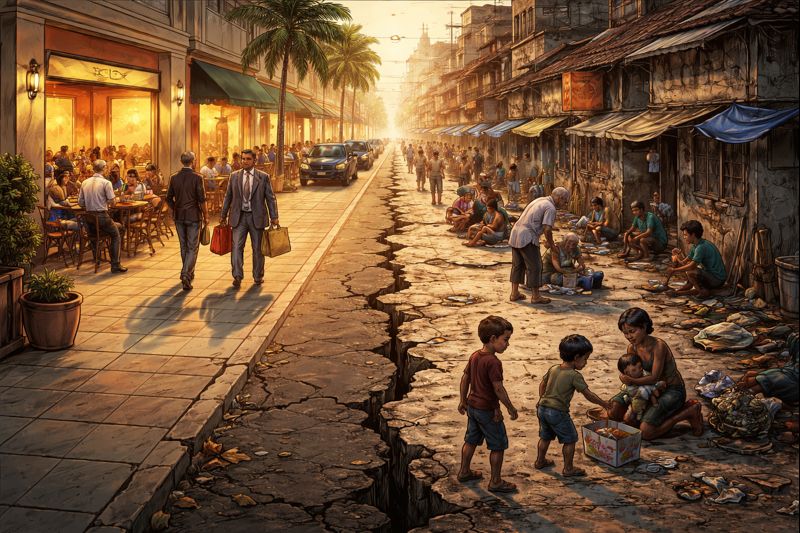
Brazil can be understood through a simple act: crossing the street. On one side, polished storefronts, comfortable cafés and confident talk about the future. On the other, broken sidewalks, exhausted schools and people trained from an early age not to plan ahead, but to get through the day. This is not a metaphor. It is daily life.
The country rightly prides itself on its cultural, ethnic and regional diversity. Few nations bring together such a wide range of origins, beliefs and ways of living. The difficulty arises when diversity is celebrated as a symbolic achievement while deep inequality is treated as an unavoidable condition. Diversity fills speeches and campaigns; inequality fills statistics — and the lived experience of millions.
Brazilians live close to one another, yet inhabit worlds that rarely meet. They share the same territory, but not the same prospects. Children are born under the same sun, but into sharply different social climates. Some grow up surrounded by books, time and protection; others by urgency, improvisation and insecurity. For some, the future is something to be designed. For others, it is something to be feared.
Public discourse often praises diversity in the abstract while managing inequality with troubling ease. Poverty is frequently framed as cultural circumstance rather than historical failure. Exclusion becomes data; the gap becomes background. Over time, astonishment gives way to familiarity — and that shift may be the most damaging of all.
This uneven coexistence produces a quiet form of moral accommodation. Hardship is visible but dulled by repetition. Affluence is conspicuous but shielded by physical barriers, legal structures and social distance. Each group comes to explain its position as personal merit or unfortunate fate, rarely as the result of shared choices and responsibilities.
Brazil endures, largely through the ingenuity of its people rather than the strength of its institutions. Informal networks of care, improvised markets and cultural initiatives sustain daily life where public policy falls short. But endurance is not a national strategy. Resilience cannot substitute for justice, nor can improvisation replace coherent public action.
The central danger is not inequality itself, but its normalization. When injustice no longer unsettles, society does not simply fail — it becomes morally depleted, learning to live with what should never be acceptable.
Charles Dickens once judged societies by how they treated those rendered invisible. By that measure, Brazil faces a choice that remains unresolved. The question is not whether diversity exists, but whether it will function as a bridge or a barrier — whether it will support democratic coexistence or serve as comforting rhetoric in a country long accustomed to living on two sidewalks.
by Palmarí H. de Lucena