
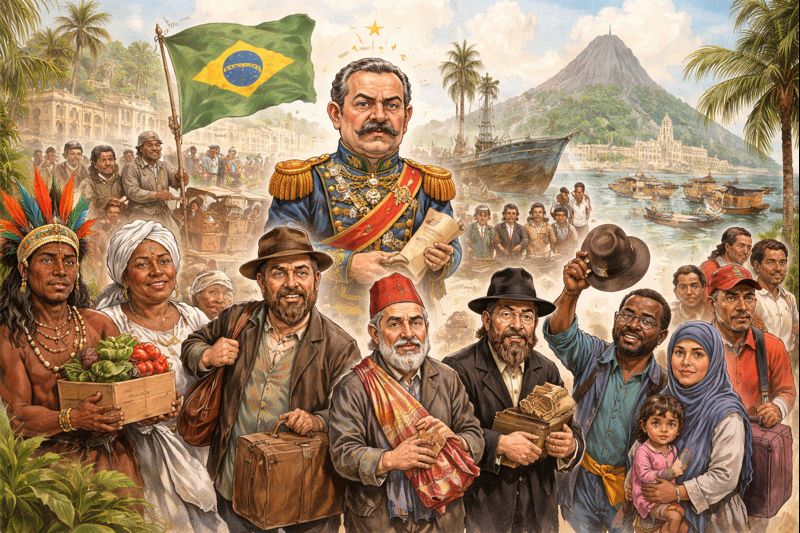
Brazilian culture is not the outcome of a coherent national design. It is the product of layered historical processes—often improvised, frequently unresolved. Since colonization, the country has been shaped by forced encounters, involuntary displacement, and repeated attempts to impose order on a society that expanded faster than the state’s capacity to govern it.
Indigenous peoples constituted the initial foundation of this formation. They provided essential knowledge of territory, agriculture, and survival in an unfamiliar environment. Core aspects of Brazilian language, food systems, and spatial organization bear lasting Indigenous influence. Yet, across successive political regimes, Indigenous presence was routinely marginalized in favor of developmental models that treated it as incompatible with progress.
African slavery structured Brazil for more than three centuries, not only as an economic system but as a central organizing principle of social life. Music, religious practice, cuisine, and oral culture were decisively shaped by African traditions. Abolition, however, was not followed by a comprehensive framework for social integration. Legal emancipation did not translate into political or economic inclusion, and structural inequality was deferred rather than addressed.
By the late nineteenth century, this unresolved legacy was reframed by segments of Brazil’s intellectual elite as a problem of national composition. Influenced by European scientific and social theories then in circulation, thinkers such as Nina Rodrigues interpreted Brazil’s social structure through racialized frameworks now widely recognized as obsolete. Others, including Sílvio Romero, adopted a more gradualist view, arguing that miscegenation, time, and immigration would realign the country with what were considered modern social norms.
These interpretations informed public policy. European immigration was actively promoted in several regions as a strategy of economic modernization and social reorientation. Meanwhile, policies aimed at integrating formerly enslaved populations remained limited in scope and ambition. Demographic change and the passage of time were implicitly treated as substitutes for direct social reform.
Brazil’s social evolution, however, did not conform to these expectations. European immigrants arrived under heterogeneous conditions and were absorbed into a society more complex than its architects anticipated. Rather than becoming culturally uniform, Brazil became more plural. Japanese immigration in the early twentieth century followed a different rationale—primarily economic rather than symbolic—introducing agricultural techniques and family-based labor structures while encountering forms of resistance common to migrant populations elsewhere.
Syrian and Lebanese migrants, originating in the late Ottoman Empire, followed yet another trajectory. Largely excluded from state-sponsored settlement programs, they integrated through urban commerce and emerging internal markets, contributing to economic circulation and social connectivity through largely decentralized processes.
Between the two world wars—and especially after 1945—Brazil also received Jewish populations displaced by persecution and conflict. These communities integrated while maintaining institutional and cultural continuity, contributing significantly to Brazil’s intellectual, scientific, and urban development. In the twenty-first century, new humanitarian migration flows—most notably from Haiti, Syria, and Venezuela—have again tested Brazil’s institutional capacity. These movements, driven by crisis rather than planning, highlight both governance constraints and the persistence of informal mechanisms of social absorption.
Despite this historical record, discredited racial theories continue to reemerge in contemporary political discourse. Extremist movements increasingly deploy culturalist variants of these ideas, replacing biological determinism with claims of civilizational incompatibility, demographic threat, or fixed national identity. Such narratives offer simplified explanations for structural challenges, converting social complexity into political antagonism.
Brazil’s historical experience stands in tension with these claims. A society formed through mobility, mixture, and adaptation cannot be sustainably organized around notions of purity or hierarchy. Its cultural trajectory suggests that identity functions less as a fixed attribute than as an ongoing process shaped by negotiation and institutional capacity.
The broader implication is clear. Brazil has consistently resisted efforts to be reshaped according to imported or technocratic blueprints. That resistance—uneven, conflictual, and incomplete—helps explain both the country’s persistent vulnerabilities and its enduring social resilience.
by Palmarí H. de Lucena