
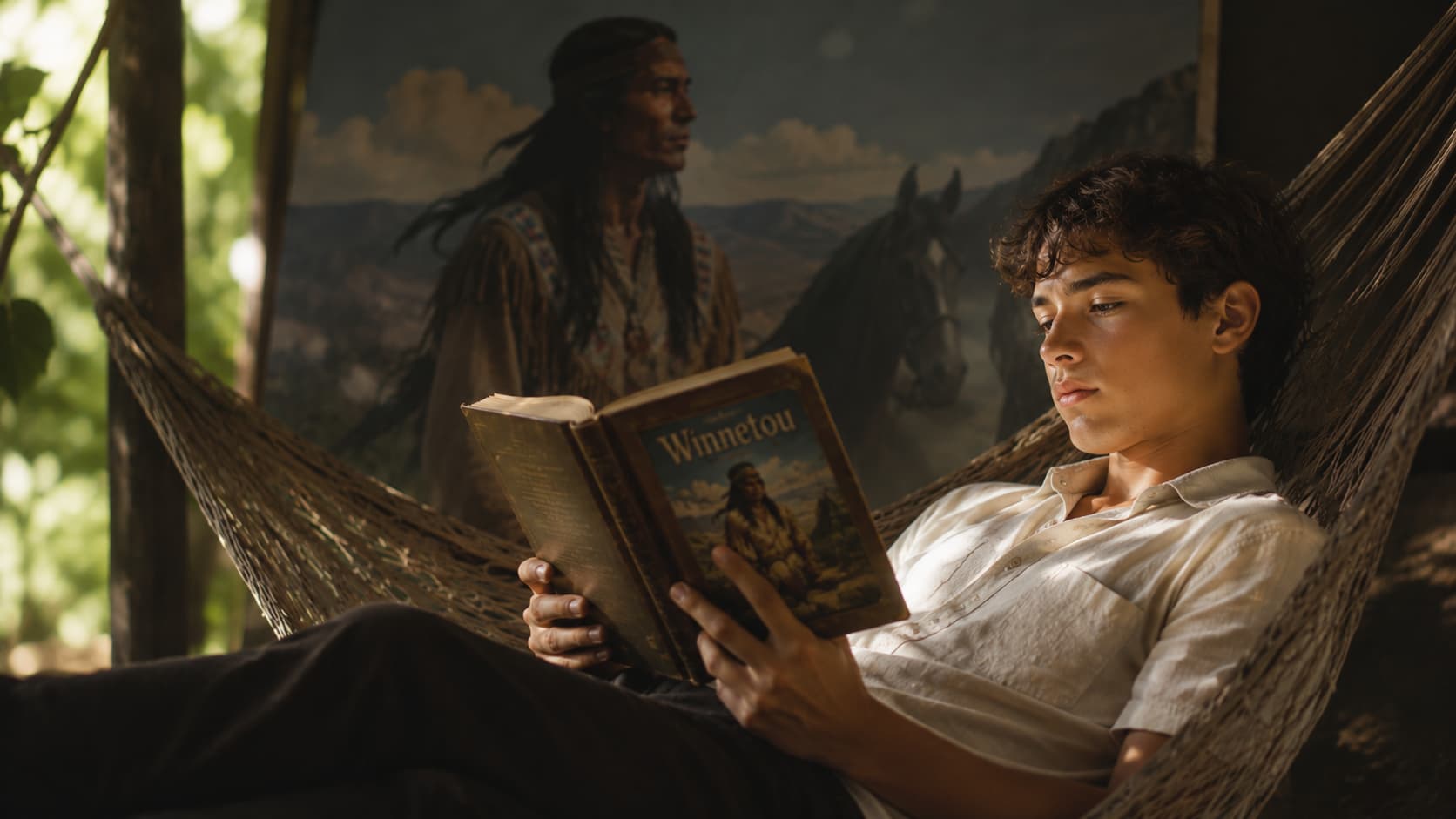
When I first read Karl May at fifteen, I experienced something that still resists easy explanation. It was not merely the enthusiasm of a young reader, nor simply a fascination with adventure. It was something quieter, almost physical: the sensation that a book could rearrange a person inwardly, opening within them a larger space for the world.
It was around the same time that I attempted to read The Magic Mountain by Thomas Mann. Yet while that novel felt slow, dense, and remote to me, Karl May spoke directly to the imagination. I understood his deserts, caravans, mountains, and crossings instinctively, long before I could grasp Mann’s extended meditations on time, illness, and the spiritual exhaustion of Europe.
At that moment in life, I needed horizons more than diagnoses.
Now I can see that both writers, each in his own way, were speaking about the same restless Europe. But Thomas Mann seemed to write from inside a closed room, filled with silence and historical consciousness. Karl May wrote like a man opening a window.
Perhaps that is why his books marked so many adolescents. They offered air.
What remains most remarkable is that the man who introduced me to the world had invented much of it himself. Karl May wrote about the American West, Middle Eastern deserts, and Indigenous peoples before ever seeing many of those places. He created entire landscapes out of imagination — and during certain periods of his life, quite literally out of confinement. Even now, the image astonishes me: a man writing vastness from inside a prison cell.
For the young, that carries an almost dangerous power. Adolescents do not merely read stories; they read possibilities of existence.
In Winnetou and Old Shatterhand, I encountered more than adventure. I encountered the feeling that life might be larger than the narrow place in which one begins. Before any real journey, Karl May taught me that the world was not simply a distant geography, but a promise. His characters crossed deserts and borders while searching for something inward — courage, dignity, belonging.
Many years later, of course, it became impossible to reread Karl May with the same innocence. The contemporary world has learned to distrust many of the fantasies of the nineteenth century. We now understand that his Indigenous characters were often European idealizations, that his America belonged more to the German imagination than to historical reality, and that his depictions of peoples and cultures carried unmistakable romanticism.
Yet reducing Karl May to that alone seems insufficient.
His books continue to reveal something enduring about human experience: the need to imagine other worlds to endure the limitations of one’s own. Perhaps this explains why there remains, even now, such a diffuse nostalgia for authenticity, nature, silence, and horizons less artificial than modern life permits. The vocabulary has changed, but not the inward thirst that once led young German readers to dream of Karl May’s deserts.
This may also explain the astonishing range of his admirers. Few writers have been embraced by figures as different as Hermann Hesse, Franz Kafka, Albert Einstein, Carl Gustav Jung — and even Adolf Hitler.
That may be one of the most unsettling aspects of Karl May. His imagination could nourish both generous dreams and dangerous fantasies of grandeur. Hitler admired his work deeply, casting a difficult shadow over May’s reputation after the war. Yet perhaps this ambiguity reveals something essential: imagination is never morally neutral. It can open horizons of freedom or produce destructive illusions.
And still, when I think today of that fifteen-year-old boy reading Karl May while struggling through Thomas Mann, what remains is neither ideological debate nor historical analysis. What remains is a sensation.
The sensation that a larger world existed beyond the province, beyond childhood, beyond the life already arranged by others.
Thomas Mann would later teach me to recognize the spiritual fatigue of modern Europe. Karl May first taught me to desire the world.
And perhaps youth requires precisely that sequence: before an awareness of crisis, the discovery of the horizon.
I know now that the true journey begun by those books was never geographical. It was inward. Karl May taught, even if unintentionally, that imagination may precede destiny; that we cross borders within ourselves before we ever cross oceans.
Some books accompany us only for a time. Others become a silent part of what we eventually are.
Karl May belongs, for me, to the latter category.
And certain departures begun in youth never entirely end.
By Palmarí H. de Lucena