
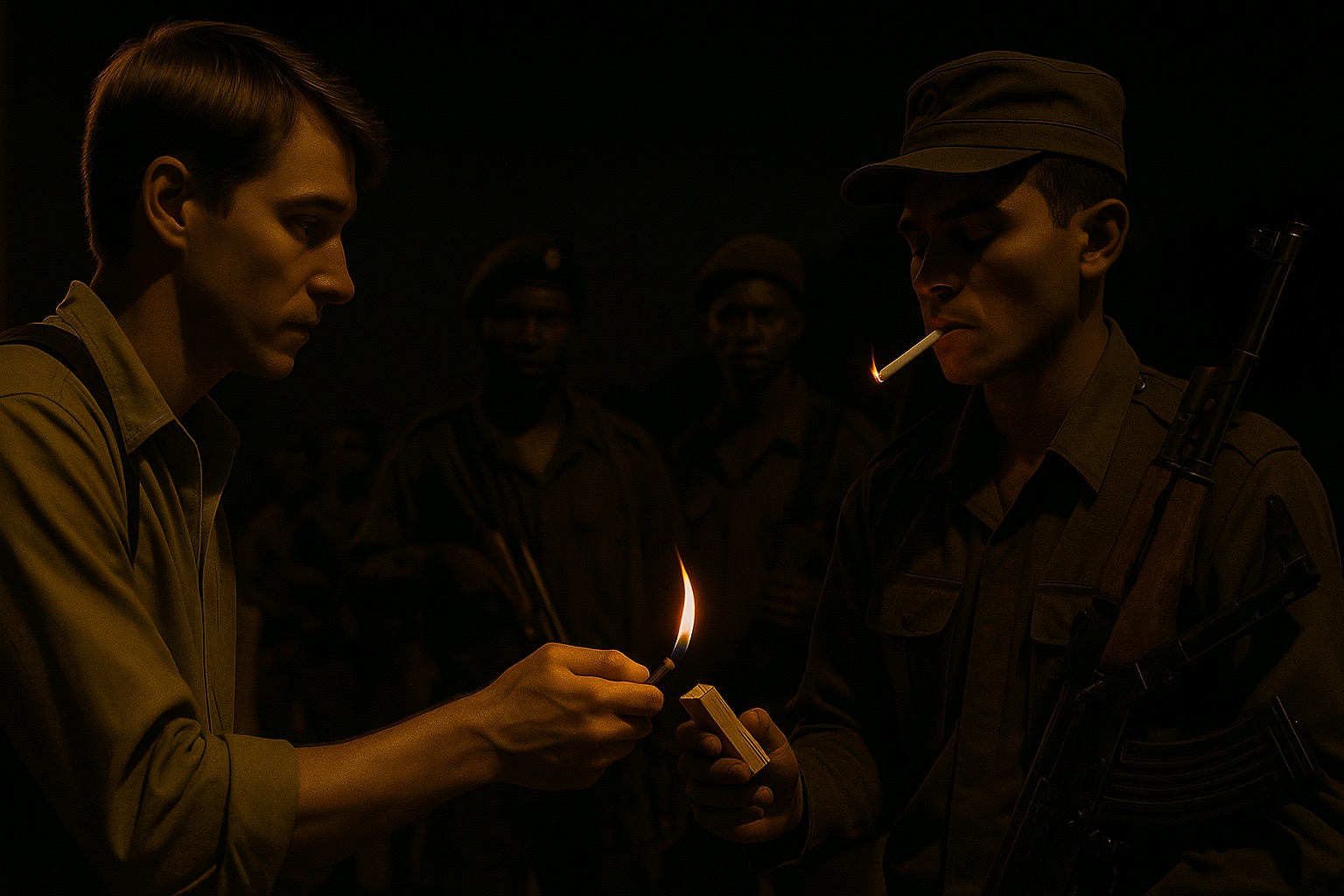
Some lives are spared by accident — and sometimes that accident takes the shape of a burning cigarette.
Through years of travel and humanitarian work, smoking was more than a habit. It was a truce, a form of currency, a pocket-sized talisman against chaos. I remember tense hands, rifles half-raised, and the dull glow of an ember that, by some absurd logic, so often meant survival.
In Ghana, it began in a suffocating room heavy with dust and fatigue. We were negotiating food deliveries to starving villages. Soldiers moved in and out, Kalashnikovs slung from their shoulders. The commander, his face unreadable, listened for a few minutes before saying quietly,
— “Revolutionary justice will punish severely those who steal humanitarian aid.”
No one replied. We all understood the warning.
Days earlier, on the road to Togo, another patrol had stopped us. Their leader — hungry, anxious, and unshaven — searched our bags until he found a pack of American cigarettes. He lit one with the kind of joy a child might reserve for Christmas morning. The same pack that would carry the warning Smoking kills back home was, in that instant, the reason we lived. The tension melted. Tobacco became a language everyone spoke. The diplomacy of smoke proved stronger than any treaty or speech.
In Mozambique, the story took a darker turn.
We were driving through the district of Chókwè, where rebels had ransacked a leprosarium and terrorized the nuns. The sun was bleeding into the horizon when a teenage boy emerged from the shadows, holding an AK-47 nearly his height.
— “Turn around. Hands up.”
The barrel pressed cold against my neck.
— “You smoke?” he asked.
— “Yes.”
There was no doctor, no missionary in that moment — only the question, the gun, and the smoke between us.
He smiled briefly, took our cigarettes, muttered Kanimambo — thank you — and disappeared into the dusk. We stood there, still and breathless, knowing that tobacco had just purchased another night of life.
My lungs would complain later; survival, at least, had bought a little time.
So we kept moving, wrapped in the irony of a fate that sometimes trades the smell of gunpowder for that of tobacco — and, for an instant, pauses the war to let humanity catch its breath.
These scenes replay like an old film reel: boy soldiers with cigarettes dangling from lips too young to have learned the art of breathing. The smoke made them feel older, invincible — as if each drag aged them into men. They were the caricature of war itself: youth burned away slowly, like a cheap cigarette that refuses to stay lit. No health manual would advise it; reality never reads the instructions.
Years later, crossing Eastern Europe, I reached the border between Romania and Serbia. Night had fallen over the Iron Gates Bridge, and the Danube ran below like a cracked mirror, holding both moonlight and the hum of turbines.
A young Serbian soldier stepped from the shadows, a Soviet papirosa hanging from his lips. He signaled for us to stop, checked our documents, rummaged through our bags. When he found the American tobacco, he hesitated — then asked for one. We gave him three packs. He nodded, a silent gesture of truce. The bridge, a monument of steel and fear, became for a few minutes a place where the world exhaled.
I thought back to my adolescence — the first cigarette, the illusion of adulthood, the puffed chest and practiced swagger. Tobacco was disguise and armor, a rite of passage mistaken for courage. Each drag felt like a lesson in life; in truth, it was only nicotine wrapped in vanity.
Now the same smell repels me. The gesture that once meant relief now recalls the absurd negotiations I made with death — conversations carried on in irony and smoke. Statistics say tobacco kills millions; my own story notes the times it kept a rifle from killing first. A strange contest between the slow death of lungs and the instant one of a bullet.
Once, in a quiet night of reflection, someone said to me:
— “You must first make a commitment to yourself before you can expect it from others.”
I quit smoking that night — not out of fear, but out of gratitude. Gratitude for the absurd grace of survival. If truth were printed honestly, cigarette packs might carry a smaller line beneath their warnings:
“This product causes cancer, heart disease, stroke, and addiction.
In rare circumstances, it might keep a man from being shot.
Still, best not to count on it.”
Tobacco accompanied me where reason failed. Now it’s my turn to protect it — not from flame, but from forgetting — turning every old puff into a story, every cloud of smoke into a sober memory.
Romania, Serbia, Ghana, Mozambique — 1973–1990
By Palmarí H. de Lucena