
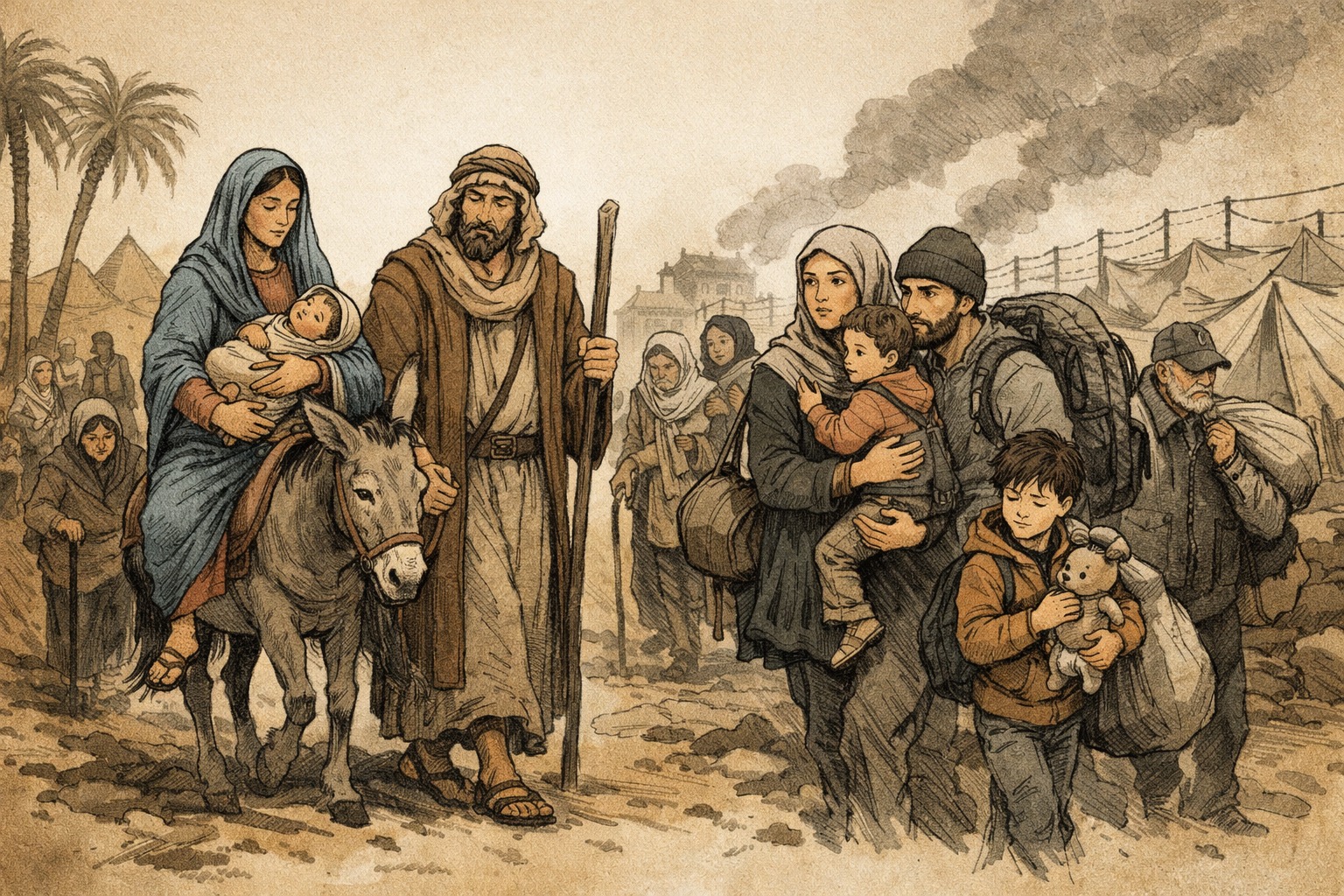
The flight of the Holy Family to Egypt is commonly understood as a formative episode in Christian tradition. It can also be read, more broadly, as a story of refuge: a family crossing borders to protect a child after a violent decree. Names change and centuries pass, but the gesture itself remains familiar. Before doctrine or interpretation, there was the urgency to escape harm.
To flee, then as now, meant to withdraw from visibility. There were no humanitarian corridors, no formal guarantees, no documents ensuring passage. There were discreet routes, uncertain hospitality, and the practical need to reach a place beyond the immediate reach of power. Coptic tradition places Assiut, in Upper Egypt, as the site of the longest stay. At the foot of Mount Qusqam, now marked by the Monastery of Al‑Muharraq, the cave associated with the Holy Family is remembered not as a site of spectacle, but as shelter. History receded there so that life could continue.
Mount Dronka, further on, marks the outer limit of the journey. Not a destination, but a pause—the moment when advancing further was no longer possible and remaining became the only viable option. For those who flee danger, routes are rarely linear. They are shaped by temporary stops, improvised refuges, and decisions made under sustained uncertainty.
I visited this site in 1983 at the invitation of a Coptic bishop. Entry required a short, careful descent. Light narrowed quickly; the stone was cold and uneven. The air was dry and still. There were no ornament and no suggestion of comfort. The cave appeared designed for a single function: protection rather than welcome. Inside, time feels suspended. It is a space entered in order not to be seen and occupied only long enough to endure.
That experience resists romantic interpretation. This is not a devotional setting arranged for visitors, but a practical refuge marked by constraint. Stone offers safety, but also isolation. Silence is not mystical; it is functional. Standing there makes clear that the Holy Family’s stay can be understood not as symbolic exile, but as a condition comparable in structure—though not in circumstance—to that faced by displaced families in many periods.
Families today continue to leave homes under pressure, cross uncertain borders, and live for extended periods in provisional accommodations. They do not flee by preference, but because remaining is no longer safe. In such situations, shelter is not an endpoint; it is an interval that allows life to continue.
The caves of Assiut were not temples. They were minimal solutions. Like temporary shelters, converted public buildings, or overcrowded housing, they suspend ordinary life to preserve it. While public history advances through proclamations and records, survival often proceeds quietly.
Coptic memory preserves this episode without embellishment. The Holy Family is recalled not as symbol, but as a family in need of protection. The account endures because it draws attention to a basic human condition: before theology, there is refuge.
History is often written from the perspective of arrival. Meaning, however, frequently begins in flight. To remember the Holy Family in this light is to recall that before belief or interpretation, there was a child—and a place where survival was possible.
By Palmarí H. de Lucena