
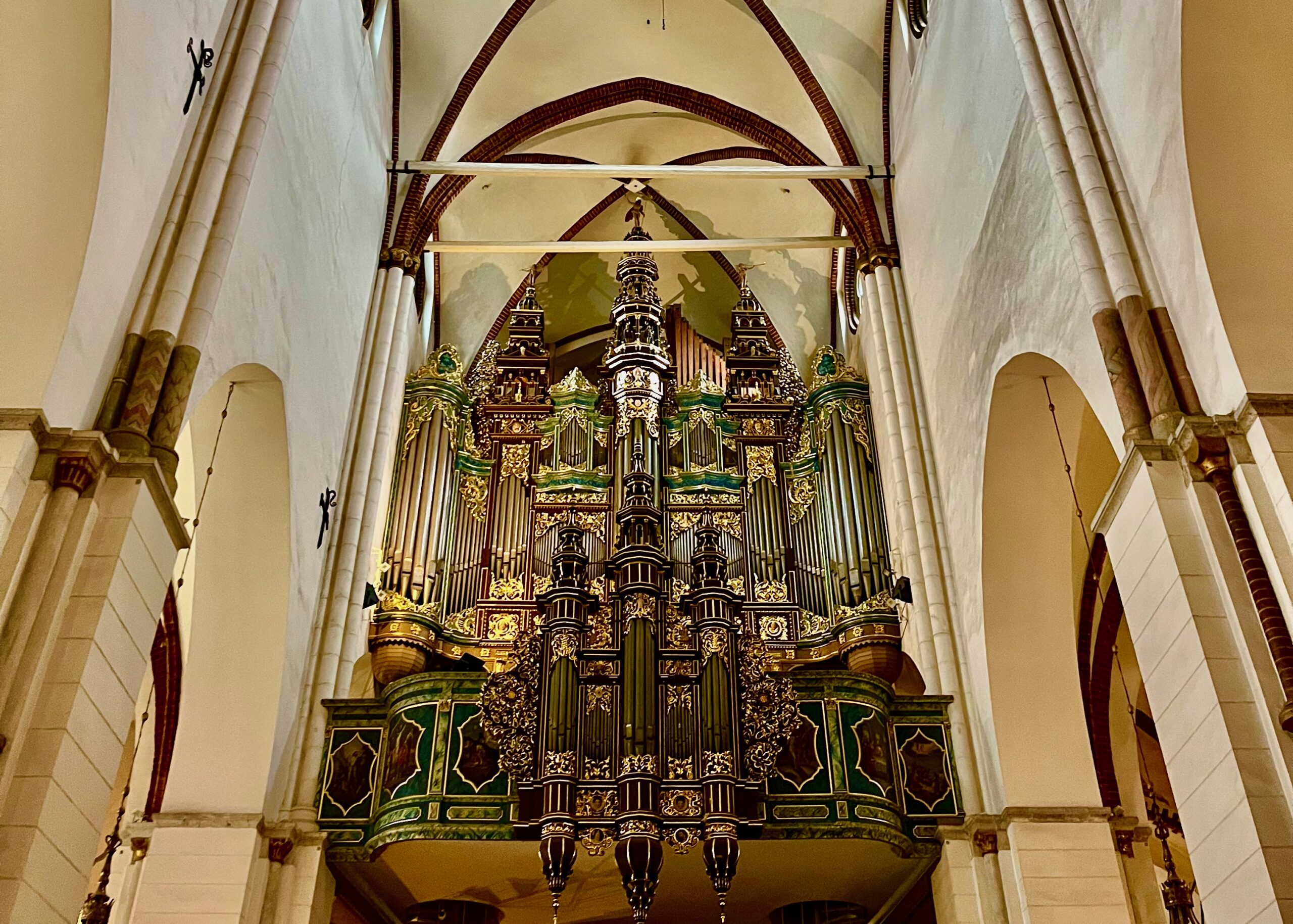
To step into the Cathedral of Riga is to cross a threshold between the visible and the invisible. The red brick, worn smooth by centuries, rises in solemn columns that seem to bear not only the weight of the vaults but the burden of the soul itself. Through the stained glass, light spills in fractured blues and purples, dividing the heavens into silent benedictions. The entire space breathes an ancient stillness — not the absence of sound, but the presence of waiting.
At the altar of music stands the great organ, golden as the Baltic sunrise, its pipes crowned by motionless angels who appear poised to sound their trumpets. There sat Ilze Reine, the distinguished organist — a graduate of the Jāzeps Vītols Academy of Music, refined in Germany, and since 1996, the organist and conductor at St. John’s Church in Riga. Her artistry has echoed as far as France, Sweden, and Japan. Yet on that afternoon, unlike the grand evenings of concert performance, there were no titles, no borders — only a sacred communion between musician, instrument, and space.
When her fingers touched the first chords of Gounod’s Ave Maria, time itself seemed to loosen its hold. I was suddenly carried back to childhood — to the days when that melody would drift from the family radio, filling the room with a reverence that no one named, but everyone felt. Even the furniture, it seemed, breathed slowly then, as we children learned — without understanding — that music, too, could be prayer.
Inside the Cathedral, that forgotten tenderness expanded into fullness. Each note multiplied under the arches, descended along the columns, brushed across the dark wooden pews, and came to rest upon the shoulders of the motionless faithful. There was no choir, no ceremony — only an invisible conductor and the organist who, with her hands, turned the fleeting instant into eternity.
And then I understood: the universality of that melody lies in its closeness. It envelops us without the need for translation, speaking directly to the soul. Each phrase seemed to lift and soar, carrying us toward unseen mountains, toward the high plains of memory where humanity stores its most fragile dreams.
The music did not fill the space — it became the space. It turned stone into prayer, light into hope, remembrance into promise. The Cathedral itself, with its centuries-old stones, seemed to pray with us. And in that shared silence, every heart present understood — without words — that there is something greater than ourselves, something that only music, in its purest form, can reveal.
By Palmarí H. de Lucena