
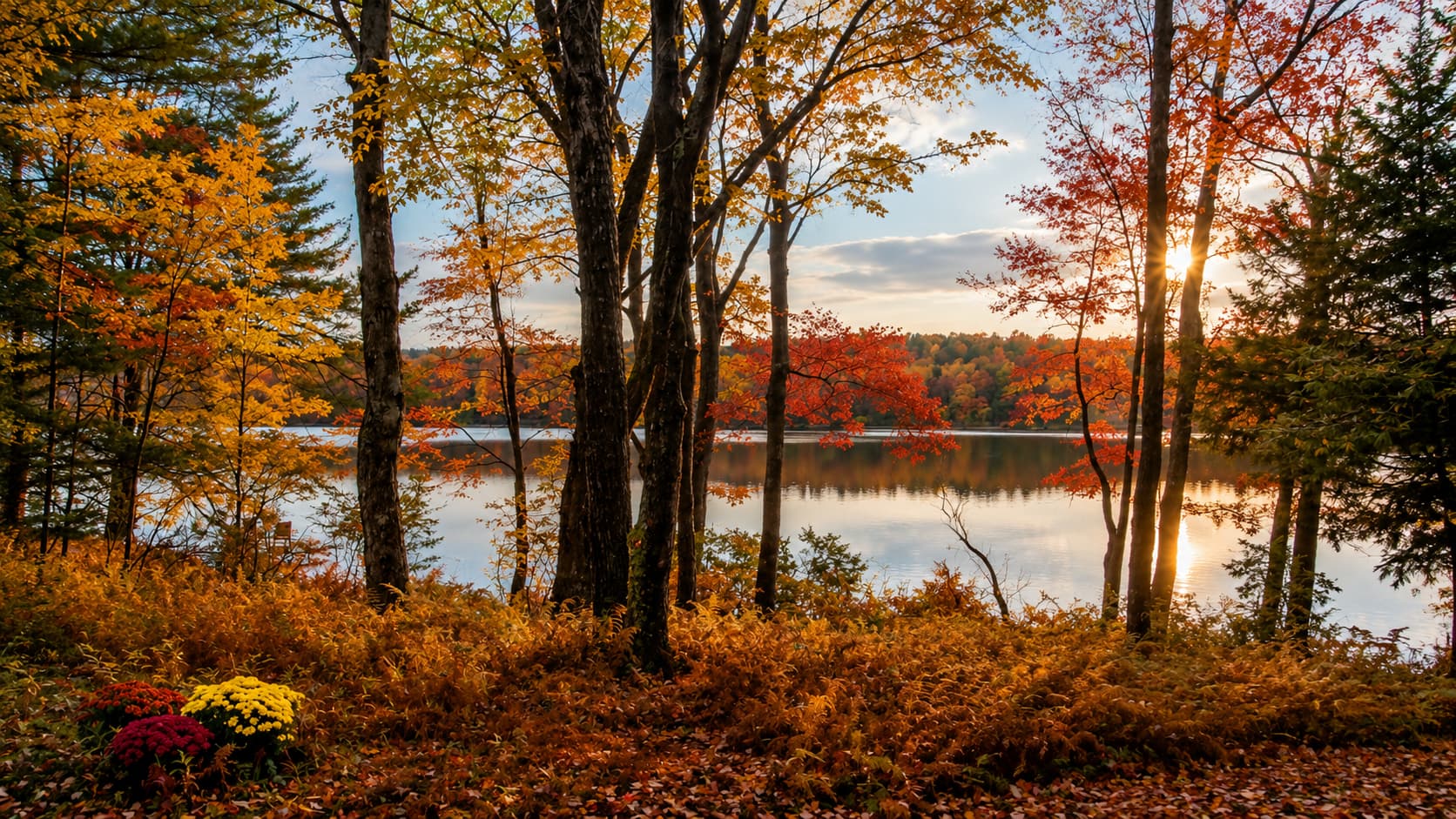
Reflections from the Pocono Mountains
There are afternoons when the world seems to lose its appetite for brilliance.
The light softens. The air grows still. Even the wind, which only weeks before rushed through the forest with youthful confidence, now moves more gently, persuading the leaves to let go.
By the lake, nothing happens in haste.
A single leaf drifts onto the water. Its reflection lingers for a moment before dissolving into widening circles of light. The shoreline, dressed in amber, crimson, and copper, seems less interested in displaying color than in revealing time itself.
Autumn has never been merely a season.
It is a different way of seeing.
Summer celebrates abundance. Autumn celebrates measure. Under its lower light, the landscape sheds every unnecessary gesture until only its essential forms remain. The trees become lighter by surrendering what they can no longer keep, and in doing so they discover a quiet elegance impossible at any other time of year.
Albert Camus understood this paradox when he wrote, “Autumn is a second spring when every leaf is a flower.” It is one of those rare sentences that become larger than literature itself. Beauty does not disappear with the passing of time. It simply changes its language.
Standing by the lake, I begin to understand what he meant.
The water receives each falling leaf without resistance. Nothing is hurried. Nothing is wasted. The afternoon unfolds with the patient rhythm of something that has no need to prove its existence.
Perhaps that is why Paul Verlaine heard music in autumn long before he found words for it. In Autumn Song, the season is carried not by description but by sound—the distant voice of violins, fragile and lingering, echoing through memory. Listening to the wind move across the water, it is easy to imagine that melody still traveling through the trees.
Memory behaves much like this lake.
It is not a warehouse of facts but a living landscape.
Some memories remain bright upon the surface, as clear as reflections on still water. Others descend beyond sight, where they rest in silence until awakened by a scent, a shaft of afternoon light, or the dry whisper of leaves underfoot.
Time does not erase them.
It edits them.
Little by little, it removes what was accidental and preserves what was essential. What remains is not the event itself, but its meaning.
Perhaps that is why age changes our relationship with the world. We stop measuring life by what we accumulate and begin measuring it by what continues to illuminate us after everything else has faded.
The lake seems to understand this better than we do.
It reflects the sky without trying to possess it. It welcomes every leaf without mourning its fall. It teaches, simply by existing, that permanence is not the refusal to change but the grace with which change is accepted.
As evening settles over the Pocono Mountains, the first star appears above the darkening water. The colors that only moments ago set the forest ablaze begin to dissolve into shadow. Yet nothing feels diminished.
The landscape has not become less beautiful.
It has become quieter.
And perhaps that is autumn’s deepest lesson.
The world is never asking us to hold on forever.
It is asking us to pay attention.
For every season has its own light, every silence its own music, and every ending, if we are willing to see it, carries within itself the quiet promise of another beginning.