
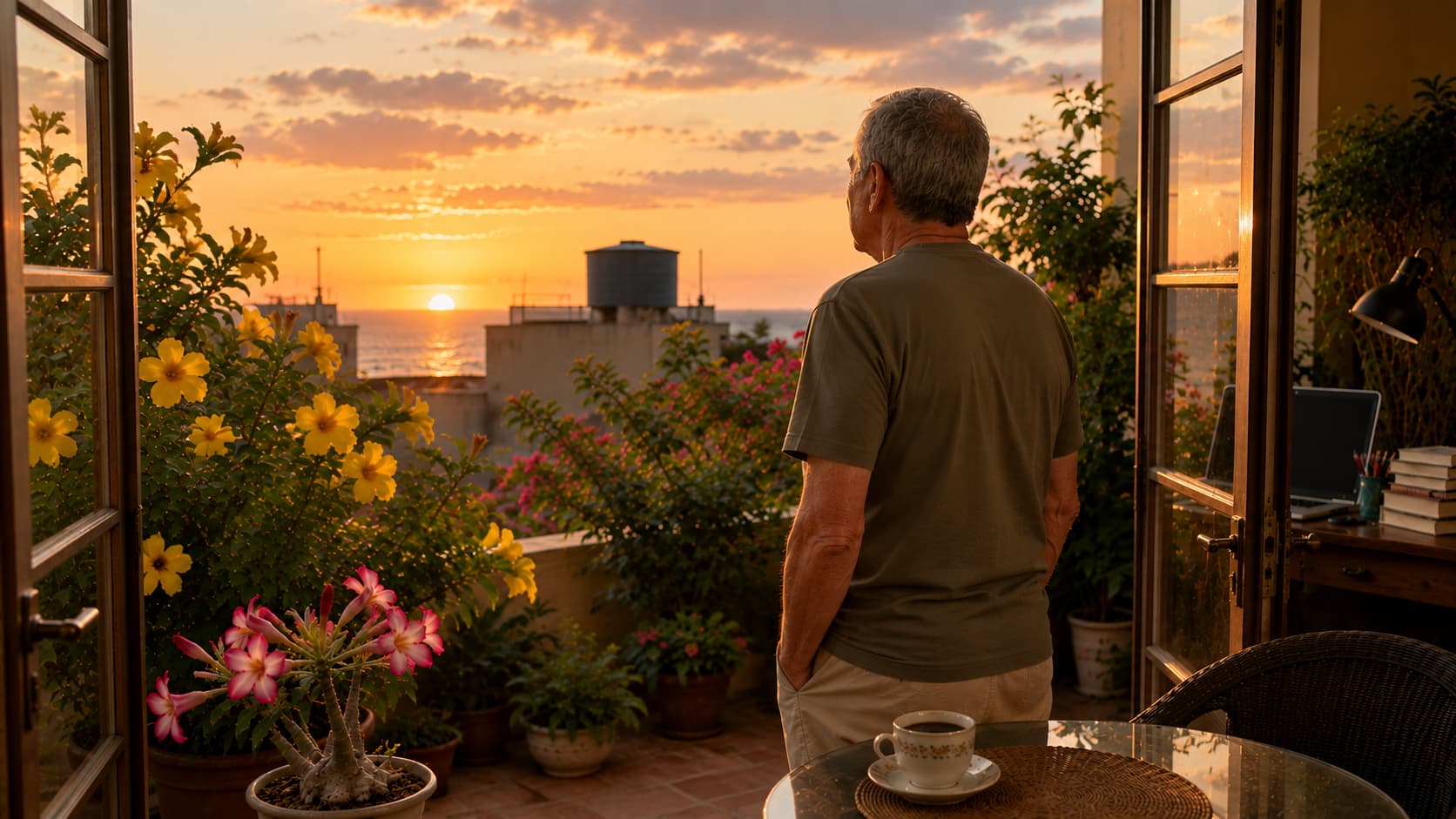
Morning rarely arrives all at once. Sometimes it begins with the first pale ribbon of sunlight stretching across the terrace. Other times it announces itself in the quiet rhythm of rain, each drop settling gently upon leaves that have learned, over countless seasons, how to receive it. Either way, before I belong to the day’s obligations, I belong for a few moments to my garden.
Crossing its narrow path has become less a habit than a quiet ritual. There, the noise of the world recedes almost imperceptibly, as though someone has lowered the volume of life beyond the walls. I move without hurry among the flowers, noticing which blossoms chose the night to unfold, following the uncertain flight of the first birds, breathing the rich scent of earth still holding the memory of dawn.
I have long since realized that I never enter the same garden twice.
The flowers have shifted. The light has found new angles. Shadows, faithful only to the passing hour, have quietly rearranged themselves. Even silence seems to possess a different texture each morning. Without offering explanations, nature repeats the oldest lesson it knows: life is not sustained by permanence but by renewal.
Only afterward do I return indoors.
Breakfast is already waiting, and I linger over it with deliberate slowness, reluctant to interrupt the conversation the garden has begun. As coffee warms my hands, I allow my thoughts to awaken in their own time. Ideas, I have learned, resemble seeds far more than machines. They cannot be hurried. They ask only for patience, stillness, and the quiet confidence that unseen things are already growing.
Only then do I sit before the illuminated screen.
The computer has never replaced the garden. If anything, it has enlarged it.
Beyond the glass of the monitor lies another landscape—one cultivated not by rain and sunlight but by centuries of human curiosity. Books converse with scientific discoveries. Ancient philosophers meet contemporary researchers. Maps, journals, photographs, forgotten letters, and ideas scattered across continents gather effortlessly within reach. One question opens another. One page awakens a memory. One discovery quietly rearranges everything that came before.
More often than not, I begin searching for a single fact and find myself wandering through territories I never intended to visit. Age has taught me not to resist these detours. They are seldom distractions. More often, they are where understanding patiently waits.
Only in later life did I come to recognize what this daily ritual truly meant. For decades I imagined that I searched because I wished to learn. Now I see that I have continued learning simply because I never stopped asking questions. Curiosity, I have discovered, is less an appetite than a way of inhabiting the world. Looking back, I suspect it has been the quiet compass by which my life has always been guided.
At eighty-five, the past changes its character.
It no longer resembles a timeline faithfully arranged from one year to the next. Instead, it becomes something more like an ongoing conversation, one in which earlier versions of ourselves continue speaking long after their voices should have faded. Memory returns not to imprison us in nostalgia but to deepen our understanding of the present.
The garden has taught me this as well.
Some memories lie dormant for decades, indistinguishable from forgotten seeds. Then a line in a book, the fragrance of a familiar flower, the opening notes of an old melody, or a photograph discovered in an unexpected drawer restores them to life with astonishing clarity. Others emerge without invitation, revealing meanings that simply did not exist when the events themselves unfolded. Time, it seems, does more than preserve memory. It continues writing it.
Perhaps that is why writing has become inseparable from my days.
I have never written merely to preserve experience. Memory alone is content to archive. Writing asks something more demanding. It asks us to understand.
Again and again I begin an essay believing I know where it will end, only to discover that the destination changes as the sentences unfold. Writing gathers distant moments into conversation. It gives shape to thoughts that have remained scattered for years. It uncovers relationships that were quietly waiting beneath the surface of ordinary experience. More than once I have had the curious feeling that the words understood something before I did.
Age has taught me another lesson as well: never underestimate small discoveries.
An incidental remark overheard in passing. A forgotten footnote. An observation made while walking. A child’s unexpected question. A seemingly insignificant fact encountered during an afternoon of research. Such fragments may remain silent for years, suspended somewhere beyond conscious attention, until one day they encounter another fragment waiting just as patiently. From that meeting, an entirely new idea is born.
Perhaps creativity is seldom the lightning bolt we imagine it to be. More often it resembles the slow convergence of thoughts that have been searching for one another across the years.
During my lifetime I have watched one technological revolution after another arrive with the promise of transforming the world. Each seemed astonishing in its own moment.
I remember the wonder inspired by the fax machine, capable of carrying a handwritten page across oceans in minutes. Then came the Walkman, turning an ordinary walk into an intimate conversation with music. The steady percussion of my typewriter accompanied much of my professional life before surrendering to the quiet glow of the computer. Soon afterward the internet appeared, followed by smartphones, until what once required entire libraries could rest upon a single desk.
Each innovation changed the tools I used.
None changed the questions I asked.
More recently came drones.
They awakened in me a delight so immediate that it felt almost childlike. For the first time I could trace the winding course of a river from above, discover the hidden geometry of forests, or contemplate cities from perspectives once reserved for birds alone. My feet remained on solid ground, yet my imagination had quietly acquired wings.
Only then did I understand that learning often begins with nothing more complicated than changing where we stand. Reality itself may remain unchanged. Perspective transforms everything.
Today another remarkable companion has entered that long procession of inventions: artificial intelligence.
I greet it with the same curiosity that welcomed every technological transformation I have witnessed across the decades. It expands the reach of my research, connects ideas separated by disciplines and generations, and opens pathways I might never have discovered on my own.
I have never regarded it with fear.
To me, it represents one more chapter in humanity’s enduring story of imagination.
Every algorithm begins with a question. Every invention begins with someone willing to imagine what does not yet exist. Machines may organize information, reveal patterns, accelerate discovery, and illuminate possibilities. Yet they remain instruments. It is still human judgment that distinguishes knowledge from mere information, wisdom from accumulation, and responsibility from power.
Looking back now, I see that my life has been shaped far less by the answers I found than by the questions I refused to abandon. They led me through books and journeys, through laboratories and libraries, through technologies that once seemed miraculous, only to return me, almost inevitably, to the small terrace garden where every morning begins again—familiar, yet never quite the same.
Perhaps this is the quiet gift of growing old.
Time asks less of our speed than of our presence. Knowledge reveals itself not as a destination but as a lifelong pilgrimage. Aging does not move us away from life. If we are fortunate, it brings us closer to its essence.
Youth, I have come to believe, belongs less to the body than to the enduring capacity for wonder.
Tomorrow the first light—or perhaps the gentle cadence of rain—will announce another morning. I will walk once more among the flowers. I will return to the breakfast table and let the coffee cool as my thoughts gather themselves. Then I will sit before the waiting screen.
Some question I cannot yet imagine will begin searching for its first words.
Palmarí H. de Lucena