
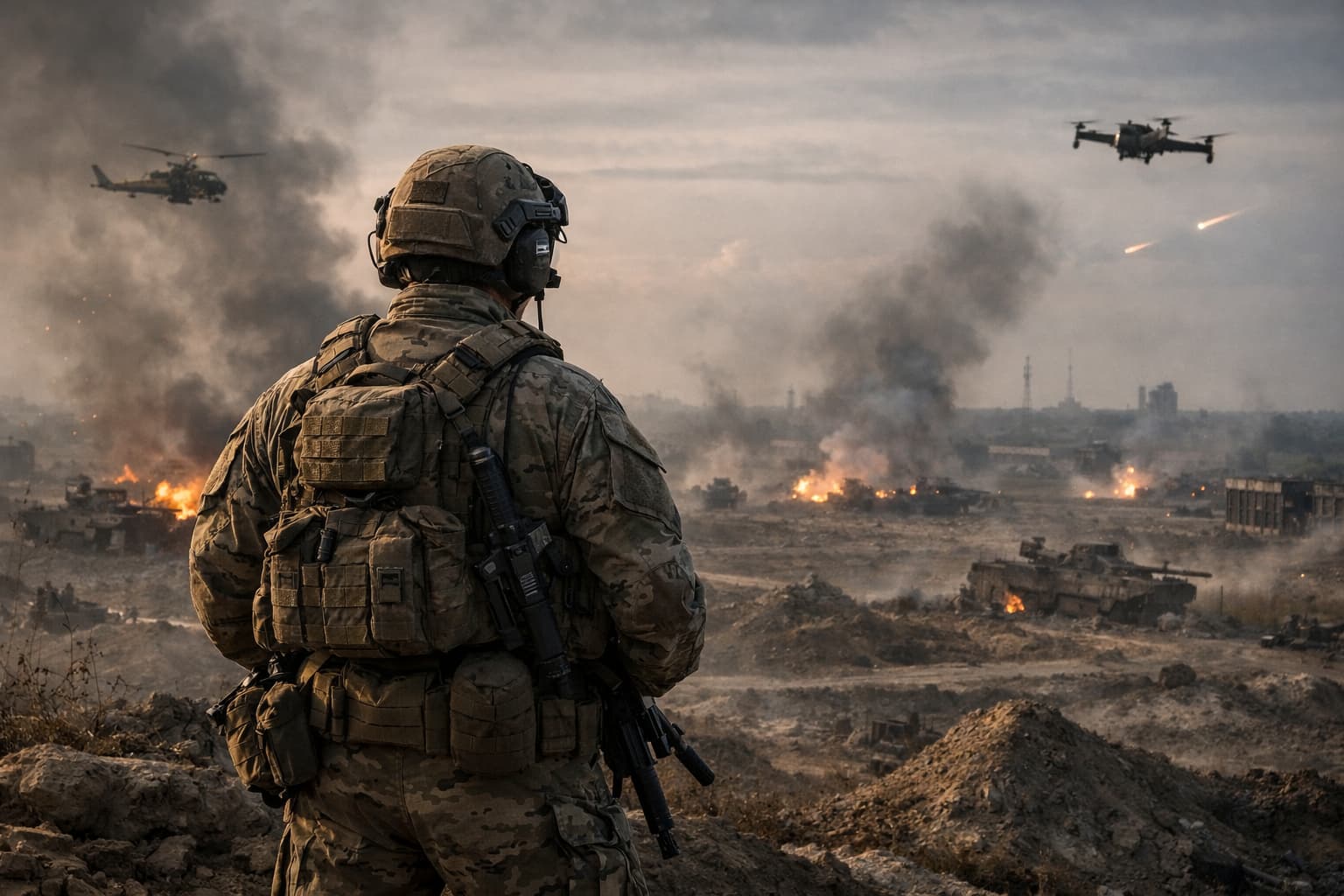
I do not know exactly when we began to understand. Perhaps it was not understanding, but fatigue—a fatigue that settles slowly, like mud rising over our boots until it can no longer be distinguished from the skin itself. At first, we still spoke. Of home, of the future, of things that seemed possible. Words came easily, as if they still belonged to us. Then they grew scarce. Not because there was nothing to say, but because everything had already been said in advance—and nothing changed. Now we remain silent more often.
There are moments when the world is reduced to very little: a piece of bread, a cigarette passed from hand to hand, the sound of someone breathing beside you. It is enough. It must be enough. Everything else has become distant, almost imagined. I remember how we were taught. They spoke of duty as if it were something clear. They spoke of honor as if it were visible. Here, such things do not appear. What we see are men trying, simply, not to disappear.
The curious thing is that we are still alive. Despite everything, there remains in us a stubborn, almost absurd attachment. It is not courage, nor is it hope—it is simply the habit of continuing. Sometimes I look at the others and think that we are no longer young. We have not aged—that would require time. We have been displaced from it, as though removed from the natural course of things and placed here, where nothing grows.
The enemy is so close that he no longer seems foreign. When we imagine him, he resembles us: lying in the same mud, thinking the same thoughts, waiting through the same empty hours. If we were to meet without weapons, we might not know what to do. There are days when everything is suspended. We neither advance nor retreat—we simply remain. And in that remaining there is something worse than danger: a slow hollowing, as though, little by little, we were ceasing to inhabit our own bodies.
And yet, death has changed.
Once, it came with steps we could hear, from directions we could guess. Now it perfects itself. It learns. It withdraws from the human body and becomes calculation, machine, distance. It comes from above, in silence or in a thin hum that grows too late. It does not seek a face—it seeks a coordinate.
There is something colder in this transformation. Not in the violence, which has always existed, but in the absence. Death no longer requires even the presence of the one who delivers it. It descends on its own, guided by eyes that do not see as we do, by decisions that do not hesitate.
And we, below, feel this.
We feel that we are no longer confronted, but found. As though we are being searched for by something that does not know us and therefore cannot recognize us. There is no exchange. No shared instant. Only interruption.
Perhaps this is the true refinement: to strip death even of its last semblance of human encounter—and, in doing so, to strip us, too, of what remains of our humanity.
I wonder, then, what remains when even that disappears. When there is no longer even the illusion of confrontation, but only the certainty that something may come from the sky and end everything without witness, without memory, without a name.
And still, we go on.
Not out of strength, but from the inertia of life. Because the body insists where meaning fails. Because even reduced to almost nothing, we still breathe—and that, in itself, is a form of resistance that does not declare itself.
I wonder, sometimes, whether anyone still remembers what we were before. Not we who are here, but those who remained behind. Whether there still exists, somewhere, the idea that we were more than this. But such questions do not travel far. They stop midway, like everything else. What we have learned here cannot be spoken outside of it—not because it is secret, but because it has lost the shape of words. It is something carried: in gestures, in silences, in the way one looks at what is still alive.
And perhaps that is what weighs most: to know that, even if we return, we will not bring back what we were. We will remain. In some way, we will always remain here.
Still, far from here, someone will continue to speak. In clean rooms, the same words are repeated: duty, honor, necessity. They organize decisions, justify movements, seem to give meaning to what, seen up close, dissolves. Perhaps there are not only the guilty—perhaps there is also distance. Distance between those who decide and those who endure the consequences. Between the idea and the body. Between the plan and a man’s final moment.
This distance is where war survives.
But there is something that crosses it—and it is simple: every life interrupted belongs to no side, confirms no theory, completes no argument. It simply ends.
If these lines are ever read, let them serve neither as accusation nor as defense. Let them serve as a reminder that every decision carries a weight that does not appear on maps. And that even in the midst of destruction, something resists—not as heroism, but as a quiet refusal: the refusal to accept that death is the only possible conclusion.
We do not know how peace is built. Here, we have learned more about what destroys it. But perhaps that is already a beginning. Because to understand what must not be repeated is, however little, a way of preserving what remains.
And what remains—however small—is still life.
And while there is life, even wounded, even incomplete, there remains the possibility of choosing differently. Not easily, not quickly—but still, differently.
Let this testimony not seek to persuade, but to interrupt—if only for a moment—the certainty on which destruction depends.
Because it is in the pause, not in the impulse, that something may emerge which we have never had here: a future that does not need to be defended by death.
Let life, at least once, weigh more than any victory.
Erich Maria Remarque
Conceived by Palmarí H. de Lucena