
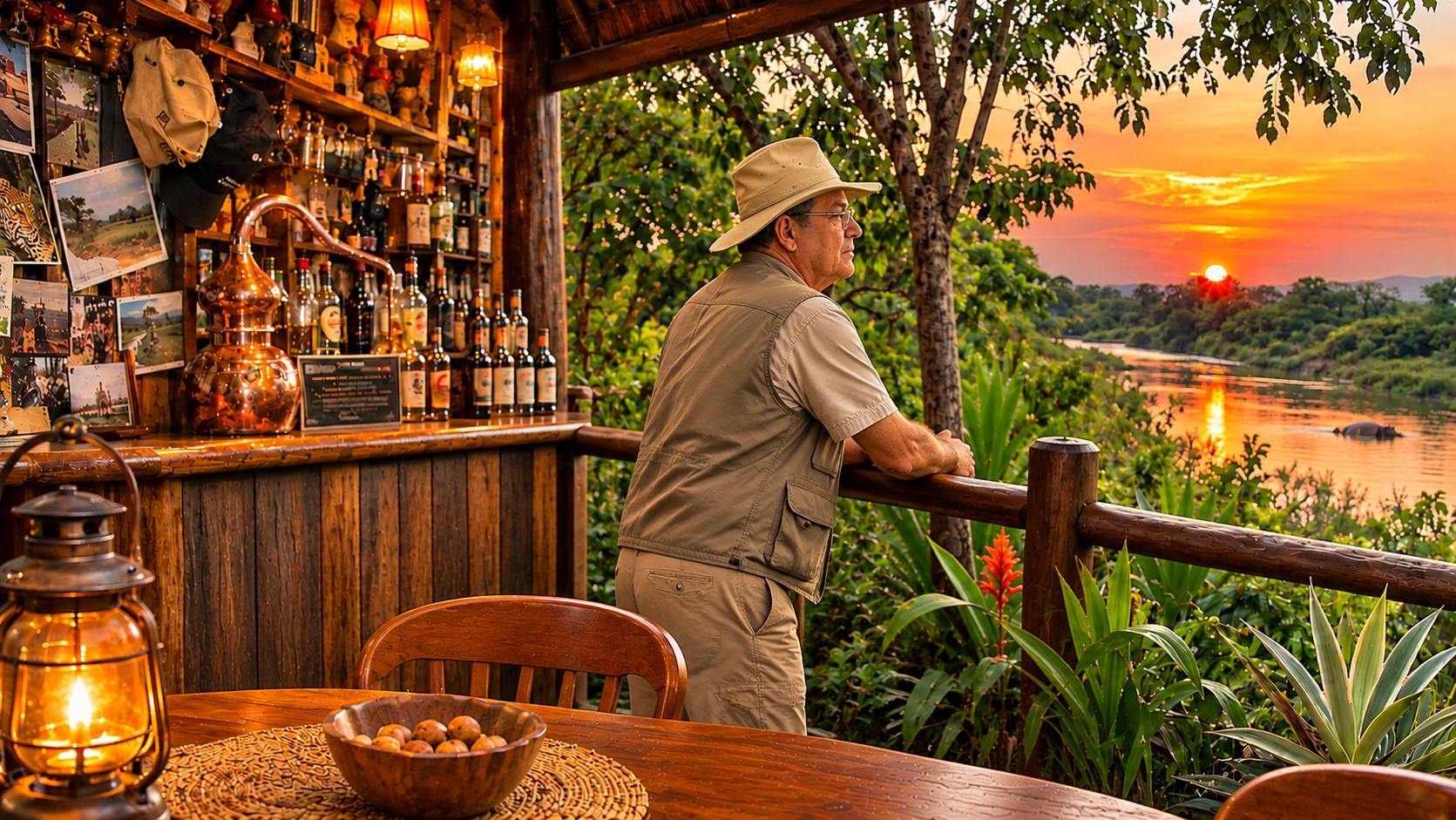
River House Guest Lodge, Malelane — South Africa
There are places we visit and places that somehow take possession of us. We may stay only a few days, yet years later return to them in memory. Their hold may come from the landscape, the people we meet, the light, or the feeling that, briefly, we have found somewhere we were meant to be.
Africa has always seemed to me a continent of such places. Its beauty is often inseparable from hardship, its vastness from loneliness, and its capacity for life from the knowledge of death. Perhaps this is why it leaves such a lasting impression.
I remember our stay at River House Guest Lodge in Malelane, close to the southern boundary of Kruger National Park. The lodge belonged to friends, so arriving felt less like checking into a hotel than entering a home shaped by friendship and personal history.
The property was surrounded by luxuriant vegetation. Trees and tropical plants crowded around the buildings. The warm air carried the smell of damp earth, leaves and sun-baked greenery. The atmosphere was unhurried; the outside world seemed left beyond the garden gate.
Yet what I remember most vividly about our arrival was the singing. The women who worked at the lodge came out to welcome us, their voices filling the space with warmth. It was not a polished commercial greeting, but something personal and spontaneous.
Only later did we learn more about their lives. All the women working at the lodge were widows. Their husbands had died as a consequence of AIDS, one of southern Africa’s great tragedies. The epidemic had left countless families bereaved and many women struggling to support themselves and their children. Our friends had given them employment, offering a way to earn a living and rebuild their lives.
Knowing this changed the way I remembered their songs. Behind the welcoming smiles lay stories of loss and survival. Yet these women greeted strangers with dignity and generosity that seemed deeper than professional courtesy. I found this profoundly moving. There was no need for explanations; their voices said enough.
Africa brings suffering and joy into close proximity. One can encounter immense hardship and, moments later, witness extraordinary vitality. Perhaps this is one of the continent’s great lessons: even when severely tested, life continues to insist upon itself.
The lodge had another attraction: its bar. It was the sort of place where a traveller might happily lose an afternoon. Its walls were covered with photographs, hats, signs and curious objects collected over the years. Every corner held a fragment of somebody else’s journey. It felt like an old travellers’ house, somewhere between a colonial outpost and a private museum.
I imagined conversations about distant countries, elephants, dangerous roads, missed trains and unexpected friendships, along with the exaggerations that gather around a bar after sunset. Its charm lay in its lack of pretension; it felt inhabited rather than decorated.
But the real attraction lay beyond the lodge, where the Crocodile River flowed. We spent long periods looking across its waters. The river appeared peaceful, although we knew life was hidden beneath its surface and among the vegetation on its banks. A hippopotamus would sometimes emerge, linger briefly and disappear. Crocodiles lay motionless near the shore, so perfectly camouflaged they seemed part of the riverbed.
There was something hypnotic about watching them. The animals were not performing for us. They moved according to an ancient rhythm unrelated to human time. We were looking into a world that existed perfectly well without us. The wilderness is not a spectacle arranged for visitors; it has its own rules and its own indifference to human curiosity. We were temporary observers, allowed a glimpse of a world that would continue after we departed.
The evenings were particularly memorable. As the sun descended, the trees turned golden and then darkened into silhouettes. The sky passed through shades of orange, crimson and purple, while the river reflected the last fragments of daylight. The African sunset seemed unusually intense, as though the sky itself had more room in which to unfold.
The heat gave way to a gentler warmth. Birds called from the vegetation, distant animals made their presence known, and night appeared along the riverbank. We would sit with a glass of Amarula, the creamy South African liqueur made from the fruit of the marula tree. It seemed entirely appropriate to the setting, and we drank it slowly as the evening unfolded.
I remember its taste, but more clearly the circumstances: the river, the animals, the fading light, the company of friends and the feeling that nowhere else required our attention. For a while, I stopped thinking about the next destination or the following day’s arrangements. I simply inhabited the present. That evening, beside the Crocodile River, I wanted to be nowhere else.
Certain journeys are not measured by the number of places visited or the distance travelled, but by the intensity with which we experience them. When I think of Malelane, I remember our friends, the lodge that was their home, and the women singing as we arrived. I remember lives reshaped by loss but not defeated by it, the bar filled with travellers’ relics, the green vegetation and the light falling across the water.
Above all, I remember the feeling of belonging, however briefly, to a place that was not ours. The lodge will continue to welcome travellers. The river will continue its course; hippos will emerge, crocodiles will rest along the banks, and the sun will set over the African landscape. But our particular evening belongs to us.
I have often thought that we travel in search of landscapes, but what we carry home are encounters: a voice, a face, a gesture of kindness, the smell of an evening, the taste of a drink beside a river. The women at River House sang when we arrived. I wonder whether they still sing to welcome visitors. I hope they do. Their songs seemed to contain something essential about Africa: a refusal to surrender to sorrow, an instinct for hospitality, and an understanding that life must be celebrated even when it has not been kind.
If I return to Malelane, I will look for the same lodge, the same bar and the same stretch of river. I will order an Amarula and sit quietly as the sun goes down. Perhaps the animals will appear; perhaps they will not. It will not matter. In my memory an African evening is already waiting: women’s voices singing, the distant movement of animals, the warm glass in my hand and the last red light dissolving into the Crocodile River.
Some journeys end at the airport. Others continue long after we return home. I left Malelane, but I never quite left Africa. A part of me remains beside the Crocodile River, where friendship, sorrow, courage and the wildness of nature came together in one unforgettable evening.
Palmarí H. de Lucena